Lew Alison K, Salam Madison E, Gross Alan E, Wang Sheila K, McGuire Erin, Pettit Natasha N, Pisano Jennifer, Nguyen Cynthia T
Department of Pharmacy, University of Chicago Medicine, Chicago, Illinois, USA.
Department of Pharmacy, University of Colorado Hospital, Aurora, Colorado, USA.
Open Forum Infect Dis. 2024 Jun 28;11(7):ofae361. doi: 10.1093/ofid/ofae361. eCollection 2024 Jul.
The purpose of this study was to compare the efficacy and safety of intravenous (IV) versus oral (PO) stepdown therapy for uncomplicated streptococcal bacteremia.
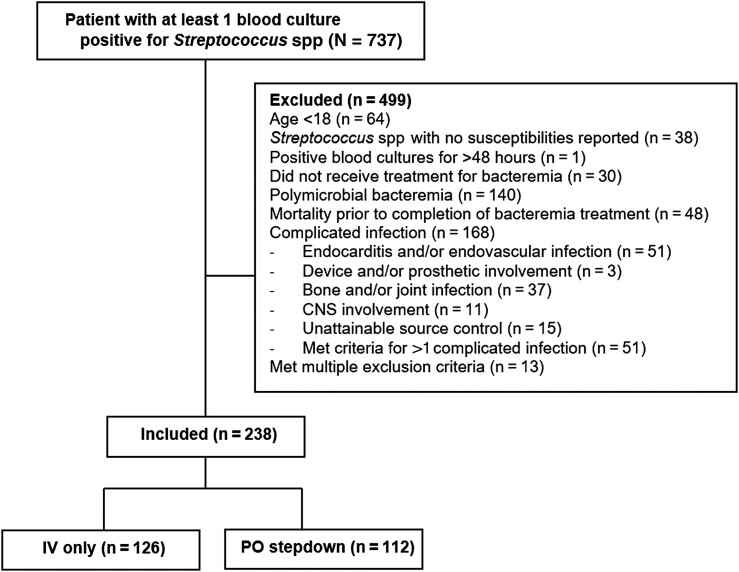
This multicenter, retrospective study included adult patients with uncomplicated streptococcal bacteremia between 1 July 2019 and 1 July 2022. Patients who received IV therapy for the full treatment course were compared to patients who transitioned to PO therapy after initial IV therapy. The primary outcome was clinical success, defined as absence of infection recurrence, infection-related readmission, and infection-related mortality at 90 days. Secondary outcomes included microbiological success, length of stay (LOS), and IV line-associated complications.
Of 238 patients included, 47.1% received PO stepdown therapy. Clinical success occurred in 94.4% and 94.6% in the IV only and PO stepdown groups, respectively ( = .946). Patients who transitioned to PO therapy received a median duration of IV therapy of 3.9 days (interquartile range, 2.9-7.3 days). Line complications were more frequent in the IV only group, primarily driven by catheter-related infections (7.2% vs 0%, = .002). LOS was significantly shorter in the PO stepdown group (5.5 vs 9.2 days, < .001).
Patients transitioned to PO antibiotics for uncomplicated streptococcal bacteremia had similar rates of clinical success compared to patients who received only IV therapy. With consideration of infectious source, severity of illness, and comorbidities, PO stepdown following initial IV antibiotics for uncomplicated streptococcal bacteremia in select patients is a reasonable approach that may result in decreased LOS and line-related complications.
本研究的目的是比较静脉注射(IV)与口服(PO)降阶梯疗法治疗非复杂性链球菌菌血症的疗效和安全性。
这项多中心回顾性研究纳入了2019年7月1日至2022年7月1日期间患有非复杂性链球菌菌血症的成年患者。将接受全程静脉治疗的患者与初始静脉治疗后转为口服治疗的患者进行比较。主要结局是临床成功,定义为90天时无感染复发、与感染相关的再入院和与感染相关的死亡。次要结局包括微生物学成功、住院时间(LOS)和与静脉置管相关的并发症。
在纳入的238例患者中,47.1%接受了口服降阶梯疗法。仅静脉治疗组和口服降阶梯治疗组的临床成功率分别为94.4%和94.6%(P = 0.946)。转为口服治疗的患者静脉治疗的中位持续时间为3.9天(四分位间距,2.9 - 7.3天)。仅静脉治疗组的置管并发症更常见,主要由导管相关感染引起(7.2%对0%,P = 0.002)。口服降阶梯治疗组的住院时间明显更短(5.5天对9.2天,P < 0.001)。
与仅接受静脉治疗的患者相比,因非复杂性链球菌菌血症转为口服抗生素治疗的患者临床成功率相似。考虑到感染源、疾病严重程度和合并症,对于部分患者,在初始静脉使用抗生素治疗非复杂性链球菌菌血症后采用口服降阶梯疗法是一种合理的方法,可能会缩短住院时间并减少与置管相关的并发症。