Department of Urology, Renji Hospital, School of Medicine in Shanghai Jiao Tong University, 160 Pujian Road, Shanghai, 200127, P. R. China.
State Key Laboratory of Systems Medicine for Cancer, School of Biomedical Engineering and Institute of Medical Robotics, Shanghai Jiao Tong University, Shanghai, 200030, P. R. China.
Adv Sci (Weinh). 2024 Sep;11(34):e2401919. doi: 10.1002/advs.202401919. Epub 2024 Jul 8.
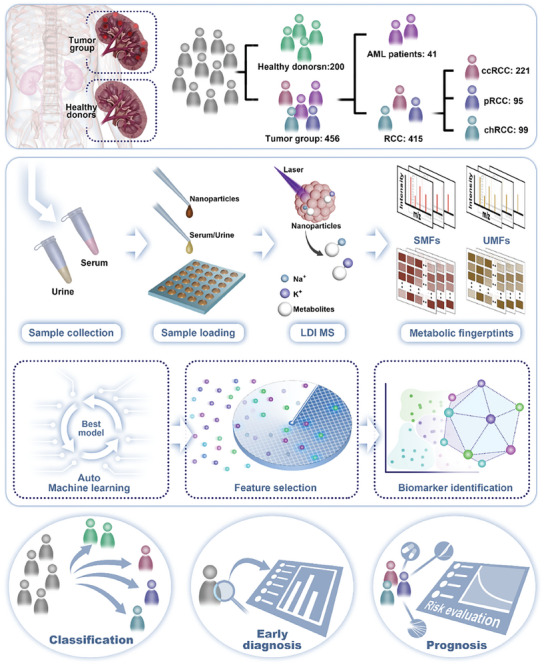
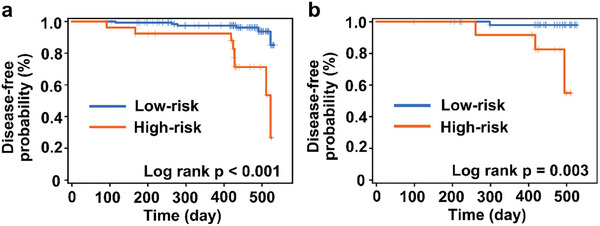
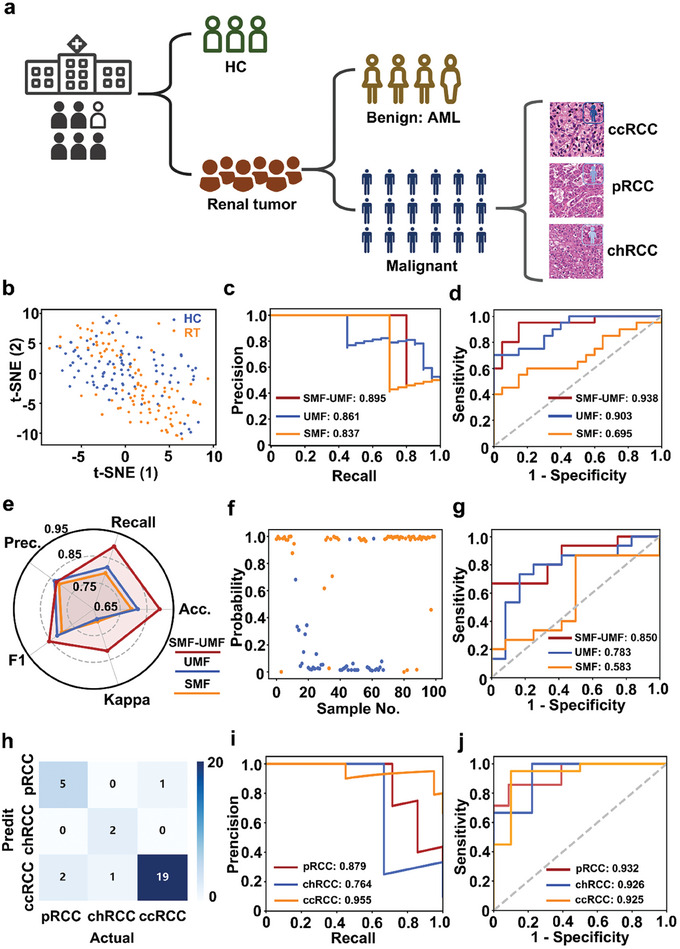
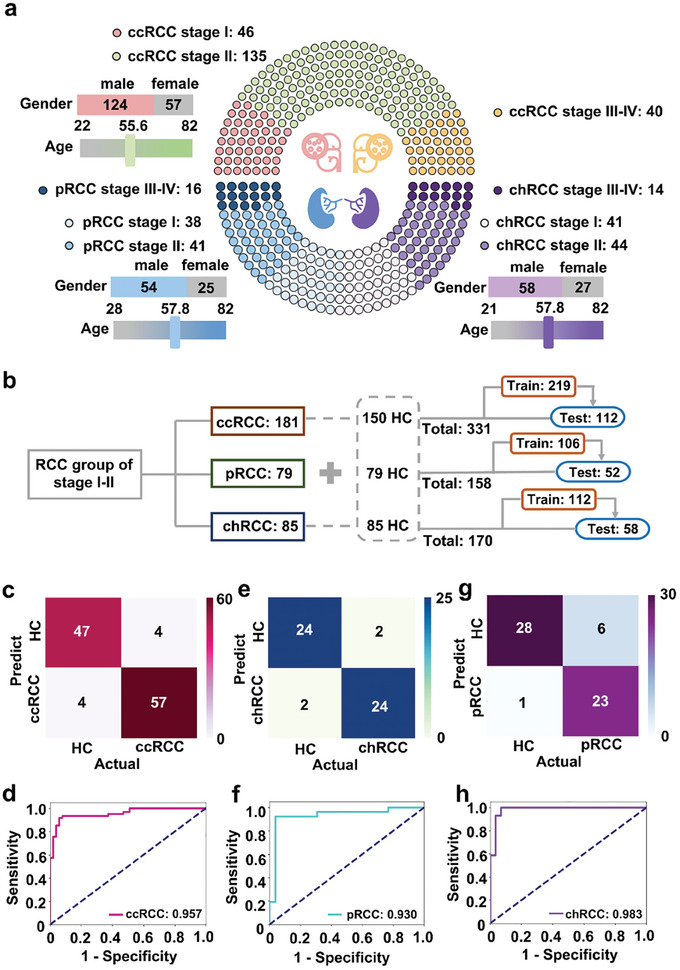
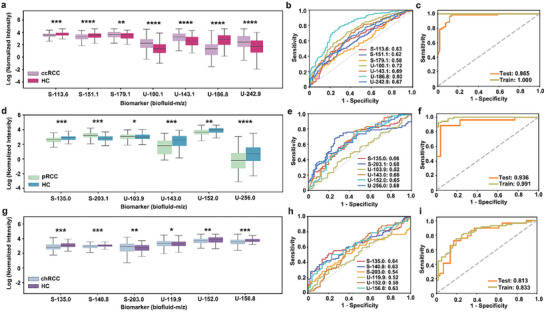
Renal cell carcinoma (RCC) is a substantial pathology of the urinary system with a growing prevalence rate. However, current clinical methods have limitations for managing RCC due to the heterogeneity manifestations of the disease. Metabolic analyses are regarded as a preferred noninvasive approach in clinics, which can substantially benefit the characterization of RCC. This study constructs a nanoparticle-enhanced laser desorption ionization mass spectrometry (NELDI MS) to analyze metabolic fingerprints of renal tumors (n = 456) and healthy controls (n = 200). The classification models yielded the areas under curves (AUC) of 0.938 (95% confidence interval (CI), 0.884-0.967) for distinguishing renal tumors from healthy controls, 0.850 for differentiating malignant from benign tumors (95% CI, 0.821-0.915), and 0.925-0.932 for classifying subtypes of RCC (95% CI, 0.821-0.915). For the early stage of RCC subtypes, the averaged diagnostic sensitivity of 90.5% and specificity of 91.3% in the test set is achieved. Metabolic biomarkers are identified as the potential indicator for subtype diagnosis (p < 0.05). To validate the prognostic performance, a predictive model for RCC participants and achieve the prediction of disease (p = 0.003) is constructed. The study provides a promising prospect for applying metabolic analytical tools for RCC characterization.
肾细胞癌(RCC)是泌尿系统的一种重要病理学疾病,其患病率呈上升趋势。然而,由于该疾病的异质性表现,目前的临床方法在管理 RCC 方面存在局限性。代谢分析被认为是临床上一种首选的非侵入性方法,它可以极大地帮助 RCC 的特征描述。本研究构建了一种纳米颗粒增强激光解吸电离质谱(NELDI MS),用于分析 456 例肾肿瘤患者(n)和 200 例健康对照者(n)的代谢指纹图谱。分类模型产生的曲线下面积(AUC)分别为 0.938(95%置信区间(CI),0.884-0.967),用于区分肾肿瘤和健康对照者,0.850 用于区分恶性肿瘤和良性肿瘤(95%CI,0.821-0.915),0.925-0.932 用于分类 RCC 的亚型(95%CI,0.821-0.915)。对于 RCC 亚型的早期阶段,在测试集中的平均诊断敏感性为 90.5%,特异性为 91.3%。代谢生物标志物被鉴定为亚型诊断的潜在指标(p<0.05)。为了验证预测性能,构建了一个用于 RCC 参与者的预测模型,并实现了对疾病的预测(p=0.003)。本研究为应用代谢分析工具进行 RCC 特征描述提供了一个有前景的方向。