Department of Medical Biology, Amsterdam UMC, University of Amsterdam, Amsterdam, the Netherlands.
Department of Obstetrics and Gynecology, Amsterdam UMC, University of Amsterdam, Amsterdam, the Netherlands.
Acta Obstet Gynecol Scand. 2024 Sep;103(9):1868-1876. doi: 10.1111/aogs.14848. Epub 2024 Jul 8.
The decision to terminate a pregnancy due to fetal anomalies can have a significant emotional impact, especially in second-trimester terminations. Previous studies on the psychological consequences of pregnancy termination have had limitations, and little is known about the outcomes for partners and the impact of fetal donation. Therefore, we aimed to investigate the psychological effects of second-trimester pregnancy termination and identify factors associated with outcomes in both women and men, including donation of fetal remains to science.
A longitudinal cohort study was conducted at the Amsterdam UMC in the Netherlands, involving women and partners who underwent termination at or before 23 weeks and 6 days of gestation. Questionnaires were administered at termination, 6 weeks, and 4 months after. We utilized validated questionnaires to assess psychological morbidity (grief, post-traumatic stress and postnatal depression and quality of life [QoL]), and factors that could potentially influence outcomes.
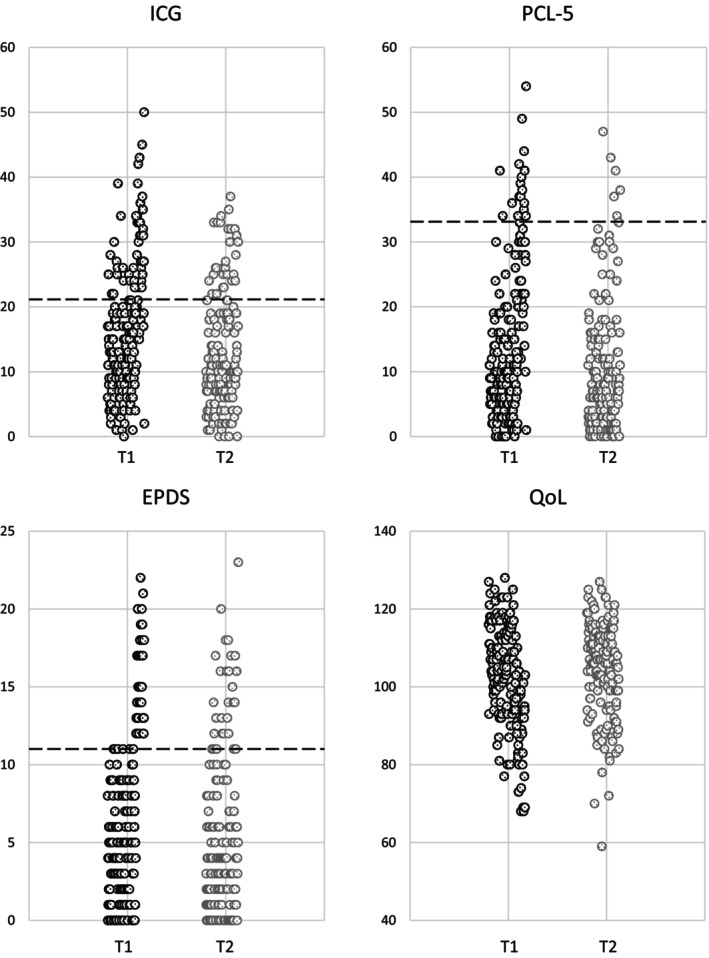
Of 241 participants, women displayed more pronounced psychological distress than men, though both groups improved over time. Four months after termination, 27.4% of women and 9.1% of men showed signs of pathological grief. Scores indicative for postnatal depression occurred in 19.8% women and 4.1% of men. A prior psychiatric history was a consistent predictor of poorer outcomes. Fetal donation to the Dutch Fetal Biobank was associated with reduced likelihood of symptoms of complicated grief four months after termination.
Second-trimester termination of pregnancy for fetal anomalies can lead to psychological morbidity, particularly in women. However, there is a notable improvement over time for both groups. Individuals with prior psychiatric history appear more vulnerable post-termination. Also, fetal donation to science did not have a negative impact on psychological well-being.
由于胎儿畸形而终止妊娠的决定可能会产生重大的情感影响,尤其是在中期妊娠终止时。之前关于妊娠终止后心理后果的研究存在局限性,对于伴侣的结局以及胎儿捐赠的影响知之甚少。因此,我们旨在研究中期妊娠终止后的心理影响,并确定与女性和男性结局相关的因素,包括将胎儿遗体捐赠给科学。
在荷兰阿姆斯特丹 UMC 进行了一项纵向队列研究,涉及在 23 周零 6 天或之前接受终止妊娠的女性及其伴侣。在终止妊娠时、6 周和 4 个月后进行问卷调查。我们使用经过验证的问卷评估心理困扰(悲伤、创伤后应激和产后抑郁以及生活质量[QoL]),以及可能影响结局的因素。
在 241 名参与者中,女性的心理困扰比男性更明显,但两组都随着时间的推移而改善。终止妊娠后 4 个月,27.4%的女性和 9.1%的男性出现病理性悲伤的迹象。19.8%的女性和 4.1%的男性出现产后抑郁的评分。先前的精神病史是不良结局的一致预测因素。将胎儿捐赠给荷兰胎儿生物库与终止妊娠后 4 个月复杂悲伤症状的可能性降低相关。
胎儿畸形中期妊娠终止可导致心理困扰,尤其是在女性中。然而,两组人群的情况都随着时间的推移而显著改善。有先前精神病史的个体在终止后更容易受到影响。此外,将胎儿捐赠给科学并没有对心理健康产生负面影响。