Azpiroz Jaione Tirapu, Giro Ronaldo, Neumann Barros Ferreira Rodrigo, Nogueira Pereira da Silva Marcio, Fernandes Blanco Rodriguez Manuela, Lopez Adolfo E Correa, Vasquez David A Lazo, Esteves Ferreira Matheus, Del Grande Mariana, Ferreira Da Silva Ademir, Steiner Mathias B
IBM Research, Av. República do Chile, 330, Rio de Janeiro, RJ, CEP 20031-170, Brazil.
IBM Research, Rd J Fco Aguirre Proenca Km 9 Sp101, Hortolandia, Sao Paulo, SP, 13186-900, Brazil.
Sci Rep. 2024 Jul 9;14(1):15852. doi: 10.1038/s41598-024-65920-6.
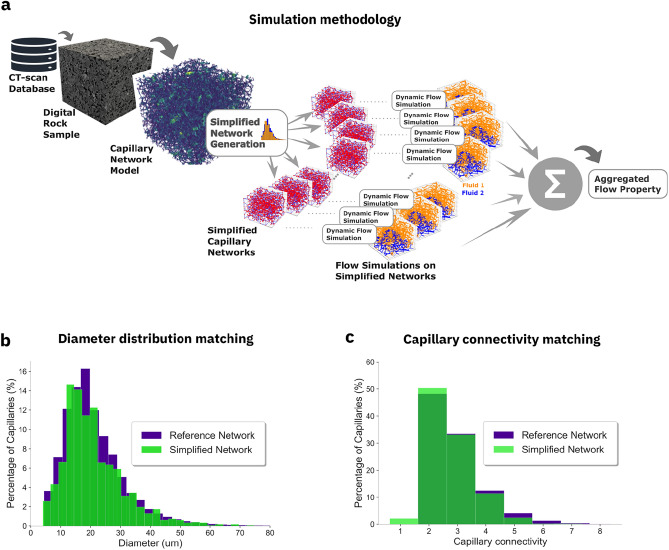
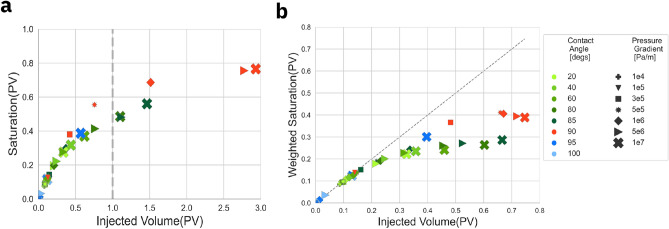
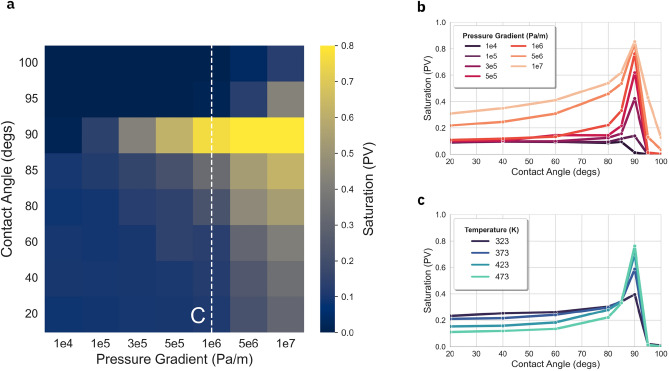
Carbon dioxide (CO ) trapping in capillary networks of reservoir rocks is a pathway to long-term geological storage. At pore scale, CO drainage displacement depends on injection pressure, temperature, and the rock's interaction with the surrounding fluids. Modeling this interaction requires adequate representations of both capillary volume and surface. For the lack of scalable representations, however, the prediction of a rock's CO storage potential has been challenging. Here, we report how to represent a rock's pore space by statistically sampled capillary networks (ssCN) that preserve morphological rock characteristics. We have used the ssCN method to simulate CO drainage within a representative sandstone sample at reservoir pressures and temperatures, exploring intermediate- and CO -wet conditions. This wetting regime is often neglected, despite evidence of plausibility. By raising pressure and temperature we observe increasing CO penetration within the capillary network. For contact angles approaching 90 , the CO saturation exhibits a pronounced maximum reaching 80 of the accessible pore volume. This is about twice as high as the saturation values reported previously. For enabling validation of our results and a broader application of our methodology, we have made available the rock tomography data, the digital rock computational workflows, and the ssCN models used in this study.
二氧化碳(CO₂)在储层岩石毛细管网中的捕获是长期地质封存的一条途径。在孔隙尺度上,CO₂的驱替位移取决于注入压力、温度以及岩石与周围流体的相互作用。对这种相互作用进行建模需要对毛细管体积和表面进行充分的表征。然而,由于缺乏可扩展的表征方法,预测岩石的CO₂储存潜力一直具有挑战性。在此,我们报告了如何通过保留岩石形态特征的统计采样毛细管网(ssCN)来表征岩石的孔隙空间。我们使用ssCN方法在储层压力和温度下模拟了代表性砂岩样品内的CO₂驱替,探索了中间湿润和CO₂湿润条件。尽管有合理性证据,但这种湿润状态常常被忽视。通过提高压力和温度,我们观察到CO₂在毛细管网中的渗透率增加。对于接近90°的接触角,CO₂饱和度呈现出明显的最大值,达到可及孔隙体积的80%。这大约是先前报道的饱和度值的两倍。为了验证我们的结果并更广泛地应用我们的方法,我们提供了本研究中使用的岩石断层扫描数据、数字岩石计算工作流程和ssCN模型。