Zhao Yuxiang, Ma Nannan, Wu Wanngyu, Wu Ying, Zhang Wenbo, Qian Weiwei, Sun Xin, Zhang Tao
Anhui Medical University, Second Affiliated Hospital, Department of Urology, Hefei, China.
Anqing 116 Hospital, Department of Urology, Anqing, China.
Genet Mol Biol. 2024 Jul 1;47(2):e20230347. doi: 10.1590/1678-4685-GMB-2023-0347. eCollection 2024.
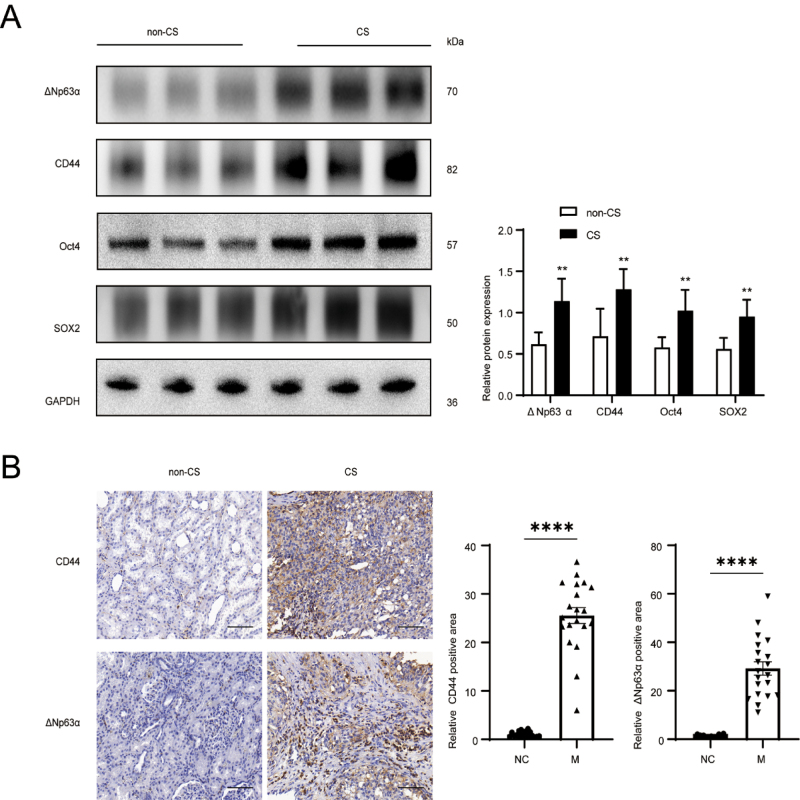
Cigarette smoke (CS) has been generally recognized as a chief carcinogenic factor in renal cell carcinoma (RCC). The stimulative effect of CS on renal cancer stem cells (RCSCs) has been described previously. The Sonic Hedgehog (SHH) pathway plays an essential role in self-renewal, cell growth, drug resistance, metastasis, and recurrence of cancer stem cells (CSCs). Renal cancer-related gene ΔNp63α is highly expressed in renal epithelial tissues and contributes to the RCSCs characteristics of tumors. The aim of this study was to elucidate the role of ΔNp63α and the SHH pathway on the activity of RCSCs induced by CS through a series of in vivo and in vitro studies. It was shown that in renal cancer tissues, ΔNp63α and RCSCs markers in smokers are expressed higher than that in non-smokers. RCSCs were effectively enriched by tumor sphere formation assay. Besides, CS increased the expression of RCSCs markers and the capability of sphere-forming in vitro and in vivo. Moreover, the SHH pathway was activated, and the specialized inhibitor alleviated the promotion of CS on RCSCs. ΔNp63α activated the SHH pathway and promoted CS-induced enhancement of RCSCs activity. These findings indicate that ΔNp63α positively regulates the activity of CS-induced RCSCs via the SHH pathway.
香烟烟雾(CS)已被公认为肾细胞癌(RCC)的主要致癌因素。此前已有研究描述了CS对肾癌细胞干细胞(RCSCs)的刺激作用。音猬因子(SHH)信号通路在癌症干细胞(CSCs)的自我更新、细胞生长、耐药性、转移和复发中起着至关重要的作用。肾癌相关基因ΔNp63α在肾上皮组织中高表达,并有助于肿瘤的RCSCs特性。本研究的目的是通过一系列体内和体外研究,阐明ΔNp63α和SHH信号通路在CS诱导的RCSCs活性中的作用。结果表明,在肾癌组织中,吸烟者的ΔNp63α和RCSCs标志物表达高于非吸烟者。通过肿瘤球形成试验有效地富集了RCSCs。此外,CS增加了RCSCs标志物的表达以及体外和体内的成球能力。此外,SHH信号通路被激活,特异性抑制剂减轻了CS对RCSCs的促进作用。ΔNp63α激活了SHH信号通路,并促进了CS诱导的RCSCs活性增强。这些发现表明,ΔNp63α通过SHH信号通路正向调节CS诱导的RCSCs活性。