Chen Mian, Deng Shenghe, Cao Yinghao, Wang Jun, Zou Falong, Gu Junnang, Mao Fuwei, Xue Yifan, Jiang Zhenxing, Cheng Denglong, Huang Ning, Huang Liang, Cai Kailin
Department of Gastrointestinal Surgery, Union Hospital, Tongji Medical College, Huazhong University of Science and Technology, Wuhan, Hubei, China.
Department of General Surgery (Colorectal Surgery), The Sixth Affiliated Hospital, Sun Yat-sen University, Guangdong, Guangzhou, China.
Ann Surg Oncol. 2024 Sep;31(9):6320-6330. doi: 10.1245/s10434-024-15759-y. Epub 2024 Jul 10.
Colorectal cancer (CRC) patients with mismatch repair-deficient/microsatellite instability-high (dMMR/MSI-H) status are conventionally perceived as unresponsive to adjuvant chemotherapy (ACT). The mitochondrial transcription factor A (TFAM) is required for mitochondrial DNA copy number (mtDNA-CN) expression. In light of previous findings indicating that the frequent truncating-mutation of TFAM affects the chemotherapy resistance of MSI CRC cells, this study aimed to explore the potential of mtDNA-CN as a predictive biomarker for ACT efficacy in dMMR CRC patients.
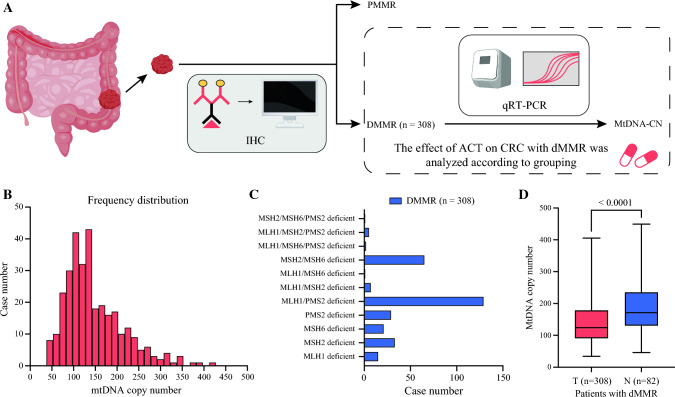
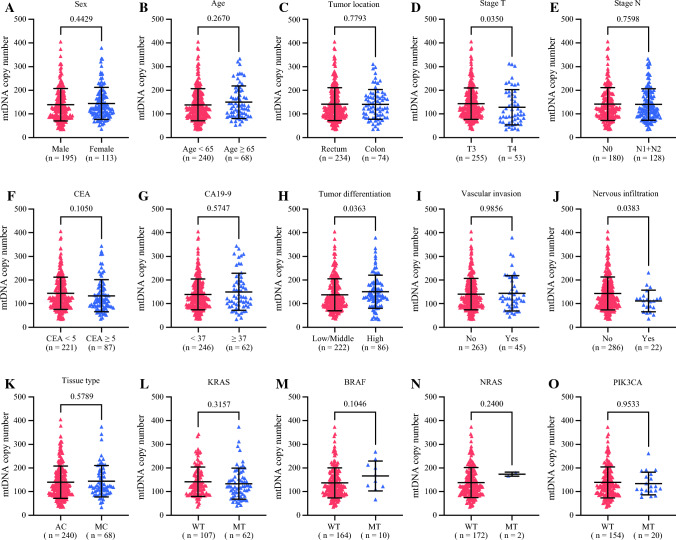
Levels of MtDNA-CN were assessed using quantitative real-time polymerase chain reaction (qRT-PCR) in a cohort of 308 CRC patients with dMMR comprising 180 stage II and 128 stage III patients. Clinicopathologic and therapeutic data were collected. The study examined the association between mtDNA-CN levels and prognosis, as well as the impact of ACT benefit on dMMR CRC patients. Subgroup analyses were performed based mainly on tumor stage and mtDNA-CN level. Kaplan-Meier and Cox regression models were used to evaluate the effect of mtDNA-CN on disease-free survival (DFS) and overall survival (OS).
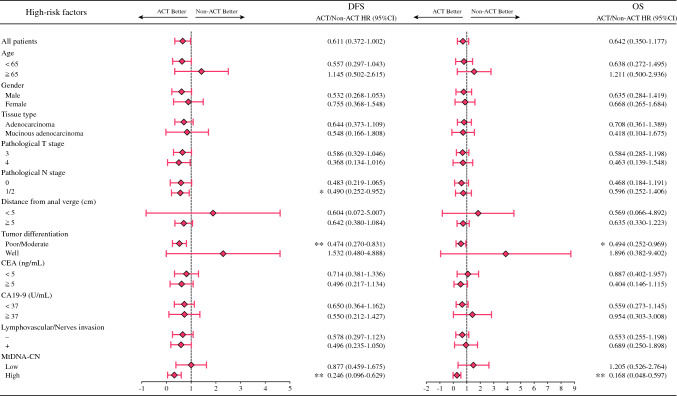
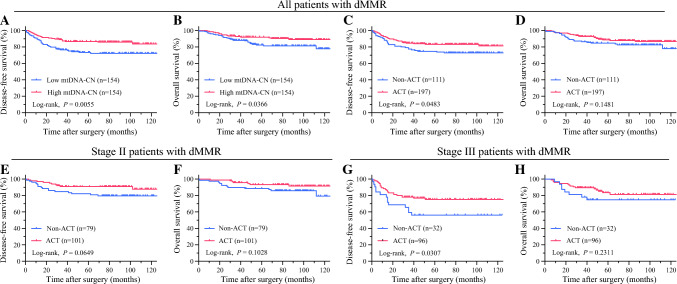
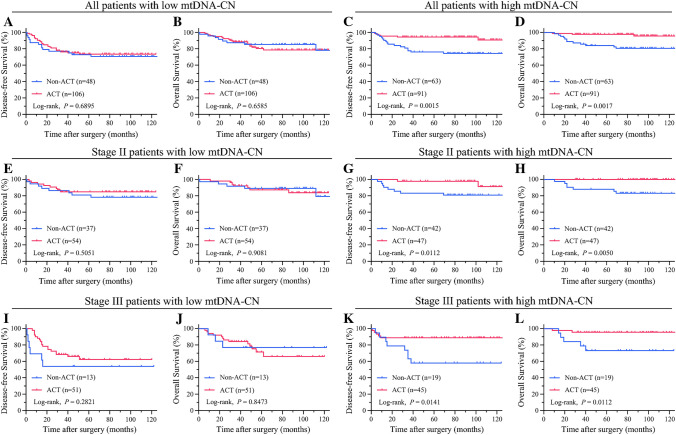
A substantial reduction in mtDNA-CN expression was observed in tumor tissue, and higher mtDNA-CN levels were correlated with improved DFS (73.4% vs 85.7%; P = 0.0055) and OS (82.5% vs 90.3%; P = 0.0366) in dMMR CRC patients. Cox regression analysis identified high mtDNA-CN as an independent protective factor for DFS (hazard ratio [HR] 0.547; 95% confidence interval [CI] 0.321-0.934; P = 0.0270) and OS (HR 0.520; 95% CI 0.272-0.998; P = 0.0492). Notably, for dMMR CRC patients with elevated mtDNA-CN, ACT significantly improved DFS (74.6% vs 93.4%; P = 0.0015) and OS (81.0% vs 96.7%; P = 0.0017), including those with stage II or III disease.
The mtDNA-CN levels exhibited a correlation with the prognosis of stage II or III CRC patients with dMMR. Elevated mtDNA-CN emerges as a robust prognostic factor, indicating improved ACT outcomes for stages II and III CRC patients with dMMR. These findings suggest the potential utility of mtDNA-CN as a biomarker for guiding personalized ACT treatment in this population.
错配修复缺陷/微卫星高度不稳定(dMMR/MSI-H)的结直肠癌(CRC)患者传统上被认为对辅助化疗(ACT)无反应。线粒体转录因子A(TFAM)是线粒体DNA拷贝数(mtDNA-CN)表达所必需的。鉴于先前的研究结果表明TFAM的频繁截断突变会影响MSI CRC细胞的化疗耐药性,本研究旨在探讨mtDNA-CN作为dMMR CRC患者ACT疗效预测生物标志物的潜力。
使用定量实时聚合酶链反应(qRT-PCR)评估308例dMMR CRC患者(包括180例II期和128例III期患者)队列中的MtDNA-CN水平。收集临床病理和治疗数据。该研究检查了mtDNA-CN水平与预后之间的关联,以及ACT获益对dMMR CRC患者的影响。主要基于肿瘤分期和mtDNA-CN水平进行亚组分析。使用Kaplan-Meier和Cox回归模型评估mtDNA-CN对无病生存期(DFS)和总生存期(OS)的影响。
在肿瘤组织中观察到mtDNA-CN表达大幅降低,dMMR CRC患者中较高的mtDNA-CN水平与改善的DFS(73.4%对85.7%;P = 0.0055)和OS(82.5%对90.3%;P = 0.0366)相关。Cox回归分析确定高mtDNA-CN是DFS(风险比[HR] 0.547;95%置信区间[CI] 0.321 - 0.934;P = 0.0270)和OS(HR 0.520;95% CI 0.272 - 0.998;P = 0.0492)的独立保护因素。值得注意的是,对于mtDNA-CN升高的dMMR CRC患者,ACT显著改善了DFS(74.6%对93.4%;P = 0.0015)和OS(81.0%对96.7%;P = 0.0017),包括II期或III期疾病患者。
mtDNA-CN水平与II期或III期dMMR CRC患者的预后相关。升高的mtDNA-CN是一个强有力的预后因素,表明II期和III期dMMR CRC患者的ACT结果改善。这些发现表明mtDNA-CN作为该人群中指导个性化ACT治疗的生物标志物的潜在效用。