Tsypes Aliona, Hallquist Michael N, Ianni Angela, Kaurin Aleksandra, Wright Aidan G C, Dombrovski Alexandre Y
Department of Psychiatry, University of Pittsburgh School of Medicine, Pittsburgh, Pennsylvania.
Department of Psychology and Neuroscience, University of North Carolina, Chapel Hill.
JAMA Psychiatry. 2024 Oct 1;81(10):1010-1019. doi: 10.1001/jamapsychiatry.2024.1796.
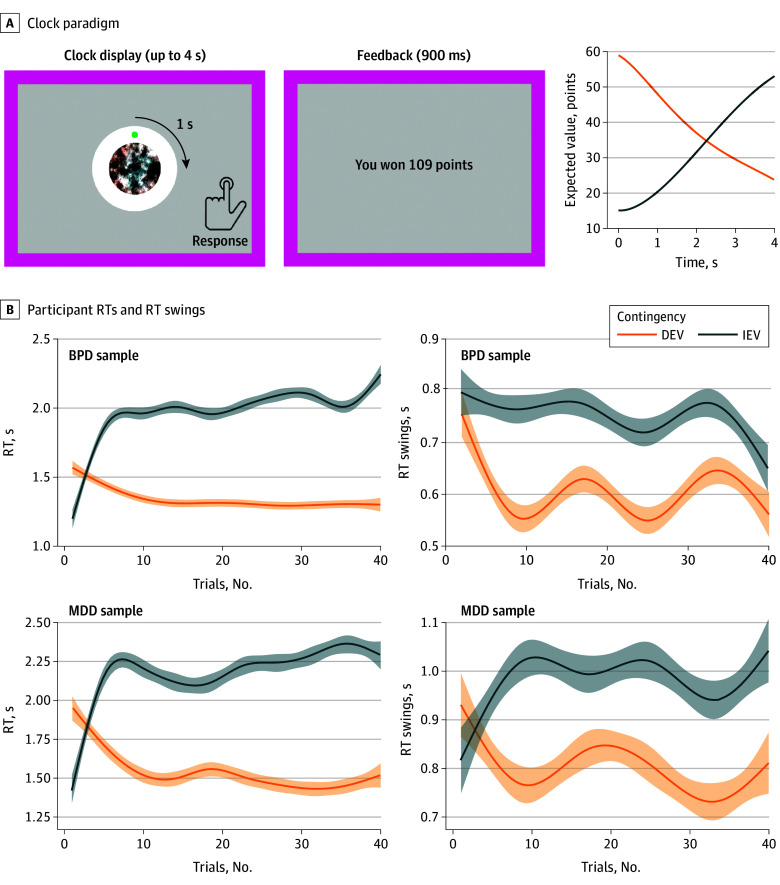
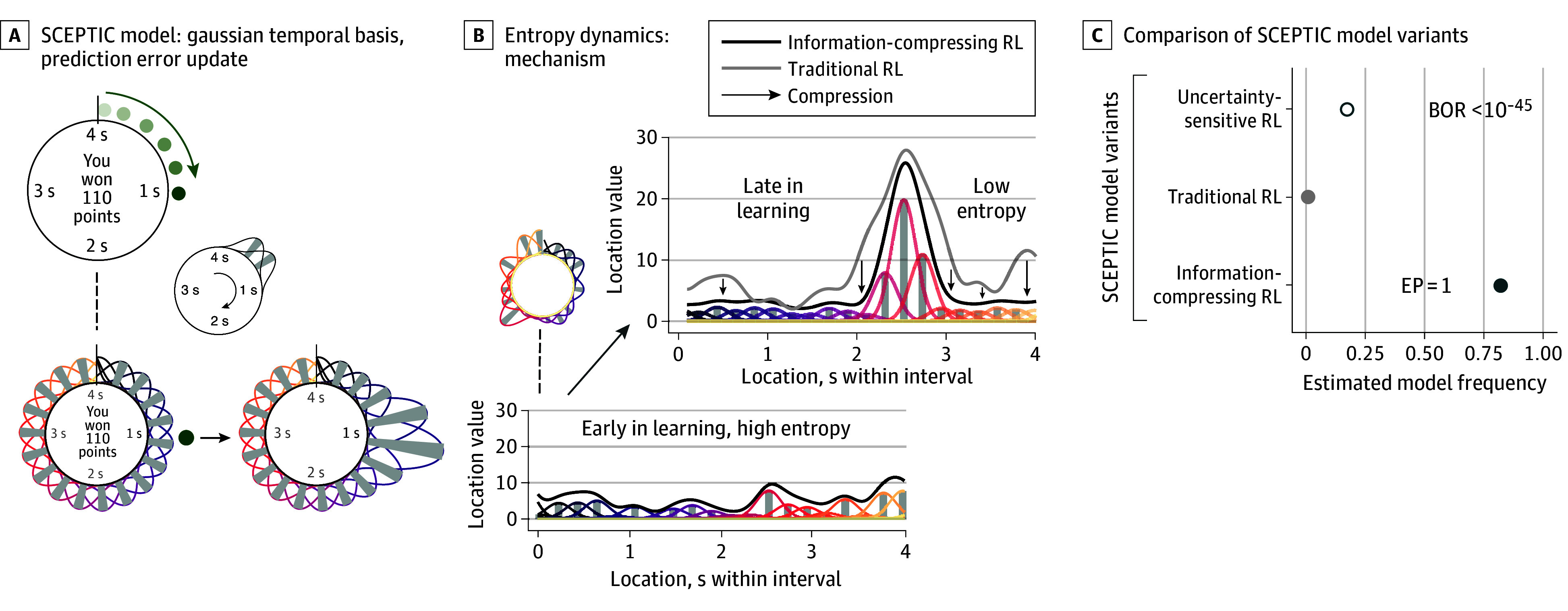
Clinical theory and behavioral studies suggest that people experiencing suicidal crisis are often unable to find constructive solutions or incorporate useful information into their decisions, resulting in premature convergence on suicide and neglect of better alternatives. However, prior studies of suicidal behavior have not formally examined how individuals resolve the tradeoffs between exploiting familiar options and exploring potentially superior alternatives.
To investigate exploration and exploitation in suicidal behavior from the formal perspective of reinforcement learning.
DESIGN, SETTING, AND PARTICIPANTS: Two case-control behavioral studies of exploration-exploitation of a large 1-dimensional continuous space and a 21-day prospective ambulatory study of suicidal ideation were conducted between April 2016 and March 2022. Participants were recruited from inpatient psychiatric units, outpatient clinics, and the community in Pittsburgh, Pennsylvania, and underwent laboratory and ambulatory assessments. Adults diagnosed with borderline personality disorder (BPD) and midlife and late-life major depressive disorder (MDD) were included, with each sample including demographically equated groups with a history of high-lethality suicide attempts, low-lethality suicide attempts, individuals with BPD or MDD but no suicide attempts, and control individuals without psychiatric disorders. The MDD sample also included a subgroup with serious suicidal ideation.
Behavioral (model-free and model-derived) indices of exploration and exploitation, suicide attempt lethality (Beck Lethality Scale), and prospectively assessed suicidal ideation.
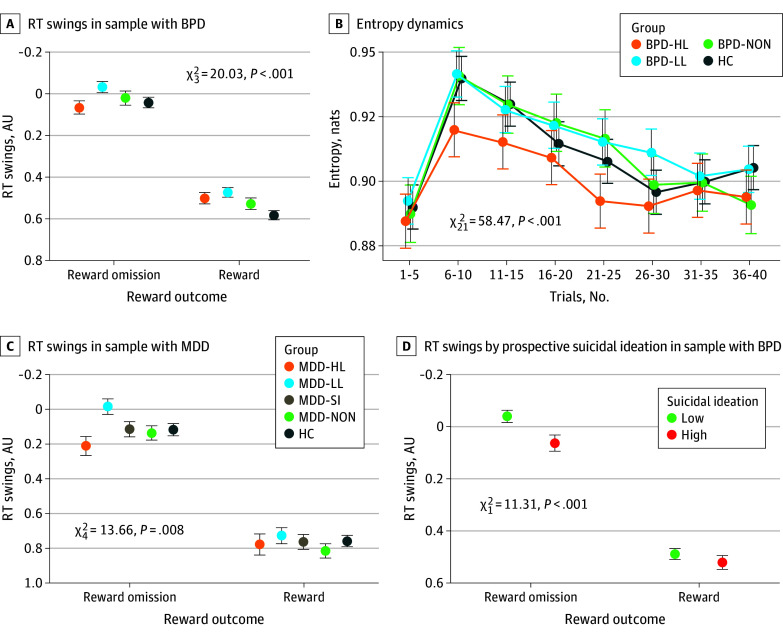
The BPD group included 171 adults (mean [SD] age, 30.55 [9.13] years; 135 [79%] female). The MDD group included 143 adults (mean [SD] age, 62.03 [6.82] years; 81 [57%] female). Across the BPD (χ23 = 50.68; P < .001) and MDD (χ24 = 36.34; P < .001) samples, individuals with high-lethality suicide attempts discovered fewer options than other groups as they were unable to shift away from unrewarded options. In contrast, those with low-lethality attempts were prone to excessive behavioral shifts after rewarded and unrewarded actions. No differences were seen in strategic early exploration or in exploitation. Among 84 participants with BPD in the ambulatory study, 56 reported suicidal ideation. Underexploration also predicted incident suicidal ideation (χ21 = 30.16; P < .001), validating the case-control results prospectively. The findings were robust to confounds, including medication exposure, affective state, and behavioral heterogeneity.
The findings suggest that narrow exploration and inability to abandon inferior options are associated with serious suicidal behavior and chronic suicidal thoughts. By contrast, individuals in this study who engaged in low-lethality suicidal behavior displayed a low threshold for taking potentially disadvantageous actions.
临床理论和行为研究表明,经历自杀危机的人往往无法找到建设性的解决方案,或在决策中纳入有用信息,导致过早地倾向于自杀,而忽视了更好的选择。然而,先前关于自杀行为的研究尚未正式考察个体如何在利用熟悉的选项和探索潜在更好的替代方案之间进行权衡。
从强化学习的正式角度研究自杀行为中的探索与利用。
设计、设置和参与者:2016年4月至2022年3月期间进行了两项病例对照行为研究,一项是对一个大的一维连续空间的探索利用研究,另一项是对自杀意念进行的为期21天的前瞻性门诊研究。参与者从宾夕法尼亚州匹兹堡的住院精神科病房、门诊诊所和社区招募,并接受实验室和门诊评估。纳入了被诊断为边缘性人格障碍(BPD)以及中年和老年重度抑郁症(MDD)的成年人,每个样本包括在人口统计学上相当的几组人群,分别有高致死性自杀未遂史、低致死性自杀未遂史、患有BPD或MDD但无自杀未遂史的个体,以及无精神疾病的对照个体。MDD样本还包括一个有严重自杀意念的亚组。
探索与利用的行为(无模型和基于模型推导)指标、自杀未遂致死性(贝克致死性量表)以及前瞻性评估的自杀意念。
BPD组包括171名成年人(平均[标准差]年龄,30.55[9.13]岁;135名[79%]为女性)。MDD组包括143名成年人(平均[标准差]年龄,62.03[6.82]岁;81名[57%]为女性)。在BPD样本(χ23 = 50.68;P <.001)和MDD样本(χ24 = 36.34;P <.001)中,高致死性自杀未遂的个体发现的选项比其他组少,因为他们无法摆脱无回报的选项。相比之下那些低致死性自杀未遂的个体在有回报和无回报的行为后容易出现过度的行为转变。在策略性早期探索或利用方面未发现差异。在门诊研究的84名患有BPD的参与者中,56人报告有自杀意念。探索不足也预测了新发自杀意念(χ21 = 30.16;P <.001),前瞻性地验证了病例对照研究的结果。这些发现对包括药物暴露、情感状态和行为异质性在内的混杂因素具有稳健性。
研究结果表明,探索范围狭窄和无法放弃劣质选项与严重的自杀行为和慢性自杀念头有关。相比之下,本研究中实施低致死性自杀行为的个体采取潜在不利行动的阈值较低。