The Department of Radiation Oncology, The Ohio State University Comprehensive Cancer Center and College of Medicine, Columbus, OH, United States.
The Ohio State University, Columbus, OH, United States.
Cancer Lett. 2024 Aug 28;598:217110. doi: 10.1016/j.canlet.2024.217110. Epub 2024 Jul 8.
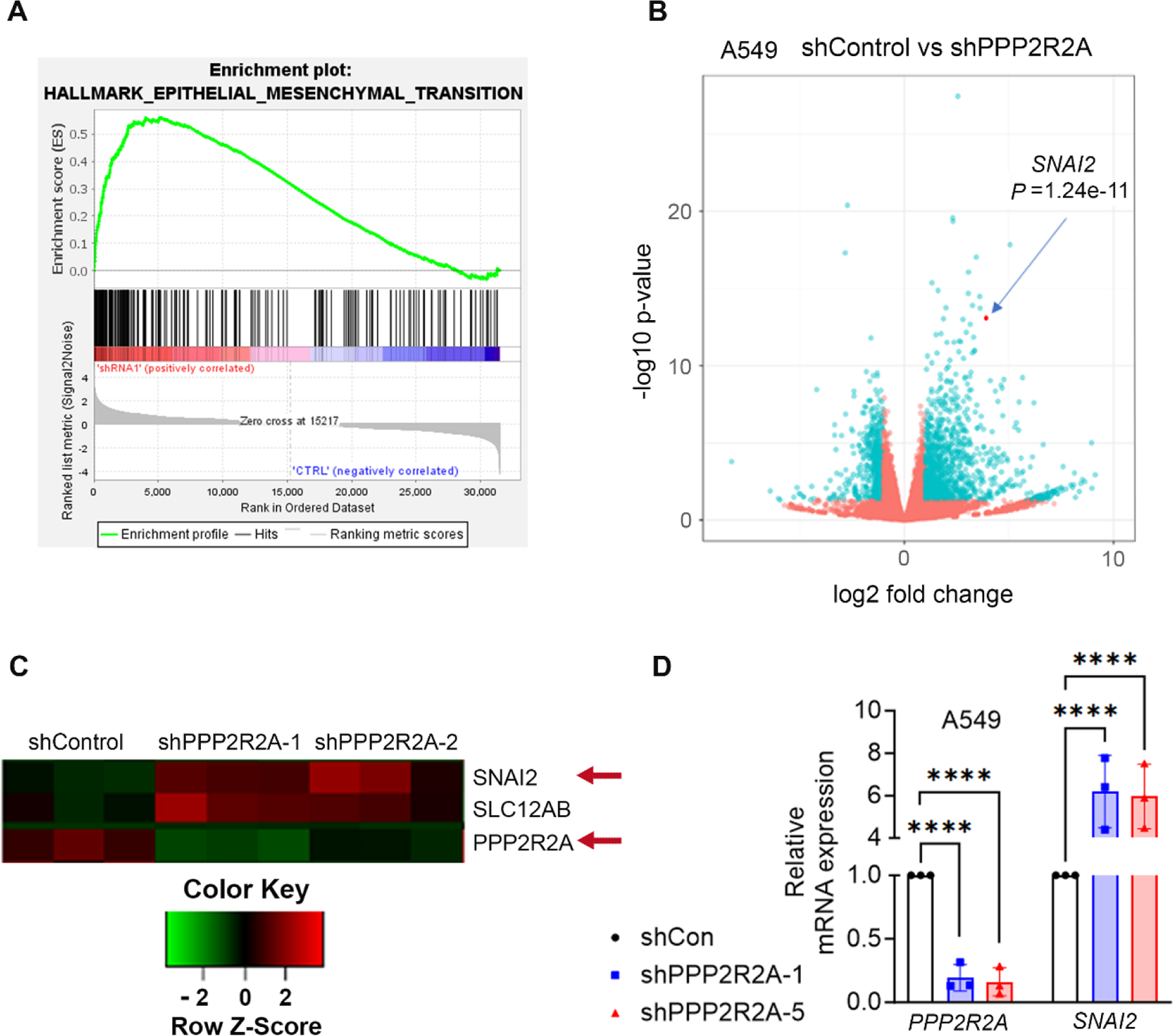
PP2A B55α, encoded by PPP2R2A, acts as a regulatory subunit of the serine/threonine phosphatase PP2A. Despite a frequent loss of heterozygosity of PPP2R2A in cases of non-small cell lung cancer (NSCLC), research on PP2A B55α's functions remains limited and controversial. To investigate the biological roles of PP2A B55α, we conducted bulk RNA-sequencing to assess the impact of PPP2R2A knockdown using two shRNAs in a NSCLC cell line. Gene set enrichment analysis (GSEA) of the RNA-sequencing data revealed significant enrichment of the epithelial-mesenchymal transition (EMT) pathway, with SNAI2 (the gene encoding Slug) emerging as one of the top candidates. Our findings demonstrate that PP2A B55α suppresses EMT, as PPP2R2A deficiency through knockdown or homozygous or hemizygous depletion promotes EMT and metastatic behavior in NSCLC cells, as evidenced by changes in EMT biomarkers, invasion and migration abilities, as well as metastasis in a tail vein assay. Mechanistically, PP2A B55α inhibits EMT by downregulating SNAI2 expression via the GSK3β-β-catenin pathway. Importantly, PPP2R2A deficiency also slows cell proliferation by disrupting DNA replication, particularly in PPP2R2A cells. Furthermore, PPP2R2A deficiency, especially PPP2R2A cells, leads to an increase in the cancer stem cell population, which correlates with enhanced resistance to chemotherapy. Overall, the decrease in PP2A B55α levels due to hemizygous/homozygous depletion heightens EMT and the metastatic or stemness/drug resistance potential of NSCLC cells despite their proliferation disadvantage. Our study highlights the significance of PP2A B55α in EMT and metastasis and suggests that targeting EMT/stemness could be a potential therapeutic strategy for treating PPP2R2A-deficient NSCLC.
PP2A B55α 由 PPP2R2A 编码,作为丝氨酸/苏氨酸磷酸酶 PP2A 的调节亚基发挥作用。尽管非小细胞肺癌 (NSCLC) 病例中经常存在 PPP2R2A 的杂合性丢失,但对 PP2A B55α 功能的研究仍然有限且存在争议。为了研究 PP2A B55α 的生物学作用,我们使用两种 shRNA 在 NSCLC 细胞系中进行了批量 RNA-seq 以评估 PPP2R2A 敲低的影响。RNA-seq 数据的基因集富集分析 (GSEA) 显示上皮-间充质转化 (EMT) 途径显著富集,其中 SNAI2(编码 Slug 的基因)是顶级候选基因之一。我们的研究结果表明,PP2A B55α 抑制 EMT,因为通过敲低或纯合或杂合缺失 PPP2R2A 会促进 NSCLC 细胞中的 EMT 和转移行为,这表现在 EMT 生物标志物、侵袭和迁移能力以及尾静脉试验中的转移的变化。从机制上讲,PP2A B55α 通过 GSK3β-β-catenin 途径下调 SNAI2 表达来抑制 EMT。重要的是,PPP2R2A 缺失还通过破坏 DNA 复制来减缓细胞增殖,尤其是在 PPP2R2A 细胞中。此外,PPP2R2A 缺失,特别是 PPP2R2A 细胞,会导致癌症干细胞群体增加,这与对化疗的增强抗性相关。总体而言,由于杂合/纯合缺失导致 PP2A B55α 水平降低,尽管 NSCLC 细胞的增殖能力受到影响,但会增强 EMT 以及转移或干细胞/耐药性潜力。我们的研究强调了 PP2A B55α 在 EMT 和转移中的重要性,并表明针对 EMT/干细胞可能是治疗 PPP2R2A 缺陷型 NSCLC 的潜在治疗策略。