Department of Fish and Wildlife Conservation, Virginia Tech, Blacksburg, VA, United States of America.
Department of Biology, University of Saskatchewan, Saskatoon, Canada.
PLoS One. 2024 Jul 11;19(7):e0304769. doi: 10.1371/journal.pone.0304769. eCollection 2024.
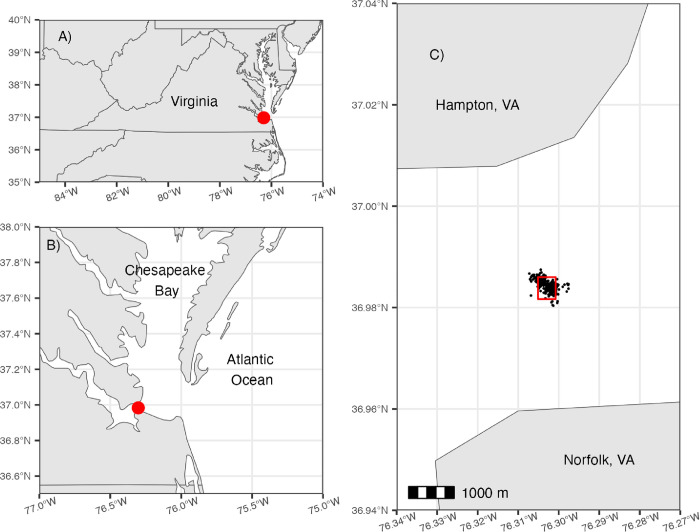
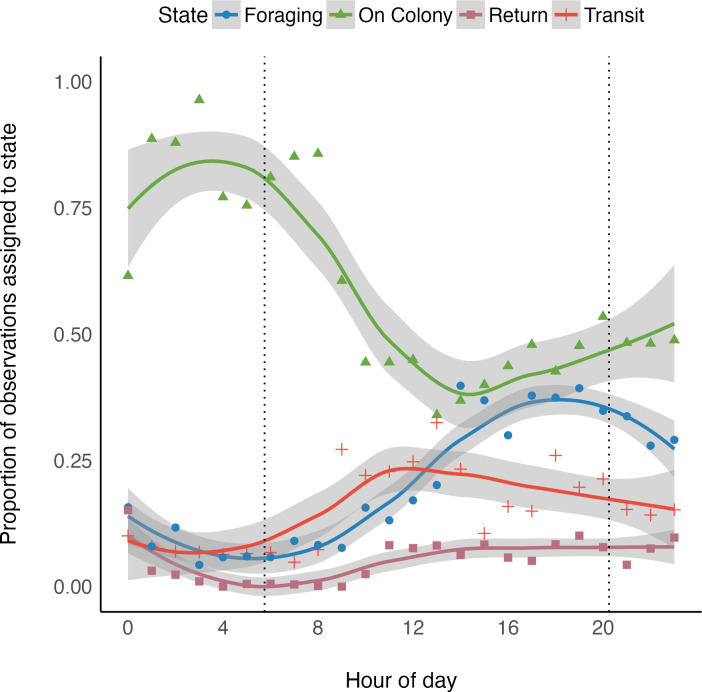
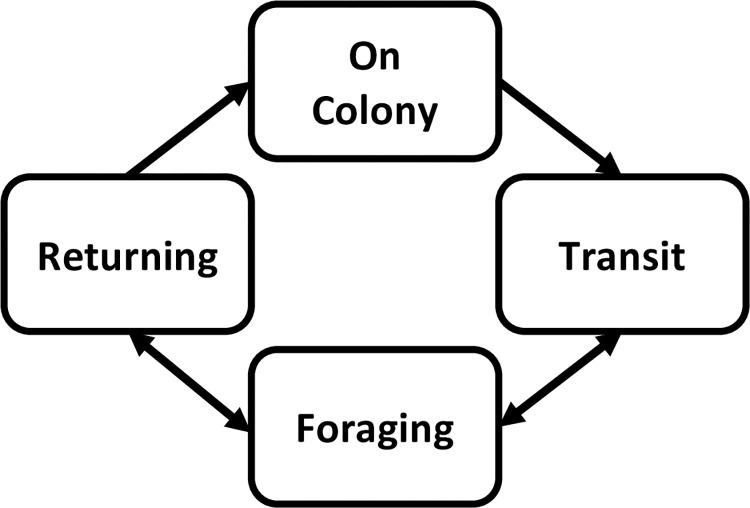
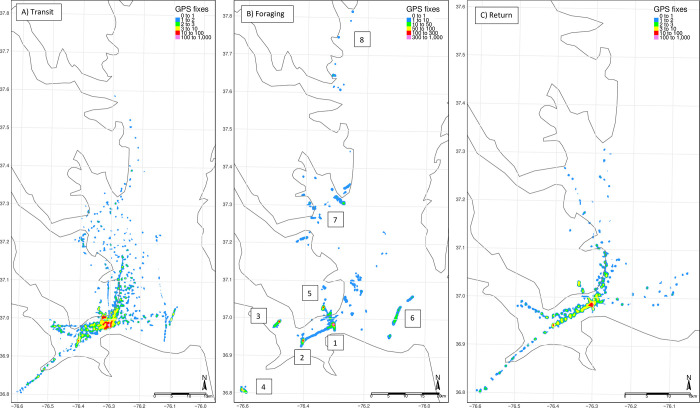
Nesting colonial seabirds are prime examples of central-place foragers, animals that must return to a central location (e.g., a breeding colony) after each bout of foraging. They must balance the costs and benefits of foraging with the need to return to their colonies frequently to form pair bonds during courtship, incubate, provision mates and offspring, and protect and rear young. For some populations, the loss and degradation of suitable breeding habitat due to human activities have necessitated the construction of new breeding sites and/or the restoration of previously occupied sites. South Island, which is part of the Hampton Roads Bridge-Tunnel (HRBT) complex in the Commonwealth of Virginia, U.S.A., is a human-created island that supported Virginia's largest mixed species seabird colony until 2020, when the expansion of the HRBT began and when all nesting seabirds were permanently excluded from the site. We studied the movement patterns of foraging common terns (Sterna hirundo) to determine how travel to and around foraging sites related to their colony location and to inform the siting and construction of a new breeding island. We tracked 18 individual common terns from 07 June to 29 June 2018, and we used a hidden Markov model to assign behavioral states and investigate common tern movements around the HRBT. Common terns spent more than half their time in the colony (58%), followed by time devoted to foraging (22%), and the remainder of their time was spent on outbound (15%) and inbound (5%) transit. Terns traveled as far as 98km from the colony, but on average foraged relatively close to South Island (13.6 ± 0.3km, mean ± 1 SD). Individuals tended to forage in the same locations, but there was variation among individuals. Flying to foraging sites uses energy during the already energetically costly breeding season, thus managers should prioritize placing a new colony site in a location that minimizes the distance traveled to the foraging locations frequented by the South Island birds while accounting for other life-history characteristics. These findings could help in the design and construction of new breeding sites or the restoration of current sites for other, related species, particularly for which these data do not exist.
筑巢的群居海鸟是中央觅食者的典型例子,它们在觅食后必须返回中央位置(例如繁殖地)。它们必须平衡觅食的成本和收益与频繁返回繁殖地的需求,以在求偶期间形成配对关系、孵化、为配偶和后代提供食物、保护和养育幼鸟。对于一些种群来说,由于人类活动导致合适的繁殖栖息地的丧失和退化,需要建造新的繁殖地和/或恢复以前占据的地点。南岛是美国弗吉尼亚州汉普顿路大桥-隧道(HRBT)综合体的一部分,是一个人工岛,直到 2020 年,HRBT 开始扩建,所有筑巢海鸟都被永久排除在该岛之外,它一直是弗吉尼亚最大的混合物种海鸟繁殖地。我们研究了觅食普通燕鸥(Sterna hirundo)的移动模式,以确定它们前往和环绕觅食地的旅行方式与它们的繁殖地位置的关系,并为新繁殖地的选址和建设提供信息。我们在 2018 年 6 月 7 日至 29 日追踪了 18 只普通燕鸥个体,并使用隐马尔可夫模型分配行为状态并调查了 HRBT 周围普通燕鸥的运动。普通燕鸥在繁殖地度过了超过一半的时间(58%),其次是觅食时间(22%),其余时间用于往返(15%)和入境(5%)过境。燕鸥最远从繁殖地飞行了 98 公里,但平均来说,它们在南岛附近觅食(13.6 ± 0.3 公里,平均值 ± 1 标准差)。个体倾向于在相同的地点觅食,但个体之间存在差异。在已经能量消耗很大的繁殖季节,飞往觅食地会消耗能量,因此管理者应优先将新的繁殖地选址在距离南岛鸟类经常光顾的觅食地最近的位置,同时考虑到其他生活史特征。这些发现可能有助于为其他相关物种设计和建造新的繁殖地或恢复当前的繁殖地,特别是对于那些没有这些数据的物种。