
成人肾病综合征患者发病时蛋白尿的预后影响:一项前瞻性队列研究的见解
Prognostic Impact of Proteinuria at Manifestation in Adult Nephrotic Syndrome Patients: Insights from a Prospective Cohort Study.
作者信息
Nagaram Srinivas, Charles Priscilla, Nandeesha Hanumanthappa, Parameswaran Sreejith, Chinnakali Palanivel, Nachiappa Ganesh Rajesh
机构信息
Pathology, Jawaharlal Institute of Postgraduate Medical Education & Research, Puducherry, IND.
Biochemistry, Jawaharlal Institute of Postgraduate Medical Education & Research, Puducherry, IND.
出版信息
Cureus. 2024 Jun 11;16(6):e62143. doi: 10.7759/cureus.62143. eCollection 2024 Jun.
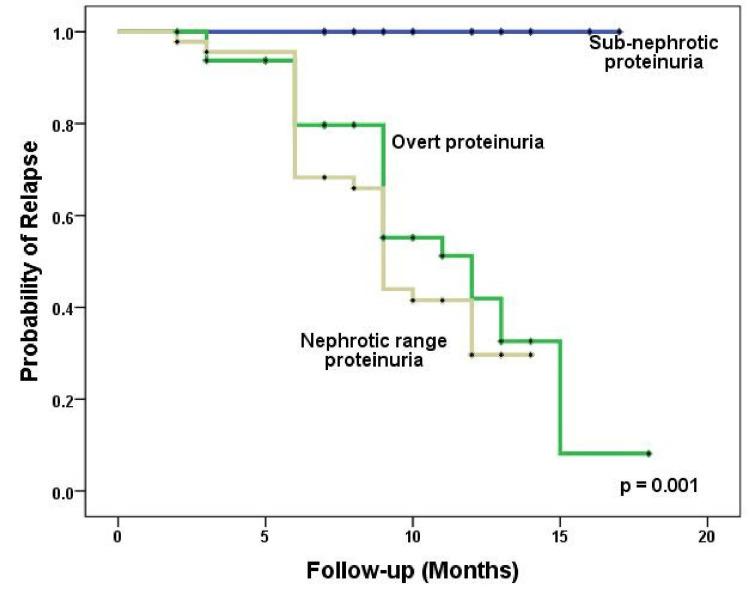
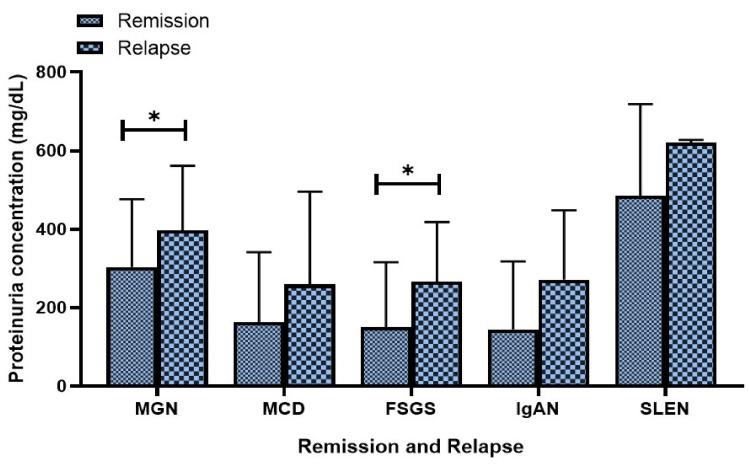
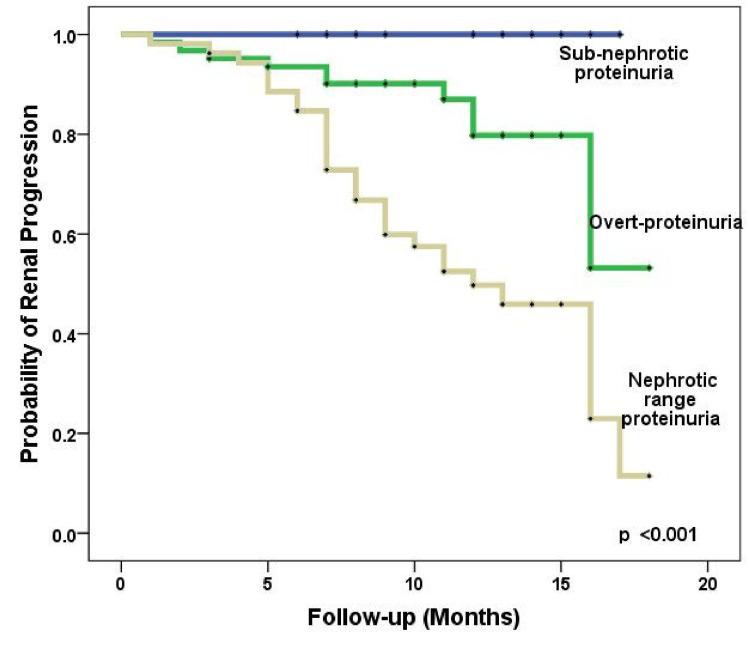
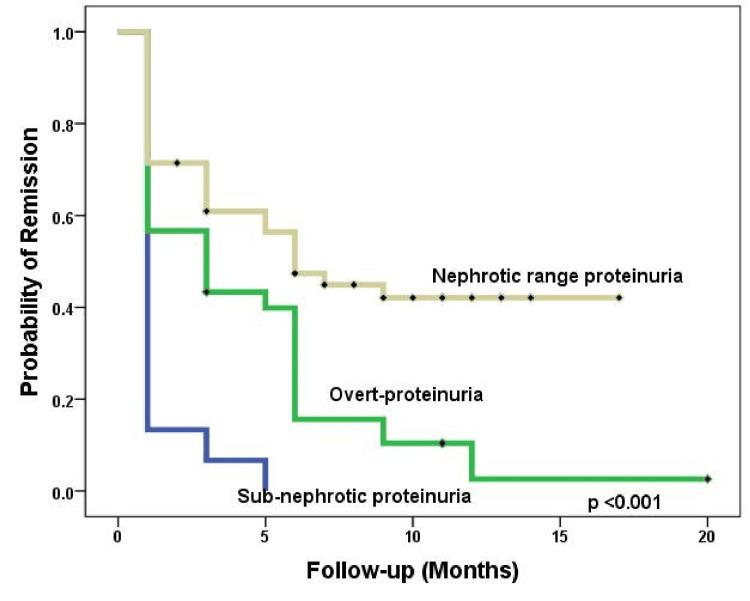
Background and objective Nephrotic syndrome is a significant worldwide health concern impacting millions of people and is marked by heavy proteinuria, edema, and decreased serum levels of albumin. Albuminuria arises from abnormal glomerular permeability and impaired tubular reabsorption, contributing to declining kidney function and a heightened risk of cardiovascular complications. The objective of this study was to investigate the prognostic role of proteinuria on the persistent decline in estimated glomerular filtration rate (eGFR) (<30 ml/minute/1.73m) during follow-up and the dynamics of remission and relapse in various subtypes of nephrotic syndrome. Methods A total of 134 adult patients, diagnosed with various histopathological categories of nephrotic syndrome, were prospectively studied. Urine protein levels were assessed using the pyrogallol red-molybdate (PRM) method. The Kaplan-Meier analysis and log-rank test were utilized to assess the prognostic role of proteinuria at manifestation on persistent decline in estimated glomerular filtration rate (eGFR) (<30 ml/minute/1.73m) and to evaluate remission and relapse based on proteinuria levels over an 18-month follow-up period. Results Patients with sub-nephrotic levels of proteinuria at manifestation did not progress to end-stage renal disease on follow-up. Patients with sub-nephrotic levels of albuminuria at manifestation were significantly associated with remission on follow-up. The Kaplan-Meier analysis indicated a significant probability of persistent eGFR decline (p < 0.001) in adult nephrotics with higher levels of albuminuria. Furthermore, patients with sub-nephrotic range proteinuria had earlier remission (p < 0.001) compared to those with relapse (p = 0.001) during the follow-up, as demonstrated by log-rank tests. Conclusion This study highlights that sub-nephrotic albuminuria at manifestation is linked to a reduced risk of renal progression and persistent eGFR decline compared to adult nephrotics with higher levels of albuminuria. Early detection and effective management of proteinuria, are crucial for preventing renal function decline and improving patient outcomes.
背景与目的 肾病综合征是一个影响全球数百万人的重大健康问题,其特征为大量蛋白尿、水肿以及血清白蛋白水平降低。蛋白尿源于肾小球通透性异常和肾小管重吸收受损,导致肾功能下降以及心血管并发症风险增加。本研究的目的是探讨蛋白尿对随访期间估计肾小球滤过率(eGFR)持续下降(<30 ml/分钟/1.73m²)的预后作用,以及肾病综合征各亚型缓解和复发的动态变化。方法 前瞻性研究了134例诊断为不同组织病理学类型肾病综合征的成年患者。采用邻苯三酚红钼法评估尿蛋白水平。使用Kaplan-Meier分析和对数秩检验来评估蛋白尿在发病时对估计肾小球滤过率(eGFR)持续下降(<30 ml/分钟/1.73m²)的预后作用,并在18个月的随访期内根据蛋白尿水平评估缓解和复发情况。结果 发病时蛋白尿水平处于亚肾病范围的患者在随访中未进展至终末期肾病。发病时白蛋白尿水平处于亚肾病范围的患者在随访中与缓解显著相关。Kaplan-Meier分析表明,白蛋白尿水平较高的成年肾病患者eGFR持续下降的可能性显著(p < 0.001)。此外,对数秩检验显示,在随访期间,蛋白尿处于亚肾病范围的患者缓解较早(p < 0.001),而复发患者缓解较晚(p = 0.001)。结论 本研究强调,与白蛋白尿水平较高的成年肾病患者相比,发病时亚肾病范围的白蛋白尿与肾脏进展风险降低和eGFR持续下降有关。早期检测和有效管理蛋白尿对于预防肾功能下降和改善患者预后至关重要。
 Zotero 插件