Dridi Bahaeddine, Agrebi Myriam, Sahnoun Dhouha, Ben Salem Chaker
Pharmacology, Pharmacovigilance Center of Sousse, Faculty of Medicine of Sousse, University of Sousse, Sousse, TUN.
Pharmacology, Faculty of Pharmacy of Monastir, University of Monastir, Monastir, TUN.
Cureus. 2024 Jun 11;16(6):e62125. doi: 10.7759/cureus.62125. eCollection 2024 Jun.
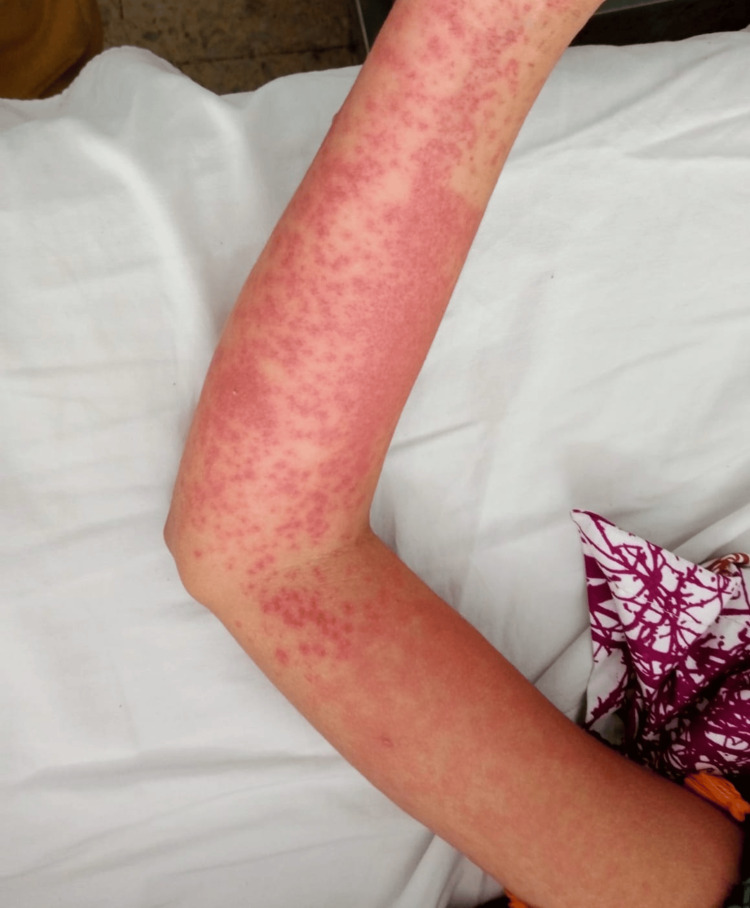
Drug reaction with eosinophilia and systemic symptoms (DRESS) is a severe and rare syndrome that causes life-threatening organ dysfunctions. Here, we present the case of a 10-year-old child who developed a pruritic erythematous eruption, fever, facial edema, and lymphadenopathy seven days after receiving intravenous metronidazole (20 mg/kg/day), vancomycin (50 mg/kg/day), and cefotaxime (200 mg/kg/day). Laboratory tests showed eosinophilia and liver damage as well as positive parvovirus B19 IgM and IgG indicating viral reactivation. Vancomycin was initially discontinued and later reintroduced with no ill effects. The patient was managed with topical corticosteroid emollients and cetirizine and improved within seven days of metronidazole withdrawal. Treatment with cefotaxime was continued and showed no adverse effects.
药物超敏反应伴嗜酸性粒细胞增多和全身症状(DRESS)是一种严重且罕见的综合征,可导致危及生命的器官功能障碍。在此,我们报告一例10岁儿童的病例,该患儿在静脉输注甲硝唑(20mg/kg/天)、万古霉素(50mg/kg/天)和头孢噻肟(200mg/kg/天)7天后出现瘙痒性红斑疹、发热、面部水肿和淋巴结病。实验室检查显示嗜酸性粒细胞增多和肝损伤,以及细小病毒B19 IgM和IgG阳性,提示病毒再激活。万古霉素最初停用,后来重新使用未出现不良反应。患者使用外用糖皮质激素润肤剂和西替利嗪治疗,在停用甲硝唑7天内病情好转。继续使用头孢噻肟治疗,未出现不良反应。