Nguyen Thu-Ha, Mohd Rozita, Daud Zulfitri 'Azuan Mat, Talib Ruzita Abd, Poh Bee-Koon
Center for Community Health Studies, Universiti Kebangsaan Malaysia Faculty of Health Sciences, Kuala Lumpur, MYS.
Department of Nutrition, 108 Military Central Hospital, Hanoi, VNM.
Cureus. 2024 Jun 10;16(6):e62105. doi: 10.7759/cureus.62105. eCollection 2024 Jun.
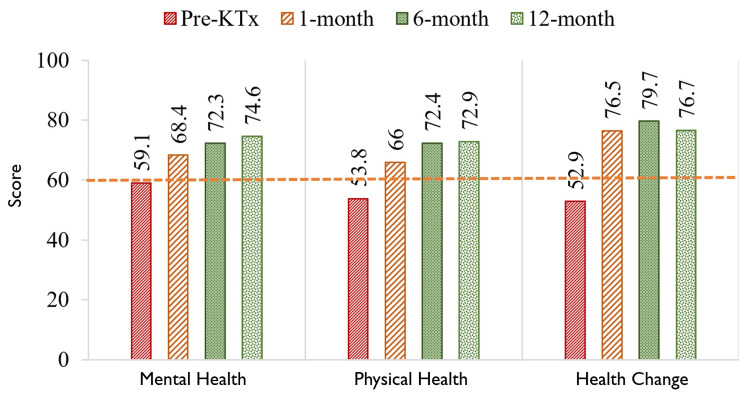
Background Malnutrition is strongly associated with lower quality of life (QoL) and lower survival rates in patients with end-stage kidney disease. However, the impact of renal transplantation on nutrition factors and QoL is unclear. Therefore, this study aims to assess changes in QoL and investigate the relationships with nutrition factors among kidney transplant recipients (KTRs). Materials and methods A longitudinal study included 86 dialysis patients aged 18-65 years who underwent primary kidney transplantation (KTx) and were followed up for one year. Body weight, biochemical parameters, and QoL data were collected before transplantation (T0) and at six months (T6) and 12 months (T12) post-transplantation. Effect size (ES) was used to measure the impact of KTx on QoL and nutritional status from T0 to T12. The predictors of QoL were calculated with β-coefficients and p<0.05 in linear regression. Results The ES of transplantation on the QoL of KTRs was large, at 1.1 for health change, 0.9 for physical health, and moderate (0.7) for mental health (MH) over one year. Hemoglobin and malnourished were affected by KTx, with ES being 2.4 and 0.6, respectively. Linear regression showed that physical health was predicted by hemoglobin (β=0.12, p<0.01), phosphorus (β=7.82, p<0.05), and dose of mycophenolate mofetil (MMF) (β=-0.01, p<0.05). Mental health was predicted by obesity (β=-7.63, p<0.05), hemoglobin (β=0.11, p<0.05), and phosphorus (β=8.49, p<0.01). Health change was indicated by nutritional risk index (NRI) score (β=0.47, p<0.05), total cholesterol (β=3.39, p<0.01), and kidney function (β=0.15, p<0.05). Conclusions The transition from end-stage kidney disease to transplantation has positive impacts on QoL and nutrition markers. Nutritional status, kidney function, and the dose of mycophenolate mofetil are significant determinants of QoL in KTRs.
营养不良与终末期肾病患者的生活质量(QoL)较低及生存率较低密切相关。然而,肾移植对营养因素和生活质量的影响尚不清楚。因此,本研究旨在评估肾移植受者(KTRs)生活质量的变化,并调查其与营养因素的关系。
一项纵向研究纳入了86名年龄在18至65岁之间接受初次肾移植(KTx)并随访一年的透析患者。在移植前(T0)、移植后6个月(T6)和12个月(T12)收集体重、生化参数和生活质量数据。效应大小(ES)用于衡量从T0到T12肾移植对生活质量和营养状况的影响。生活质量的预测因素通过线性回归中的β系数和p<0.05计算得出。
肾移植对KTRs生活质量的效应大小较大,一年中健康变化的效应大小为1.1,身体健康的效应大小为0.9,心理健康(MH)的效应大小为中等(0.7)。血红蛋白和营养不良受肾移植影响,效应大小分别为2.4和0.6。线性回归显示,身体健康由血红蛋白(β=0.12,p<0.01)、磷(β=7.82,p<0.05)和霉酚酸酯(MMF)剂量(β=-0.01,p<0.05)预测。心理健康由肥胖(β=-7.63,p<0.05)、血红蛋白(β=0.11,p<0.05)和磷(β=8.49,p<0.01)预测。健康变化由营养风险指数(NRI)评分(β=0.47,p<0.05)、总胆固醇(β=3.39,p<0.01)和肾功能(β=0.15,p<0.05)表明。
从终末期肾病到肾移植的转变对生活质量和营养指标有积极影响。营养状况、肾功能和霉酚酸酯剂量是KTRs生活质量的重要决定因素。