Gottardi Francesca, Leardini Davide, Muratore Edoardo, Baccelli Francesco, Cerasi Sara, Venturelli Francesco, Zanaroli Andrea, Belotti Tamara, Prete Arcangelo, Masetti Riccardo
Pediatric Oncology and Hematology, IRCCS Azienda Ospedaliero-Universitaria di Bologna, Bologna, Italy.
Department of Medical and Surgical Sciences (DIMEC), University of Bologna, Bologna, Italy.
Front Transplant. 2023 Sep 15;2:1251112. doi: 10.3389/frtra.2023.1251112. eCollection 2023.
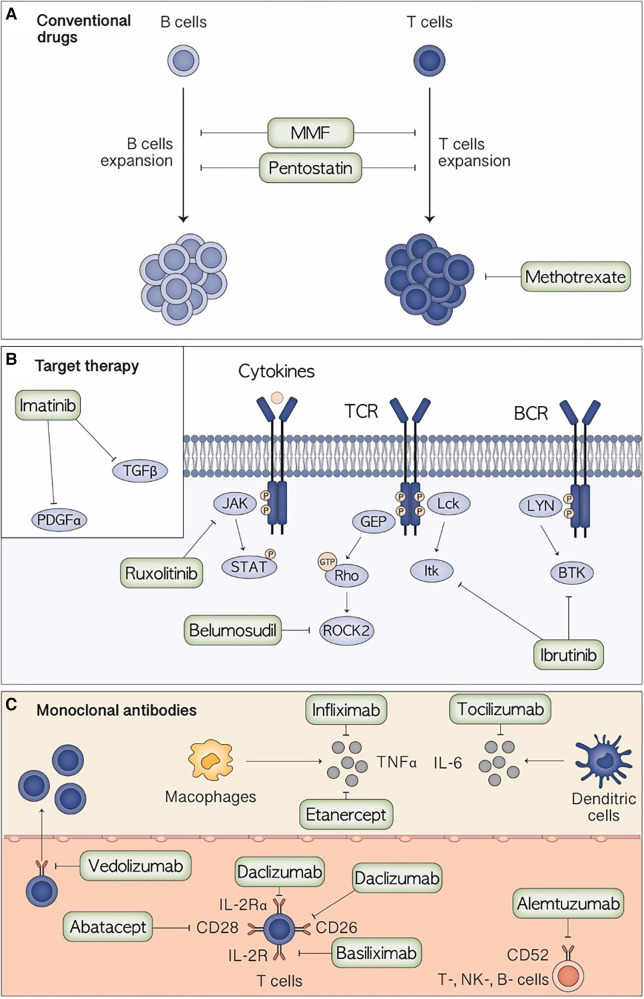
Systemic steroids are still the first-line approach in acute graft-versus-host disease (aGvHD), and the backbone of chronic GvHD management. Refractoriness to steroid represent a major cause of morbidity and non-relapse mortality after hematopoietic stem cell transplantation (HSCT). In both backgrounds, several second-line immunosuppressive agents have been tested with variable results in terms of efficacy and toxicity. Solid evidence regarding these approaches is still lacking in the pediatric setting where results are mainly derived from adult experiences. Furthermore, the number of treated patients is limited and the incidence of acute and chronic GvHD is lower, resulting in a very heterogeneous approach to this complication by pediatric hematologists. Some conventional therapies and anti-cytokine monoclonal antibodies used in the adult setting have been evaluated in children. In recent years, the increasing understanding of the biological mechanisms underpinning the pathogenesis of GvHD justified the efforts toward the adoption of targeted therapies and non-pharmacologic approaches, with higher response rates and lower immunosuppressive effects. Moreover, many questions regarding the precise timing and setting in which to integrate these new approaches remain unanswered. This Review aims to critically explore the current evidence regarding novel approaches to treat SR-GvHD in pediatric HSCT recipients.
全身用类固醇仍然是急性移植物抗宿主病(aGvHD)的一线治疗方法,也是慢性移植物抗宿主病管理的基础。对类固醇难治是造血干细胞移植(HSCT)后发病和非复发死亡率的主要原因。在这两种情况下,已经对几种二线免疫抑制剂进行了测试,在疗效和毒性方面结果各异。在儿科环境中,关于这些方法的确凿证据仍然缺乏,儿科的结果主要来自成人经验。此外,接受治疗的患者数量有限,急性和慢性移植物抗宿主病的发病率较低,导致儿科血液学家对这种并发症的处理方法非常不一致。一些在成人中使用的传统疗法和抗细胞因子单克隆抗体已在儿童中进行了评估。近年来,对移植物抗宿主病发病机制背后生物学机制的日益了解,使得人们努力采用靶向治疗和非药物方法,这些方法具有更高的缓解率和更低的免疫抑制作用。此外,关于整合这些新方法的确切时机和背景的许多问题仍未得到解答。本综述旨在批判性地探讨目前关于治疗儿科HSCT受者类固醇难治性移植物抗宿主病新方法的证据。