Division of Maternal-Fetal Medicine, Department of Obstetrics, Gynecology & Reproductive Sciences, University of California (UCSF), San Francisco, San Francisco, CA, United States.
Center for Reproductive Sciences and Department of Obstetrics, Gynecology, and Reproductive Sciences, University of California (UCSF), San Francisco, San Francisco, CA, United States.
Front Immunol. 2024 Jun 26;15:1384361. doi: 10.3389/fimmu.2024.1384361. eCollection 2024.
Maternal intervillous monocytes (MIMs) and fetal Hofbauer cells (HBCs) are myeloid-derived immune cells at the maternal-fetal interface. Maternal reproductive history is associated with differential risk of pregnancy complications. The molecular phenotypes and roles of these distinct monocyte/macrophage populations and the influence of gravidity on these phenotypes has not been systematically investigated.
Here, we used RNA sequencing to study the transcriptional profiles of MIMs and HBCs in normal term pregnancies.
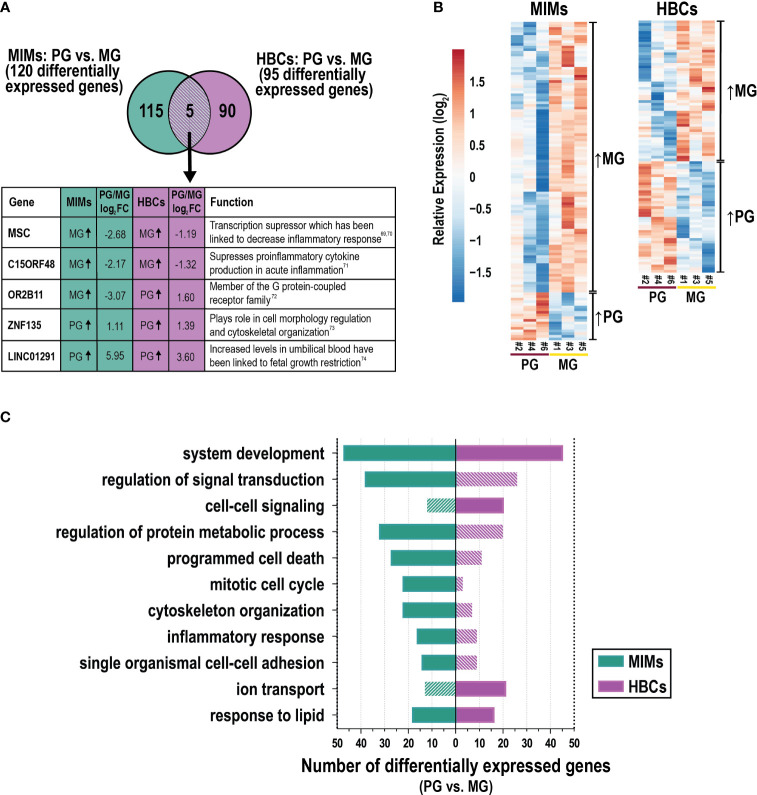
Our analyses revealed distinct transcriptomes of MIMs and HBCs. Genes involved in differentiation and cell organization pathways were more highly expressed in MIMs vs. HBCs. In contrast, HBCs had higher expression of genes involved in inflammatory responses and cell surface receptor signaling. Maternal gravidity influenced monocyte programming, as expression of pro-inflammatory molecules was significantly higher in MIMs from multigravidae compared to primigravidae. In HBCs, multigravidae displayed enrichment of gene pathways involved in cell-cell signaling and differentiation.
Our results demonstrated that MIMs and HBCs have highly divergent transcriptional signatures, reflecting their distinct origins, locations, functions, and roles in inflammatory responses. Furthermore, maternal gravidity influences the gene signatures of MIMs and HBCs, potentially modulating the interplay between tolerance and trained immunity. The phenomenon of reproductive immune memory may play a novel role in the differential susceptibility of primigravidae to pregnancy complications.
母体外绒毛间单核细胞(MIMs)和胎儿豪夫鲍尔氏细胞(HBCs)是母体-胎儿界面处的髓系来源的免疫细胞。母体生殖史与妊娠并发症的差异风险相关。这些不同的单核细胞/巨噬细胞群体的分子表型和作用,以及妊娠次数对这些表型的影响尚未被系统地研究过。
在这里,我们使用 RNA 测序来研究正常足月妊娠中 MIMs 和 HBCs 的转录谱。
我们的分析揭示了 MIMs 和 HBCs 的独特转录组。与 HBCs 相比,MIMs 中分化和细胞组织途径相关的基因表达水平更高。相比之下,HBCs 中炎症反应和细胞表面受体信号转导相关基因的表达水平更高。母体妊娠次数影响单核细胞的编程,因为多产妇的 MIMs 中促炎分子的表达明显高于初产妇。在 HBCs 中,多产妇表现出细胞间信号转导和分化相关基因途径的富集。
我们的研究结果表明,MIMs 和 HBCs 具有高度分化的转录特征,反映了它们在起源、位置、功能和炎症反应中的不同作用。此外,母体妊娠次数影响 MIMs 和 HBCs 的基因特征,可能调节耐受和训练免疫之间的相互作用。生殖免疫记忆的现象可能在初产妇对妊娠并发症的不同易感性中发挥新的作用。