Australian Regenerative Medicine Institute, Monash University, Clayton, VIC, Australia.
Division of Cellular and Developmental Biology, Molecular and Cell Biology Department, University of California, Berkeley, CA, USA.
Hum Reprod Update. 2024 Dec 1;30(6):692-705. doi: 10.1093/humupd/dmae022.
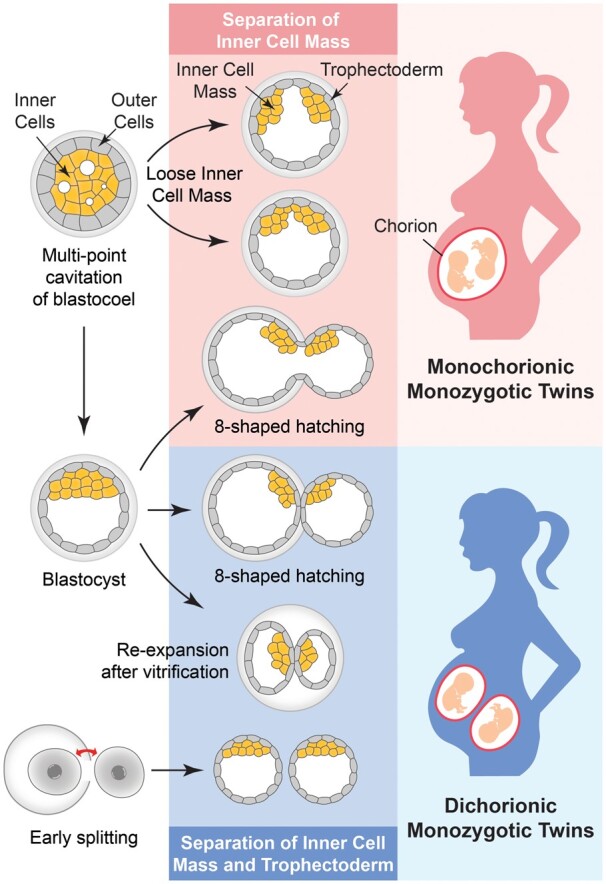
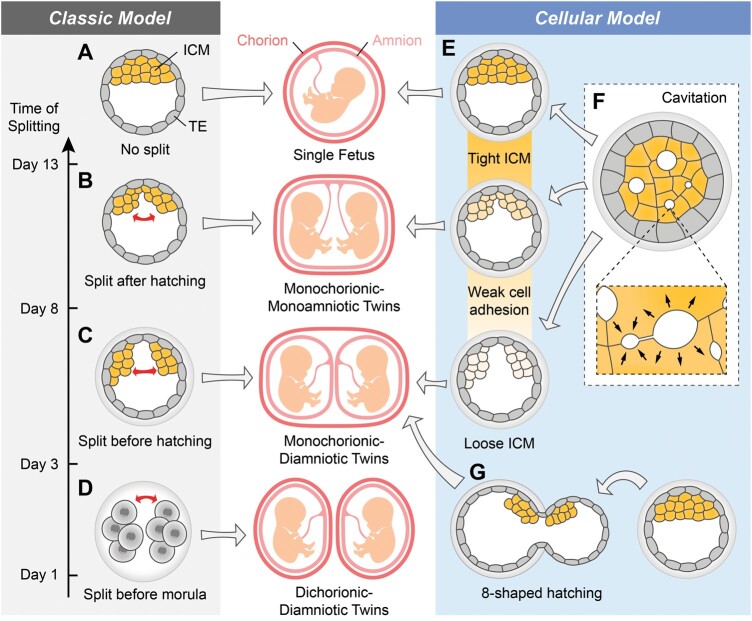
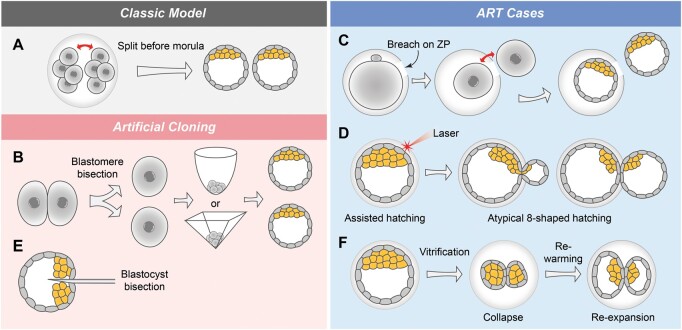
Monozygotic (MZ) twins are believed to arise from the fission of a single fertilized embryo at different stages. Monochorionic MZ twins, who share one chorion, originate from the splitting of the inner cell mass (ICM) within a single blastocyst. In the classic model for dichorionic MZ twins, the embryo splits before compaction, developing into two blastocysts. However, there are a growing number of ART cases where a single blastocyst transfer results in dichorionic MZ twins, indicating that embryo splitting may occur even after blastocyst formation.
For monochorionic MZ twins, we conducted a comprehensive analysis of the cellular mechanisms involved in ICM splitting, drawing from both ART cases and animal experiments. In addition, we critically re-examine the classic early splitting model for dichorionic MZ twins. We explore cellular mechanisms leading to two separated blastocysts in ART, potentially causing dichorionic MZ twins.
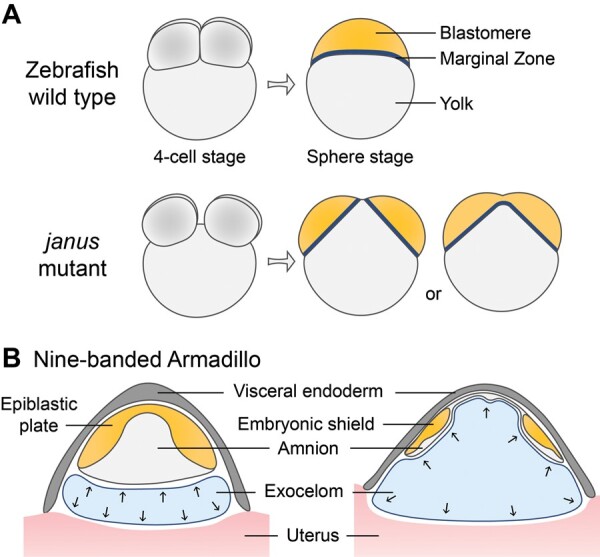
Relevant studies including research articles, reviews, and conference papers were searched in the PubMed database. Cases of MZ twins from IVF clinics were found by using combinations of terms including 'monozygotic twins' with 'IVF case report', 'ART', 'single embryo transfer', or 'dichorionic'. The papers retrieved were categorized based on the implicated mechanisms or as those with unexplained mechanisms. Animal experiments relating to MZ twins were found using 'mouse embryo monozygotic twins', 'mouse 8-shaped hatching', 'zebrafish janus mutant', and 'nine-banded armadillo embryo', along with literature collected through day-to-day reading. The search was limited to articles in English, with no restrictions on publication date or species.
For monochorionic MZ twins, ART cases and mouse experiments demonstrate evidence that a looser ICM in blastocysts has an increased chance of ICM separation. Physical forces facilitated by blastocoel formation or 8-shaped hatching are exerted on the ICM, resulting in monochorionic MZ twins. For dichorionic MZ twins, the classic model resembles artificial cloning of mouse embryos in vitro, requiring strictly controlled splitting forces, re-joining prevention, and proper aggregation, which allows the formation of two separate human blastocysts under physiological circumstances. In contrast, ART procedures involving the transfer of a single blastocysts after atypical hatching or vitrified-warmed cycles might lead to blastocyst separation. Differences in morphology, molecular mechanisms, and timing across various animal model systems for MZ twinning can impede this research field. As discussed in future directions, recent developments of innovative in vitro models of human embryos may offer promising avenues for providing fundamental novel insights into the cellular mechanisms of MZ twinning during human embryogenesis.
Twin pregnancies pose high risks to both the fetuses and the mother. While single embryo transfer is commonly employed to prevent dizygotic twin pregnancies in ART, it cannot prevent the occurrence of MZ twins. Drawing from our understanding of the cellular mechanisms underlying monochorionic and dichorionic MZ twinning, along with insights into the genetic mechanisms, could enable improved prediction, prevention, and even intervention strategies during ART procedures.
N/A.
人们认为同卵(MZ)双胞胎是由不同阶段的单个受精卵分裂形成的。同绒毛膜 MZ 双胞胎由单个囊胚内的内细胞团(ICM)分裂而来。在经典的双绒毛膜 MZ 双胞胎模型中,胚胎在致密化之前分裂,形成两个囊胚。然而,越来越多的 ART 病例中,单个囊胚转移导致双绒毛膜 MZ 双胞胎,表明胚胎分裂甚至可能发生在囊胚形成之后。
对于同绒毛膜 MZ 双胞胎,我们从 ART 病例和动物实验中综合分析了涉及 ICM 分裂的细胞机制。此外,我们对经典的双绒毛膜 MZ 双胞胎早期分裂模型进行了批判性再检查。我们探讨了导致两个分离的囊胚的细胞机制,这可能导致双绒毛膜 MZ 双胞胎。
在 PubMed 数据库中搜索了包括研究文章、综述和会议论文在内的相关研究。通过使用“monozygotic twins”与“IVF case report”、“ART”、“single embryo transfer”或“dichorionic”等术语的组合,在 IVF 诊所发现了 MZ 双胞胎的病例。根据所涉及的机制或未解释的机制对检索到的论文进行了分类。通过使用“mouse embryo monozygotic twins”、“mouse 8-shaped hatching”、“zebrafish janus mutant”和“nine-banded armadillo embryo”等术语,结合日常阅读收集的文献,找到了与 MZ 双胞胎相关的动物实验。搜索仅限于英文文章,对发表日期或物种没有限制。
对于同绒毛膜 MZ 双胞胎,ART 病例和小鼠实验表明,囊胚中较松弛的 ICM 更有可能发生 ICM 分离。囊胚形成或 8 字形孵化所产生的物理力作用于 ICM,导致同绒毛膜 MZ 双胞胎的形成。对于双绒毛膜 MZ 双胞胎,经典模型类似于体外人工克隆小鼠胚胎,需要严格控制分裂力、防止重新连接和适当聚集,以便在生理条件下形成两个独立的人囊胚。相比之下,ART 程序中涉及在非典型孵化或冷冻解冻周期后转移单个囊胚,可能导致囊胚分离。各种动物模型系统中 MZ 双胞胎的形态、分子机制和时间差异可能会阻碍这一研究领域的发展。正如未来方向中所讨论的,新型人类胚胎体外模型的最新发展可能为在人类胚胎发生过程中深入了解 MZ 双胞胎的细胞机制提供有前景的途径。
双胞胎妊娠对胎儿和母亲都有很高的风险。虽然在 ART 中通常采用单胚胎转移来防止双胎妊娠,但它不能防止 MZ 双胞胎的发生。从我们对同绒毛膜和双绒毛膜 MZ 双胞胎的细胞机制以及对遗传机制的了解中,我们可以改进预测、预防,甚至在 ART 过程中进行干预的策略。
无。