Ballhausen A, Karthaus M, Fruehauf S, Graeven U, Müller L, König A O, von Weikersthal L F, Sommerhäuser G, Jelas I, Alig A H S, Kurreck A, Stahler A, Goekkurt E, Held S, Kasper S, Heinrich K, Heinemann V, Stintzing S, Trarbach T, Modest D P
Charité-Universitätsmedizin Berlin, Freie Universität Berlin and Humboldt-Universität zu Berlin, Department of Hematology, Oncology, and Cancer Immunology (CVK/CCM), Berlin.
Klinikum Neuperlach/Klinikum Harlaching, Department of Hematology, Oncology, and Palliative Care, Munich.
ESMO Open. 2024 Jul;9(7):103628. doi: 10.1016/j.esmoop.2024.103628. Epub 2024 Jul 13.
The key endpoints for the assessment of the effect of maintenance therapy for metastatic colorectal cancer (mCRC) are survival and quality-of-life outcomes. We aimed to compare dermatology-related quality of life (DRQOL) in patients with RAS wild-type (wt) mCRC treated with fluorouracil and folinic acid (FU/FA) + panitumumab (Pmab) versus FU/FA alone as maintenance therapy after folinic acid, fluorouracil and oxaliplatin + Pmab induction.
The phase II randomized PanaMa (AIO KRK 0212; NCT01991873) trial included 387 patients at 70 community/academic sites in Germany. For this prespecified secondary analysis, DRQOL outcomes were assessed using the Functional Assessment of Cancer Therapy-epidermal growth factor receptor inhibitor (FACT-EGFRI), Dermatology Life Quality Index (DLQI), and Skindex-16 questionnaires at every second cycle of therapy until disease progression/death.
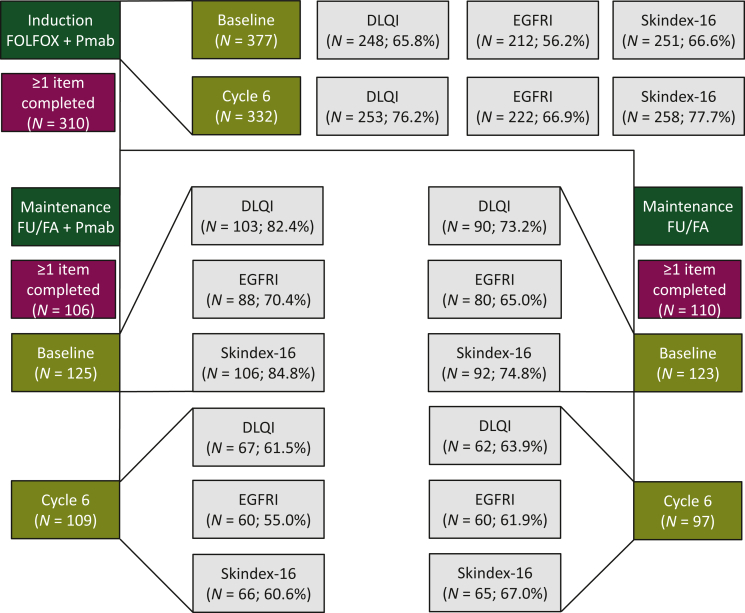
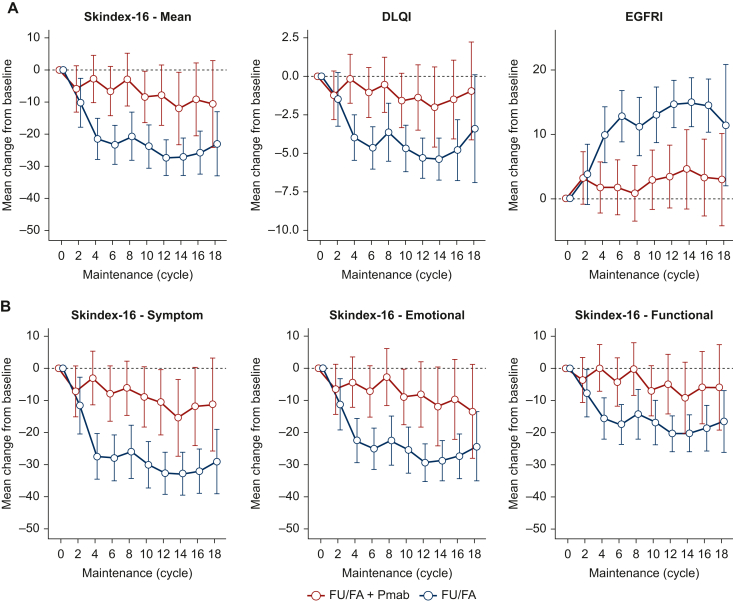
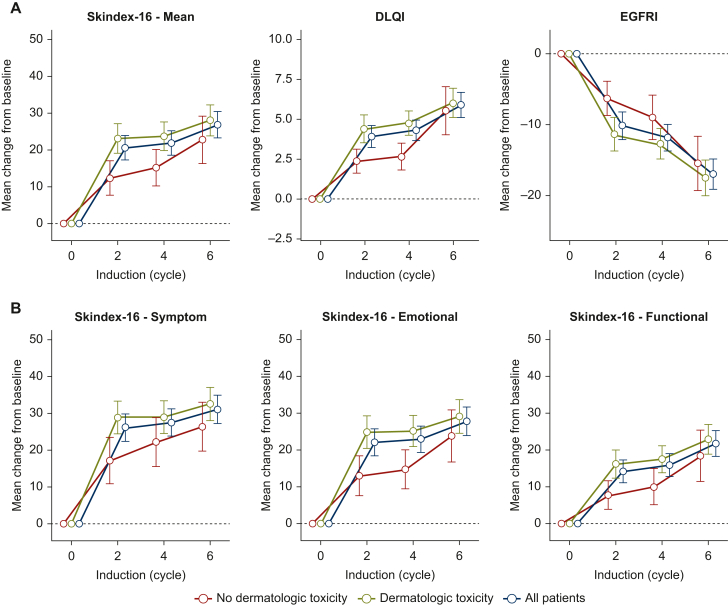
At least one DRQOL questionnaire was completed by a total of 310/377 (82%) patients who received induction therapy, and by 216/248 (87%) patients who were randomized and received maintenance therapy. Patients who experienced skin toxicity according to the National Cancer Institute (NCI)-Common Terminology Criteria for Adverse Events (CTCAE) during induction therapy had significantly worse DRQOL according to all three measures, compared to those who did not [i.e. Skindex-16, mean difference at cycle 2 -12.87; 95% confidence interval (CI) -20.01 to -5.73; P < 0.001]. During maintenance therapy, significantly improved recovery was observed in all DRQOL measures for patients receiving FU/FA, compared to those receiving additional Pmab (i.e. Skindex-16, mean difference at cycle 6 -16.53; 95% CI -22.68 to -10.38; P < 0.001).
In this secondary analysis of a phase II randomized clinical trial, patient-reported DRQOL outcomes correlated with skin toxicity according to NCI-CTCAE during induction therapy. Maintenance therapy with FU/FA + Pmab was associated with deteriorated DRQOL versus FU/FA alone in patients with RAS wt mCRC.
评估转移性结直肠癌(mCRC)维持治疗效果的关键终点是生存和生活质量结果。我们旨在比较接受亚叶酸、氟尿嘧啶和奥沙利铂 + 帕尼单抗诱导治疗后,接受氟尿嘧啶和亚叶酸(FU/FA)+ 帕尼单抗(Pmab)与单独使用FU/FA作为维持治疗的RAS野生型(wt)mCRC患者的皮肤病相关生活质量(DRQOL)。
II期随机PanaMa(AIO KRK 0212;NCT01991873)试验纳入了德国70个社区/学术机构的387例患者。对于这项预先设定的次要分析,在治疗的每第二个周期使用癌症治疗功能评估 - 表皮生长因子受体抑制剂(FACT-EGFRI)、皮肤病生活质量指数(DLQI)和Skindex-16问卷评估DRQOL结果,直至疾病进展/死亡。
共有310/377(82%)接受诱导治疗的患者和216/248(87%)随机接受维持治疗的患者至少完成了一份DRQOL问卷。根据美国国立癌症研究所(NCI)不良事件通用术语标准(CTCAE),在诱导治疗期间出现皮肤毒性的患者,与未出现皮肤毒性的患者相比,所有三项指标的DRQOL均显著更差[即Skindex-16,第2周期平均差异 -12.87;95%置信区间(CI)-20.01至 -5.73;P < 0.001]。在维持治疗期间,与接受额外Pmab的患者相比,接受FU/FA的患者在所有DRQOL指标上均观察到恢复显著改善(即Skindex-16,第6周期平均差异 -16.53;95%CI -22.68至 -10.38;P < 0.001)。
在这项II期随机临床试验的次要分析中,患者报告的DRQOL结果与诱导治疗期间根据NCI-CTCAE的皮肤毒性相关。在RAS wt mCRC患者中,与单独使用FU/FA相比,FU/FA + Pmab维持治疗与DRQOL恶化相关。