Fisher Alexander, Fisher Leon, Srikusalanukul Wichat
Department of Geriatric Medicine, The Canberra Hospital, ACT Health, Canberra 2605, Australia.
Department of Orthopaedic Surgery, The Canberra Hospital, ACT Health, Canberra 2605, Australia.
J Clin Med. 2024 Jul 7;13(13):3969. doi: 10.3390/jcm13133969.
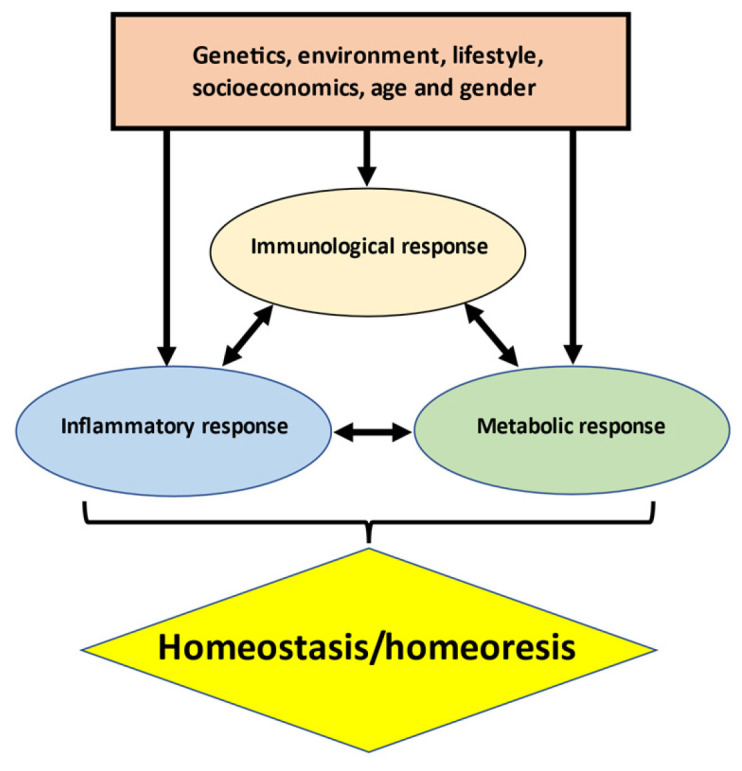
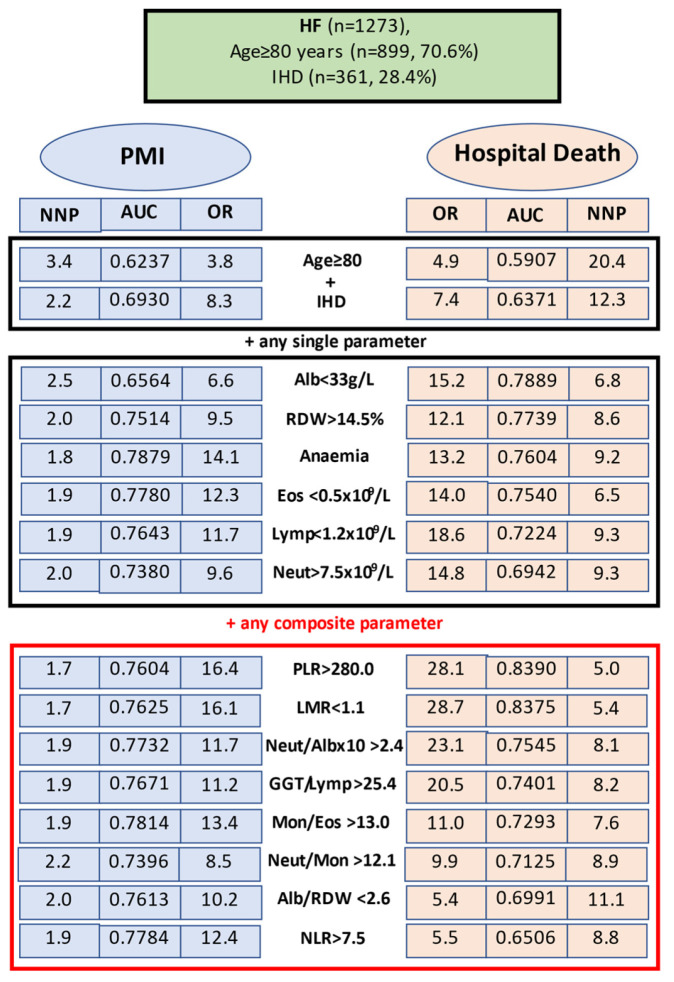
: This study, based on the concept of immuno-inflammatory-metabolic (IIM) dysregulation, investigated and compared the prognostic impact of 27 indices at admission for prediction of postoperative myocardial injury (PMI) and/or hospital death in hip fracture (HF) patients. : In consecutive HF patient (n = 1273, mean age 82.9 ± 8.7 years, 73.5% females) demographics, medical history, laboratory parameters, and outcomes were recorded prospectively. Multiple logistic regression and receiver-operating characteristic analyses (the area under the curve, AUC) were used to establish the predictive role for each biomarker. : Among 27 IIM biomarkers, 10 indices were significantly associated with development of PMI and 16 were indicative of a fatal outcome; in the subset of patients aged >80 years with ischaemic heart disease (IHD, the highest risk group: 90.2% of all deaths), the corresponding figures were 26 and 20. In the latter group, the five strongest preoperative predictors for PMI were anaemia (AUC 0.7879), monocyte/eosinophil ratio > 13.0 (AUC 0.7814), neutrophil/lymphocyte ratio > 7.5 (AUC 0.7784), eosinophil count < 1.1 × 10/L (AUC 0.7780), and neutrophil/albumin × 10 > 2.4 (AUC 0.7732); additionally, sensitivity was 83.1-75.4% and specificity was 82.1-75.0%. The highest predictors of in-hospital death were platelet/lymphocyte ratio > 280.0 (AUC 0.8390), lymphocyte/monocyte ratio < 1.1 (AUC 0.8375), albumin < 33 g/L (AUC 0.7889), red cell distribution width > 14.5% (AUC 0.7739), and anaemia (AUC 0.7604), sensitivity 88.2% and above, and specificity 85.1-79.3%. Internal validation confirmed the predictive value of the models. : Comparison of 27 IIM indices in HF patients identified several simple, widely available, and inexpensive parameters highly predictive for PMI and/or in-hospital death. The applicability of IIM biomarkers to diagnose and predict risks for chronic diseases, including OP/OF, in the preclinical stages is discussed.
本研究基于免疫 - 炎症 - 代谢(IIM)失调的概念,调查并比较了27项入院指标对髋部骨折(HF)患者术后心肌损伤(PMI)和/或医院死亡预测的预后影响。对连续的HF患者(n = 1273,平均年龄82.9±8.7岁,女性占73.5%)的人口统计学、病史、实验室参数和结局进行了前瞻性记录。采用多元逻辑回归和受试者操作特征分析(曲线下面积,AUC)来确定每个生物标志物的预测作用。在27种IIM生物标志物中,10项指标与PMI的发生显著相关,16项指标提示致命结局;在年龄>80岁的缺血性心脏病(IHD,最高风险组:占所有死亡人数的90.2%)患者亚组中,相应数字分别为26项和20项。在后一组中,术前预测PMI最强的五项指标为贫血(AUC 0.7879)、单核细胞/嗜酸性粒细胞比值>13.0(AUC 0.7814)、中性粒细胞/淋巴细胞比值>7.5(AUC 0.7784)、嗜酸性粒细胞计数< 1.1×10/L(AUC 0.7780)和中性粒细胞/白蛋白×10>2.4(AUC 0.7732);此外,敏感性为83.1 - 75.4%,特异性为82.1 - 75.0%。院内死亡的最强预测指标为血小板/淋巴细胞比值>280.0(AUC 0.8390)、淋巴细胞/单核细胞比值<1.1(AUC 0.8375)、白蛋白<33 g/L(AUC 0.7889)、红细胞分布宽度>14.5%(AUC 0.7739)和贫血(AUC 0.7604),敏感性在88.2%及以上,特异性为85.1 - 79.3%。内部验证证实了模型的预测价值。对HF患者的27项IIM指标进行比较,发现了几个简单、易于获取且成本低廉的参数,对PMI和/或院内死亡具有高度预测性。讨论了IIM生物标志物在临床前阶段诊断和预测包括骨质疏松症/骨质疏松性骨折(OP/OF)在内的慢性疾病风险的适用性。