Jacobs School of Medicine and Biomedical Sciences, University at Buffalo, The State University of New York, 955 Main Street, Buffalo, NY, 14203, USA.
University at Buffalo, The State University of New York, 12 Capen Hall, Buffalo, NY, 14260, USA.
BMC Cancer. 2024 Jul 13;24(1):838. doi: 10.1186/s12885-024-12615-w.
The National Comprehensive Cancer Network (NCCN) guideline recommends consideration of weekly cisplatin as an alternative option for patients with head and neck cancer undergoing definitive chemoradiation. However, in a recent phase III trial (ConCERT), 20% of patients treated with weekly cisplatin could not receive a total of 200 mg/m, and the association of low adherence to weekly cisplatin and cancer control outcomes remains unclear. To fill this knowledge gap, we performed an observational cohort study of patients with head and neck cancer undergoing definitive chemoradiation with weekly cisplatin.
Our institutional database was queried for patients with non-metastatic head and neck cancer who underwent definitive chemoradiation with weekly cisplatin (40 mg/m) between November 2007 and April 2023. Adherence to weekly cisplatin was defined as receiving at least 5 cycles with a total cumulative dose of 200 mg/m. Survival outcomes were evaluated using Kaplan-Meier method, log-rank tests, Cox proportional hazard multivariable (MVA) analyses. Logistic MVA was performed to identify variables associated with low adherence to weekly cisplatin. Fine-Gray MVA was performed to analyze failure outcomes with death as a competing event.
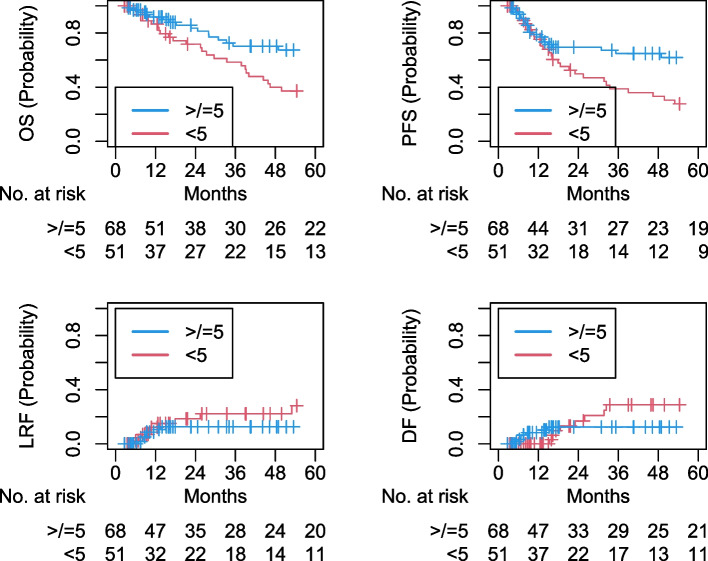
Among 119 patients who met our criteria, 51 patients (42.9%) had low adherence to weekly cisplatin. Median follow up was 19.8 months (interquartile range 8.8-65.6). Low adherence to weekly cisplatin was associated with worse overall survival (adjusted hazards ratio [aHR] 2.94, 95% confidence interval [CI] 1.58-5.47, p < 0.001) and progression-free survival (aHR 2.32, 95% CI 1.29-4.17, p = 0.005). It was also associated with worse distant failure (aHR 4.55, 95% CI 1.19-17.3, p = 0.03), but not locoregional failure (aHR 1.61, 95% CI 0.46-5.58, p = 0.46). KPS < 90 was the only variable associated with low adherence to weekly cisplatin (adjusted odds ratio [aOR] 2.67, 95% CI 1.10-6.65, p = 0.03).
Our study suggested that over 40% of patients underwent fewer than 5 weekly cisplatin cycles and that low adherence to weekly cisplatin was an independent, adverse prognostic factor for worse survival and distant failure outcomes. Those with reduced adherence to weekly cisplatin were more likely to have poor performance status. Further studies are warranted to improve the adherence to chemotherapy and outcomes.
美国国家综合癌症网络(NCCN)指南建议将每周顺铂视为头颈部癌患者接受根治性放化疗的替代选择。然而,在最近的一项 III 期试验(ConCERT)中,接受每周顺铂治疗的患者中有 20%无法接受总共 200mg/m2 的剂量,并且每周顺铂低依从性与癌症控制结果的关联仍不清楚。为了填补这一知识空白,我们对头颈部癌接受每周顺铂根治性放化疗的患者进行了一项观察性队列研究。
我们的机构数据库被查询了 2007 年 11 月至 2023 年 4 月期间接受每周顺铂(40mg/m2)根治性放化疗的非转移性头颈部癌症患者。每周顺铂的依从性定义为至少接受 5 个周期,总累积剂量为 200mg/m2。使用 Kaplan-Meier 方法、对数秩检验、Cox 比例风险多变量(MVA)分析评估生存结局。进行逻辑 MVA 以确定与每周顺铂低依从性相关的变量。进行 Fine-Gray MVA 以分析以死亡为竞争事件的失败结局。
在符合我们标准的 119 名患者中,有 51 名患者(42.9%)每周顺铂依从性较低。中位随访时间为 19.8 个月(四分位距 8.8-65.6)。每周顺铂低依从性与总生存(调整后的危险比 [aHR] 2.94,95%置信区间 [CI] 1.58-5.47,p<0.001)和无进展生存(aHR 2.32,95%CI 1.29-4.17,p=0.005)更差相关。它还与远处失败(aHR 4.55,95%CI 1.19-17.3,p=0.03)更差相关,但与局部区域失败(aHR 1.61,95%CI 0.46-5.58,p=0.46)无关。KPS<90 是与每周顺铂低依从性相关的唯一变量(调整后的优势比[aOR] 2.67,95%CI 1.10-6.65,p=0.03)。
我们的研究表明,超过 40%的患者接受了少于 5 个每周顺铂周期,每周顺铂低依从性是总生存和远处失败结局更差的独立不良预后因素。那些对每周顺铂的依从性降低的患者更有可能表现出较差的身体状况。需要进一步研究以提高化疗的依从性和结果。