Mohammed Rehab A, Sultan Intessar, Shamakh Abdulrahman A, Balamesh Adnan A, Kishta Ahmed J, Alkhotani Loai A
Internal Medicine, Ibn Sina National College for Medical Studies, Jeddah, SAU.
Internal Medicine, Al-Azhar University Faculty of Medicine for Girls, Cairo, EGY.
Cureus. 2024 Jun 11;16(6):e62201. doi: 10.7759/cureus.62201. eCollection 2024 Jun.
Syncope and other transient loss of consciousness episodes in crowded and unfamiliar environments may lead to major health hazards. Despite numerous publications, data on syncope among Hajj pilgrims in Makkah is lacking.
To identify the triggers, risk factors, and prevalence of syncope and other transient loss of consciousness episodes among domestic pilgrims.
This cross-sectional study included a convenient sample of domestic pilgrims who performed Hajj in July 2023 using an online Google Forms questionnaire (Alphabet Inc., Mountain View, CA).
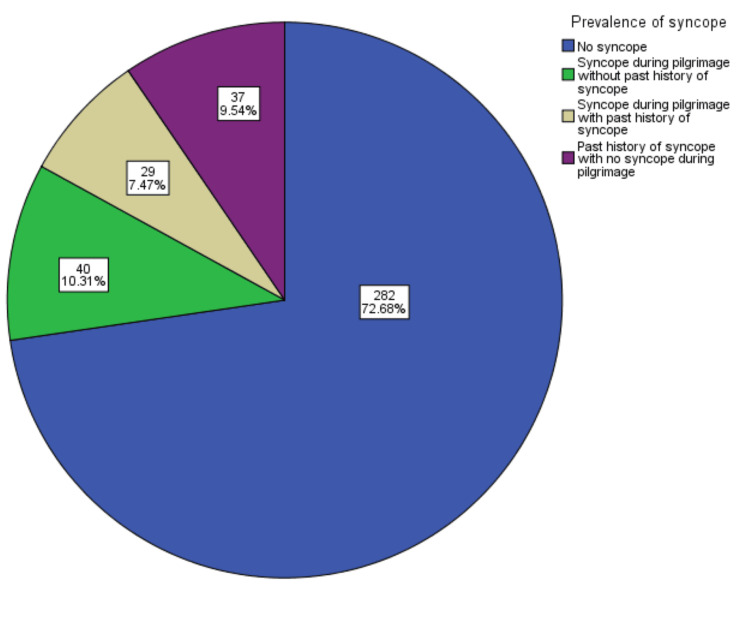
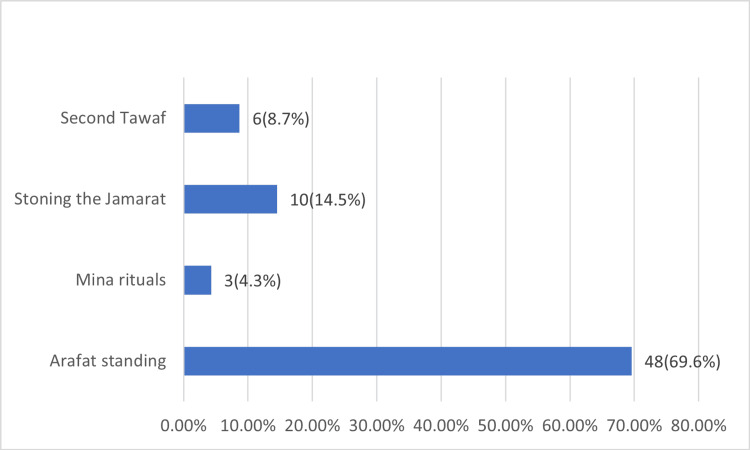
Out of 388 participants, 69 (18.1%) reported a history of syncope during the Hajj pilgrimage. Among these, 57 (82.6%) reported complete loss of consciousness, and 56 (81.2%) noted warning symptoms preceding the episode. The syncopal attack occurred once in 49 respondents (71%). Several triggers for syncope were identified, with sudden standing from a sitting position being the most prevalent (100%). Additional co-triggers were crowding (n=43; 62.3%), stressful conditions (n=30; 43.2%), prolonged standing (n=21; 30.4%), and walking (n=11; 15.9%). Traumatic injuries were reported in 33 (47.8%) as a result of syncope. Standing for long periods of time on the day of Arafat (Arafat standing) emerged as the most common triggering situation (n=48; 69.6%). There were multiple medical factors contributing to syncopal episodes; the most common medical explanations were heat exhaustion (n=48; 69.6%), dehydration (n=24; 34.8%), over-exertion (n=48; 69.6%), low blood sugar (n=10; 14.5%), and low blood pressure (n=17; 24.6%). Significant predictors were the presence of cardiac disease (odd ratio (OR) 7.6, 95% confidence interval (CI) 2.71-21.45, p<0.001), anemia (OR 2.5, 95% CI 1.01-6.09, p=0.049), previous syncope (OR 2.5, 95% CI 1.02-6.27, p=0.049, and family history of syncope (OR 10.1, 95% CI 2.08-49.32, p=0.004).
Syncope during the domestic Hajj pilgrimage is frequent, especially on the day of Arafat, and carries the risk of traumatic injury. People with previous episodes of syncope and comorbidities, especially cardiac patients and those who have a family history of syncope, are particularly prone to this risk. Healthcare should focus on at-risk patients, particularly on critical pilgrimage days, and increase pilgrims' awareness about triggers of syncope including sudden and prolonged standing, exertion, and heat exposure.
在拥挤且不熟悉的环境中发生的晕厥及其他短暂性意识丧失事件可能会导致重大健康危害。尽管已有大量相关文献发表,但关于麦加朝觐者晕厥情况的数据仍很缺乏。
确定国内朝觐者中晕厥及其他短暂性意识丧失事件的触发因素、风险因素和患病率。
这项横断面研究纳入了一个方便样本,即2023年7月通过在线谷歌表单问卷(谷歌公司,加利福尼亚州山景城)完成朝觐的国内朝觐者。
在388名参与者中,69人(18.1%)报告在朝觐期间有晕厥病史。其中,57人(82.6%)报告完全意识丧失,56人(81.2%)指出发作前有预警症状。49名受访者(71%)晕厥发作过一次。确定了几种晕厥触发因素,其中最常见的是从坐姿突然站起(100%)。其他共同触发因素包括拥挤(n = 43;62.3%)、压力状况(n = 30;43.2%)、长时间站立(n = 21;30.4%)和行走(n = 11;15.9%)。33人(47.8%)因晕厥报告有创伤性损伤。在阿拉法特日长时间站立(阿拉法特站立)是最常见的触发情况(n = 48;69.6%)。有多种医学因素导致晕厥发作;最常见的医学解释是中暑衰竭(n = 48;69.6%)、脱水(n = 24;34.8%)、过度劳累(n = 48;69.6%)、低血糖(n = 10;14.5%)和低血压(n = 17;24.6%)。重要的预测因素包括患有心脏病(比值比(OR)7.6,95%置信区间(CI)2.71 - 21.45,p < 0.001)、贫血(OR 2.5,95% CI 1.01 - 6.09,p = 0.049)、既往晕厥史(OR 2.5,95% CI 1.02 - 6.27,p = 0.049)以及晕厥家族史(OR 10.1,95% CI 2.08 - 49.32,p = 0.004)。
国内朝觐期间晕厥很常见,尤其是在阿拉法特日,并且存在创伤性损伤风险。有既往晕厥发作史和合并症的人,特别是心脏病患者和有晕厥家族史的人,尤其容易面临这种风险。医疗保健应关注高危患者,特别是在关键的朝觐日,并提高朝觐者对晕厥触发因素的认识,包括突然和长时间站立、劳累及受热。