Department of Animal and Veterinary Sciences, Clemson University, Clemson, SC, United States of America.
South Carolina Translational Research Improving Musculoskeletal Health Center, Clemson, SC, United States of America.
PLoS One. 2024 Jul 15;19(7):e0307114. doi: 10.1371/journal.pone.0307114. eCollection 2024.
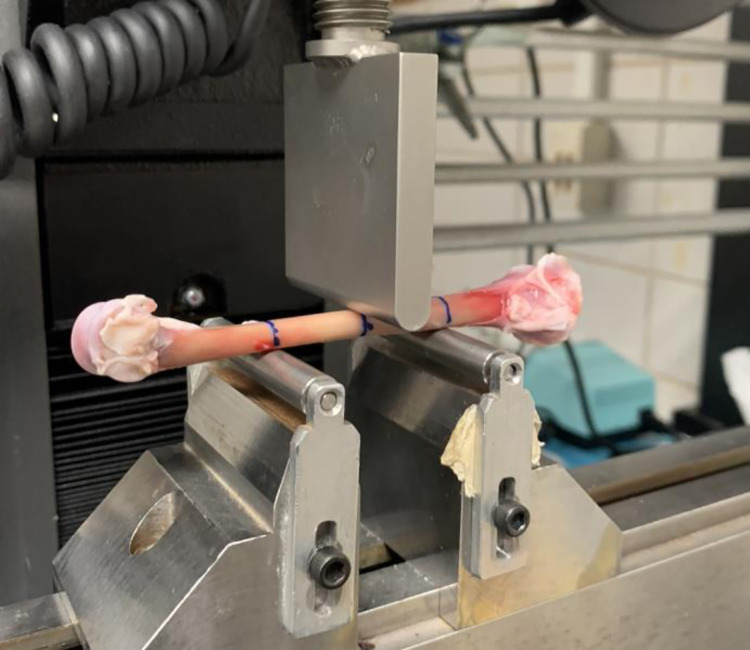
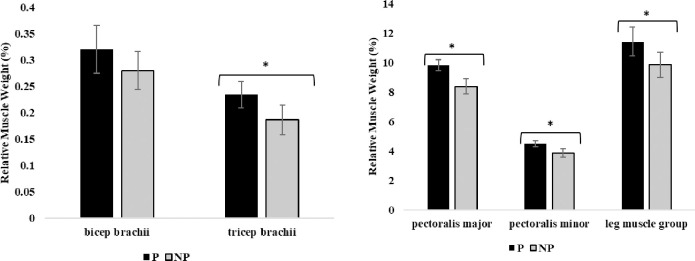
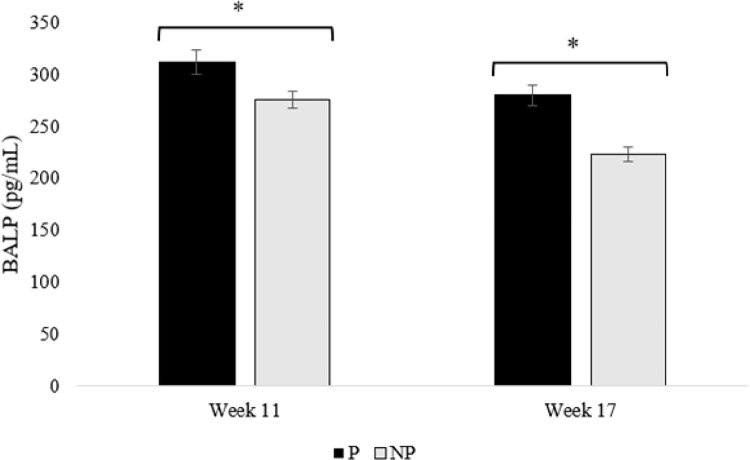
Prior research suggests exercise during pullet rearing can mitigate lay-phase bone fractures by strengthening muscles, enhancing balance, and increasing bone mass. This study aimed to confirm that Hy-Line brown pullets with multi-tier perches show increased activity and improved musculoskeletal health. Pullets (n = 810) were randomly allocated to housing systems, either with multi-tier perches (P; n = 15 pens) or without (NP; n = 15 pens), spanning from 0-17 weeks of age. At 5, 11, and 17 weeks, individual birds were meticulously monitored for activity using accelerometers over three consecutive days (n = 90 randomly selected birds/week). At 11 and 17 weeks, 60 birds underwent euthanasia and computed tomography (CT) scans to ascertain tibiotarsal bone mineral density and cross-sectional area measurements. Post-CT scanning, birds were dissected for muscle size, tibiotarsal breaking strength, and tibiotarsal ash percentage measurements. Additionally, serum concentrations of bone-specific alkaline phosphatase and procollagen type 1 N-terminal propeptide were assessed as markers of bone formation (n = 90 birds/week). Pullet group P exhibited heightened vertical activity (P<0.05), with no discernible differences in overall activity (P>0.05) during weeks 5, 11, and 17 compared to group NP. Tibiotarsal bones of P pullets demonstrated superior total and cortical bone mineral density at week 11, alongside increased cortical bone cross-sectional areas and heightened total and cortical bone mineral densities at week 17 (P<0.05) compared to NP pullets. At week 11, P pullets displayed larger leg muscles, including triceps, pectoralis major and minor, and leg muscles at week 17 (P<0.05) compared to NP pullets. Notably, at both weeks, P pullets' tibiae exhibited greater breaking strengths, higher ash percentages, and elevated concentrations of bone-specific alkaline phosphatase and procollagen type 1 N-terminal propeptide compared to NP pullets (P<0.05). The study findings underscore the benefits of providing multi-tier perches for pullets, serving as a valuable tool for enhancing bird activity and musculoskeletal health preceding the lay phase.
先前的研究表明,在育雏期进行运动可以通过增强肌肉、提高平衡能力和增加骨量来减轻产蛋期的骨折。本研究旨在证实,具有多层栖息架的海兰褐育成鸡表现出更高的活动量和改善的肌肉骨骼健康。将 810 只育成鸡(n = 810)随机分配到饲养系统中,一组有多层栖息架(P;n = 15 个鸡笼),另一组没有(NP;n = 15 个鸡笼),从 0-17 周龄。在 5、11 和 17 周龄时,使用加速度计连续三天(每周 90 只随机选择的鸡)对个体鸡进行精细的活动监测。在 11 和 17 周龄时,对 60 只鸡进行安乐死,并进行计算机断层扫描(CT)扫描,以确定胫骨骨干矿物质密度和横截面积测量值。在 CT 扫描后,对鸡进行解剖以测量肌肉大小、胫骨骨干断裂强度和胫骨骨干灰分百分比。此外,还评估了血清骨特异性碱性磷酸酶和前胶原 1 N 端前肽的浓度,作为骨形成的标志物(每周 90 只鸡)。与 NP 组相比,P 组育成鸡的垂直活动增加(P<0.05),但在第 5、11 和 17 周龄时,总体活动无明显差异(P>0.05)。与 NP 育成鸡相比,P 组育成鸡在第 11 周时胫骨骨干的总骨密度和皮质骨密度更高,在第 17 周时胫骨骨干的皮质骨横截面积更大,总骨密度和皮质骨密度更高(P<0.05)。在第 11 周时,P 组育成鸡的腿部肌肉(包括三头肌、胸大肌和胸小肌)和第 17 周的腿部肌肉比 NP 组育成鸡更大(P<0.05)。值得注意的是,在这两周,P 组育成鸡的胫骨表现出更高的断裂强度、更高的灰分百分比以及更高的骨特异性碱性磷酸酶和前胶原 1 N 端前肽浓度,与 NP 组育成鸡相比(P<0.05)。研究结果强调了为育成鸡提供多层栖息架的好处,为增强鸟类在产蛋期前的活动量和肌肉骨骼健康提供了一种有价值的工具。