Department of Laboratory Medicine, The Children's Hospital, Zhejiang University School of Medicine, National Clinical Research Center for Child Health, National Children's Regional Medical Center, Hangzhou, 310052, China.
Sir Run Run Shaw Hospital, Zhejiang University School of Medicine, Hangzhou, China.
Sci Rep. 2024 Jul 15;14(1):16312. doi: 10.1038/s41598-024-67580-y.
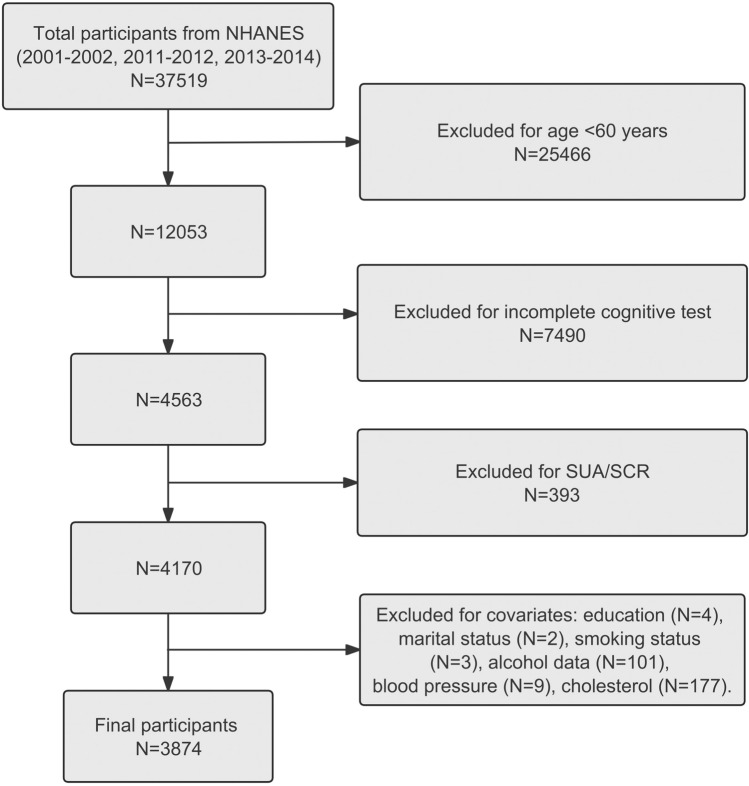
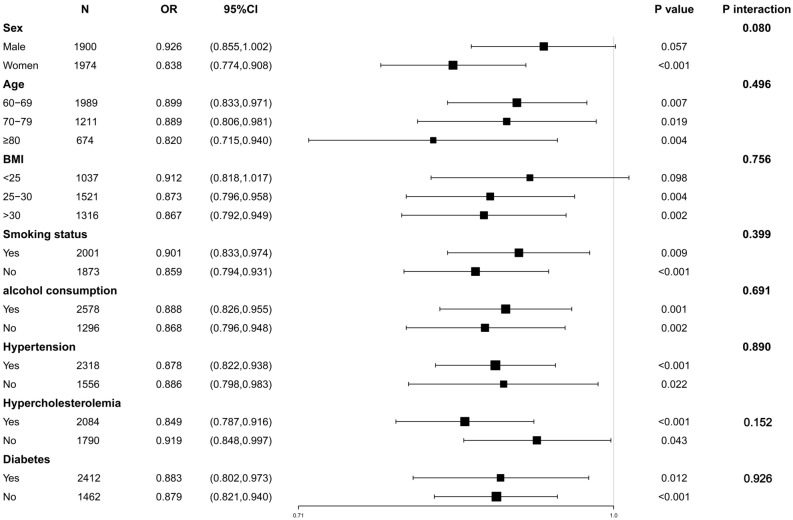
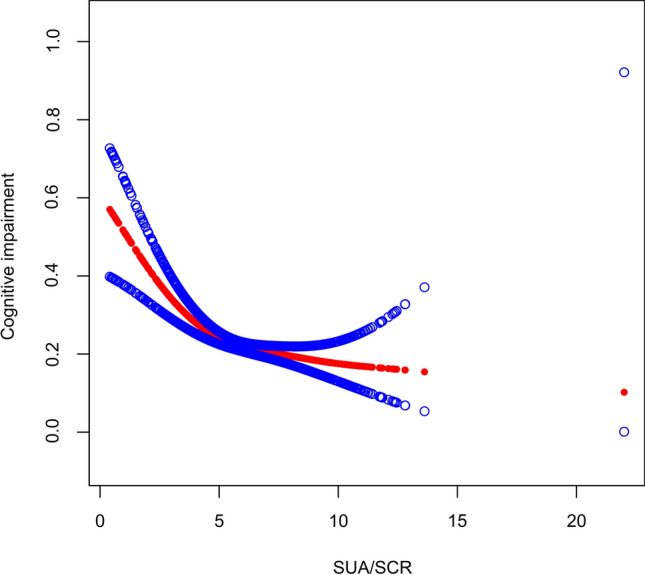
Cognitive impairment can potentially become a significant health concern in older adults. However, early effective diagnostic methods are still lacking. Therefore, we utilized the NHANES database in the US to investigate the relationship between serum uric acid to serum creatinine (SUA/SCR) ratio and cognitive impairment. In our study, a total of 3874 participants were included (2001-2002, 2011-2014). Weighted t tests or chi-square tests were utilized to analyze the basic characteristics of the population. Weighted logistic regression analysis, smooth-fit curves, threshold effects, and subgroup analysis were conducted to investigate the correlation between the SUA/SCR and cognitive impairment. In this study, the SUA/SCR was significantly lower in individuals with cognitive impairment. The logistic regression model, after adjusting for all covariates, revealed that the Q2-Q4 were 0.65 (95% CI 0.49, 0.86), 0.60 (95% CI 0.40, 0.90), 0.55 (95% CI 0.39, 0.77) respectively. This indicates that participants in the Q4 had a 45% reduced risk of cognitive impairment. Smooth-fit curves and threshold effect analysis revealed a nonlinear relationship between SUA/SCR and cognitive impairment, with a turning point at 4.13. Subgroup analysis showed no statistically significant differences in the relationship between SUA/SCR and cognitive impairment among different subgroups (P > 0.05). Our findings indicate a negative correlation between the SUA/SCR and the risk of cognitive impairment in the population of adults aged 60 and above in the US. This suggests that the SUA/SCR holds promise as a potential indicator for cognitive impairment.
认知障碍在老年人中可能成为一个重大的健康问题。然而,目前仍然缺乏早期有效的诊断方法。因此,我们利用美国 NHANES 数据库研究了血清尿酸与血清肌酐(SUA/SCR)比值与认知障碍之间的关系。在我们的研究中,共纳入了 3874 名参与者(2001-2002 年,2011-2014 年)。采用加权 t 检验或卡方检验分析人群的基本特征。采用加权逻辑回归分析、平滑拟合曲线、阈值效应和亚组分析来探讨 SUA/SCR 与认知障碍之间的相关性。在这项研究中,认知障碍患者的 SUA/SCR 显著降低。经过所有协变量调整后的逻辑回归模型显示,Q2-Q4 分别为 0.65(95%CI 0.49, 0.86)、0.60(95%CI 0.40, 0.90)、0.55(95%CI 0.39, 0.77)。这表明 Q4 组参与者认知障碍的风险降低了 45%。平滑拟合曲线和阈值效应分析显示,SUA/SCR 与认知障碍之间存在非线性关系,转折点在 4.13。亚组分析显示,SUA/SCR 与认知障碍之间的关系在不同亚组中没有统计学差异(P>0.05)。我们的研究结果表明,SUA/SCR 与美国 60 岁及以上成年人认知障碍的风险呈负相关。这表明 SUA/SCR 可能是认知障碍的一个潜在指标。