Quirino Monike Willemin, Schultz Carolini, Franz Michele Dos Passos Dezordi, Lucia Thomaz, Martelli Arthur, Gonçalves Paulo Bayard Dias, Ulguim Rafael da Rosa, Gasperin Bernardo Garziera, Bianchi Ivan
Mestrado Profissional em Produção e Sanidade Animal, Instituto Federal Catarinense, Araquari, SC, Brasil.
Núcleo de Pesquisa, Ensino e Extensão em Produção Animal, Instituto Federal Catarinense, Araquari, SC, Brasil.
Anim Reprod. 2024 Jul 15;21(2):e20230118. doi: 10.1590/1984-3143-AR2023-0118. eCollection 2024.
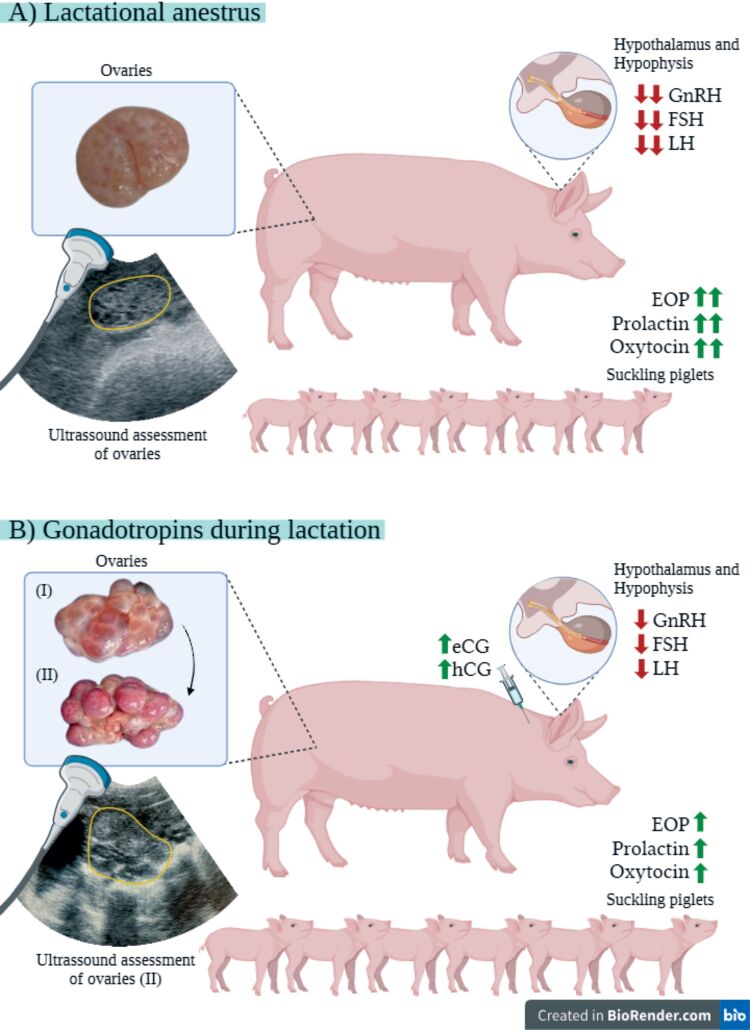
Treating lactating sows with chorionic gonadotropins may allow controlling their post-weaning reproductive function, despite the occurrence of anestrous during lactation. This article reviews the potential effectiveness of treatment with both equine and human chorionic gonadotropins (eCG and hCG, respectively) during lactation on the control of estrus expression and ovulation in weaned sows. The use of 1,000 IU hCG at 24 and 48 h postpartum may induce ovulation in the treated sows, but the ovulation rate may be variable. Pregnancy rates may be improved with combined treatment after the second week of lactation with both chorionic gonadotropins: 1,500 IU eCG plus 500 - 1,000 hCG; or 1,000 IU eCG plus 1,000 IU hCG. Treatment with eCG (1,000 - 2,000 IU) at the end of lactation may result in acceptable estrus expression and ovulation rates, although with marginal benefit for pregnancy rates. The subsequent response to treatments with chorionic gonadotropins during lactation is likely influenced by the treatment period, the suckling frequency during lactation, and the boar exposure during the weaning-to-estrus interval. A better understanding of the efficiency of such steroid-free treatments is increasingly relevant due to the constraints of the use of steroid hormones in livestock reproductive management.
尽管哺乳期间会出现乏情期,但用绒毛膜促性腺激素治疗哺乳母猪可能有助于控制其断奶后的繁殖功能。本文综述了哺乳期间使用马绒毛膜促性腺激素和人绒毛膜促性腺激素(分别为eCG和hCG)治疗对断奶母猪发情表达和排卵控制的潜在效果。产后24小时和48小时使用1000国际单位hCG可能会诱导接受治疗的母猪排卵,但排卵率可能存在差异。在哺乳第二周后联合使用两种绒毛膜促性腺激素进行治疗,妊娠率可能会提高:1500国际单位eCG加500 - 1000国际单位hCG;或1000国际单位eCG加1000国际单位hCG。在哺乳结束时使用eCG(1000 - 2000国际单位)治疗可能会产生可接受的发情表达和排卵率,尽管对妊娠率的益处不大。哺乳期间对绒毛膜促性腺激素治疗的后续反应可能受治疗时期、哺乳期间的哺乳频率以及断奶至发情间隔期间与公猪接触情况的影响。由于在畜牧繁殖管理中使用类固醇激素存在限制,更好地了解此类无类固醇治疗的效果变得越来越重要。