Department of Medicine, Clinica Medica, Surgery University Milano-Bicocca, Via Pergolesi 33, 20052, Monza, Milan, Italy.
Department of Medicine and Rehabilitation, Department of Medicine and Surgery, Policlinico Dii Monza, University Milano-Bicocca, Monza, Milan, Italy.
Clin Auton Res. 2024 Aug;34(4):437-445. doi: 10.1007/s10286-024-01054-z. Epub 2024 Jul 22.
Clinical trials have shown that in type 2 diabetes mellitus (T2D) resting office heart rate (HR) values > 70 beats/minute are associated with an increased cardiovascular risk, a worse prognosis and an unfavorable outcome. The present study was aimed at investigating whether the above mentioned treshold HR values reflect a sympathetic overdrive of marked degree.
In 58 T2D patients (age range: 39-57 years) without signs of autonomic neuropathy and in 52 age-matched healthy controls, we assessed muscle sympathetic nerve activity (MSNA, microneurography) and venous plasma norepinephrine (NE, HPLC), subdividing the study population in different subgroups according to their clinic and 24-h HR values.
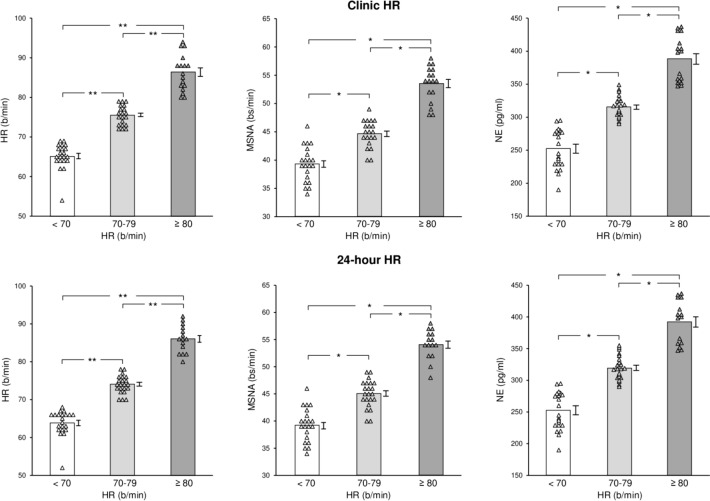
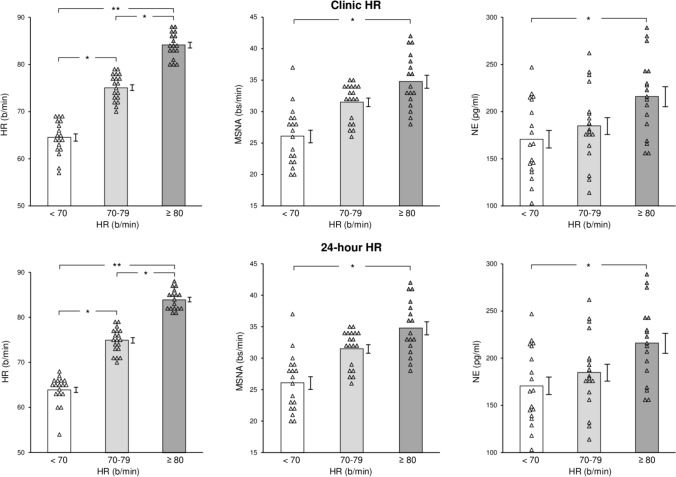
In T2D progressively greater clinic and 24-h HR values were accompanied by progressive increases in MSNA and NE. HR cutoff values indicated by clinical trials as associated with an increased cardiovascular risk (> 70 beats/minute) were accompanied by MSNA values significantly higher than those detected in patients with lower HR, this being the case also for NE. In T2D both MSNA and NE were significantly related to clinic (r = 0.93, P < 0.0001 and r = 0.87, P < 0.0001, respectively) and 24-h (r = 0.92, P < 0.0001 and r = 0.84, P < 0.0001, respectively) HR. The MSNA and NE behaviour observed in T2D was not detected in healthy controls.
In T2D clinic HR values allow to detect patients with a greater sympathetic overactivity. Considering the adverse clinical impact of the sympathetic overdrive on prognosis, our data emphasize the need of future studies investigating the potential usefulness of lifestyle and pharmacological interventions exerting sympathomodulatory effects.
临床试验表明,2 型糖尿病(T2D)患者静息时的心率(HR)值>70 次/分钟与心血管风险增加、预后不良和不利结局相关。本研究旨在探讨上述 HR 值是否反映了明显程度的交感神经兴奋过度。
在 58 例无自主神经病变迹象的 T2D 患者(年龄 39-57 岁)和 52 名年龄匹配的健康对照者中,我们评估了肌肉交感神经活动(MSNA,微神经记录)和静脉血浆去甲肾上腺素(NE,HPLC),并根据患者的临床和 24 小时 HR 值将研究人群分为不同亚组。
在 T2D 中,逐渐增加的临床和 24 小时 HR 值伴随着 MSNA 和 NE 的逐渐增加。临床试验中与心血管风险增加相关的 HR 截断值(>70 次/分钟)伴随着 MSNA 值显著高于 HR 值较低的患者,NE 也是如此。在 T2D 中,MSNA 和 NE 均与临床(r=0.93,P<0.0001 和 r=0.87,P<0.0001)和 24 小时 HR(r=0.92,P<0.0001 和 r=0.84,P<0.0001)显著相关。在健康对照组中未观察到 T2D 中观察到的 MSNA 和 NE 行为。
在 T2D 中,临床 HR 值可用于检测交感神经过度活跃的患者。考虑到交感神经兴奋过度对预后的不利临床影响,我们的数据强调了未来研究调查具有交感神经调节作用的生活方式和药物干预的潜在有用性的必要性。