Aesthet Surg J. 2024 Nov 15;44(12):1317-1329. doi: 10.1093/asj/sjae162.
The BODY-Q is a widely used patient-reported outcome measure for comprehensive assessment of treatment outcomes specific to patients undergoing body contouring surgery (BCS). However, for the BODY-Q to be meaningfully interpreted and used in clinical practice, minimal important difference (MID) scores are needed. A MID is defined as the smallest change in outcome measure score that patients perceive as important.
The aim of this study was to determine BODY-Q MID estimates for patients undergoing BCS to enhance the interpretability of the BODY-Q.
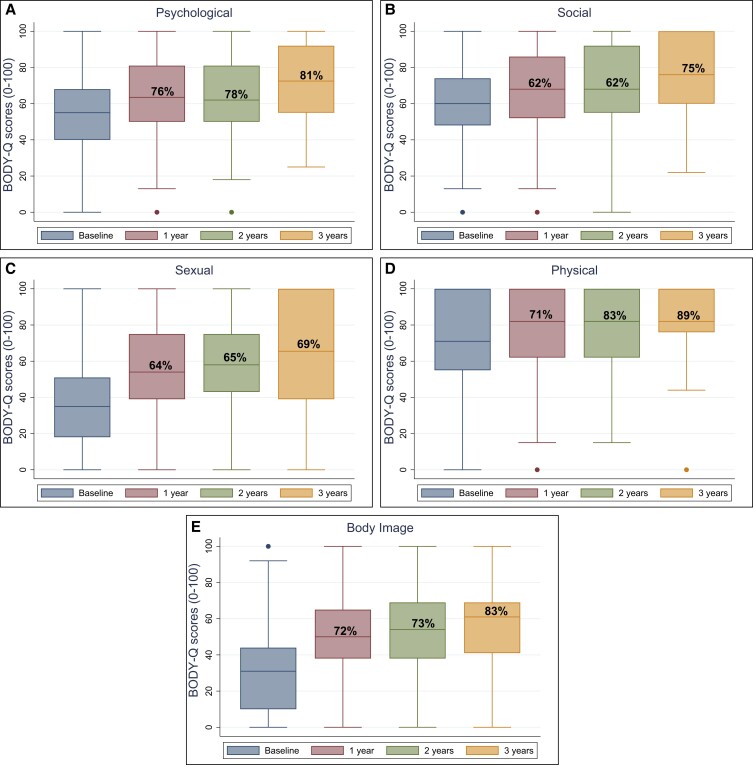
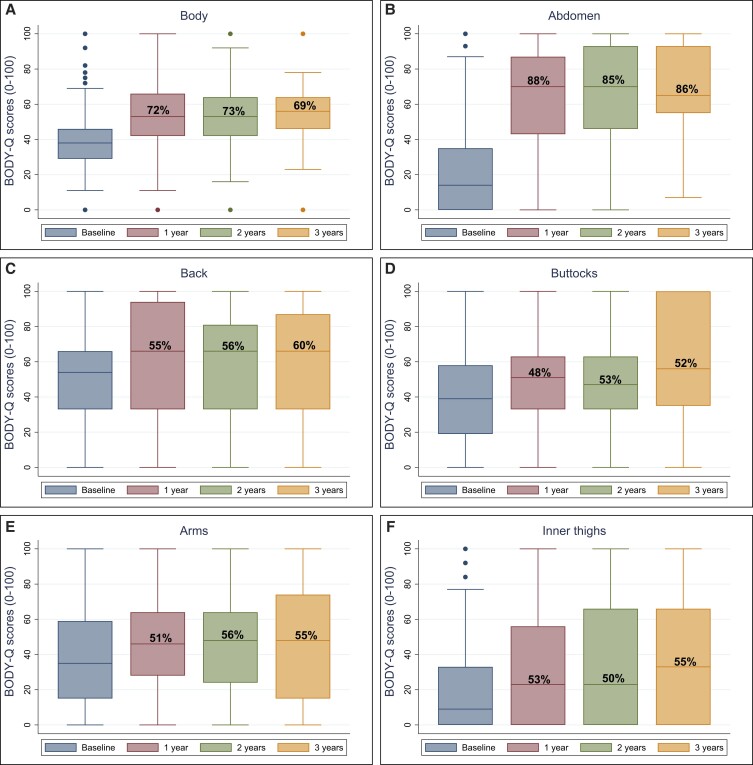
Data from an international, prospective cohort from Denmark, Finland, Germany, Italy, the Netherlands, and Poland were included. Two distribution-based methods were used to estimate MID: 0.2 standard deviations of mean baseline scores and the mean standardized response change of BODY-Q scores from baseline to 3 years postoperatively.
A total of 12,554 assessments from 3237 participants (mean age 42.5 ± 9.3 years; BMI 28.9 ± 4.9 kg/m2) were included. Baseline MID scores ranged from 1 to 5 on the health-related quality of life (HRQL) scales and 3 to 6 on the appearance scales. The estimated MID scores from baseline to 3-year follow-up ranged from 4 to 5 for HRQL and from 4 to 8 on the appearance scales.
The BODY-Q MID estimates from before BCS to 3 years postoperatively ranged from 4 to 8 and are recommended for interpretation of patients' BODY-Q scores, evaluation of treatment effects of different BCS procedures, and calculation of sample size for future studies.
BODY-Q 是一种广泛使用的患者报告结局测量工具,用于全面评估接受身体整形手术(BCS)的患者的治疗结果。然而,为了使 BODY-Q 在临床实践中具有意义并得到有效应用,需要确定最小临床重要差异(MID)评分。MID 定义为患者认为重要的结局测量评分的最小变化。
本研究旨在确定接受 BCS 的患者的 BODY-Q MID 估计值,以提高 BODY-Q 的可解释性。
纳入了来自丹麦、芬兰、德国、意大利、荷兰和波兰的国际前瞻性队列研究的数据。使用两种基于分布的方法来估计 MID:平均基线评分的 0.2 个标准差和从基线到术后 3 年 BODY-Q 评分的平均标准化反应变化。
共纳入了 3237 名参与者的 12554 次评估(平均年龄 42.5 ± 9.3 岁;BMI 28.9 ± 4.9 kg/m2)。基线 MID 评分在健康相关生活质量(HRQL)量表上的范围为 1 到 5,在外观量表上的范围为 3 到 6。从基线到 3 年随访的估计 MID 评分在 HRQL 量表上的范围为 4 到 5,在外观量表上的范围为 4 到 8。
从 BCS 前到术后 3 年的 BODY-Q MID 估计值范围为 4 到 8,建议用于解释患者的 BODY-Q 评分、评估不同 BCS 程序的治疗效果以及计算未来研究的样本量。