Division of Natural Sciences, German Archaeological Institute, Berlin, Germany.
Department of Archaeology, Durham University, Durham, UK.
Orphanet J Rare Dis. 2024 Jul 24;19(1):277. doi: 10.1186/s13023-024-03280-0.
The history of rare diseases is largely unknown. Research on this topic has focused on individual cases of prominent (historical) individuals and artistic (e.g., iconographic) representations. Medical collections include large numbers of specimens that exhibit signs of rare diseases, but most of them date to relatively recent periods. However, cases of rare diseases detected in mummies and skeletal remains derived from archaeological excavations have also been recorded. Nevertheless, this direct evidence from historical and archaeological contexts is mainly absent from academic discourse and generally not consulted in medical research on rare diseases.
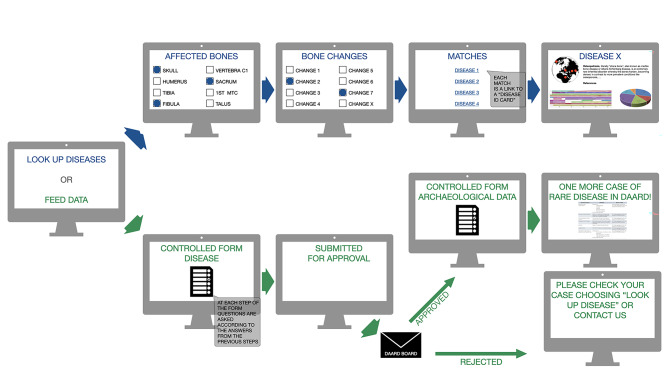
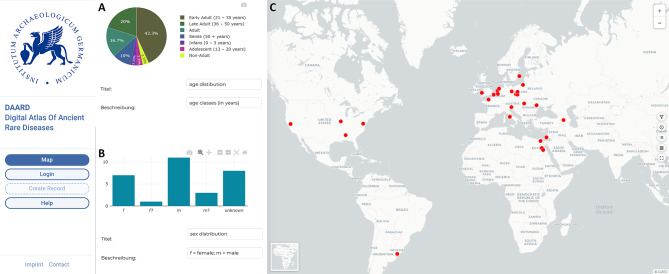
This desideratum is addressed by the Digital Atlas of Ancient Rare Diseases (DAARD: https://daard.dainst.org ), which is an open access/open data database and web-based mapping tool that collects evidence of different rare diseases found in skeletons and mummies globally and throughout all historic and prehistoric time periods. This easily searchable database allows queries by diagnosis, the preservation level of human remains, research methodology, place of curation and publications. In this manuscript, the design and functionality of the DAARD are illustrated using examples of achondroplasia and other types of stunted growth.
As an open, collaborative repository for collecting, mapping and querying well-structured medical data on individuals from ancient times, the DAARD opens new avenues of research. Over time, the number of rare diseases will increase through the addition of new cases from varied backgrounds such as museum collections and archaeological excavations. Depending on the research question, phenotypic or genetic information can be retrieved, as well as information on the general occurrence of a rare disease in selected space-time intervals. Furthermore, for individuals diagnosed with a rare disease, this approach can help them to build identity and reveal an aspect of their condition they might not have been aware of. Thus, the DAARD contributes to the understanding of rare diseases from a long-term perspective and adds to the latest medical research.
罕见病的历史在很大程度上是未知的。该主题的研究集中在突出(历史)个体和艺术(例如,图像)表现的个别病例上。医学收藏包括大量表现出罕见疾病迹象的标本,但其中大多数标本的日期都相对较近。然而,在从考古发掘中获得的木乃伊和骨骼遗骸中也记录了罕见疾病的病例。然而,这种来自历史和考古背景的直接证据主要不存在于学术话语中,并且通常在罕见病的医学研究中也没有被咨询。
这一需求由古代罕见疾病数字图集(DAARD:https://daard.dainst.org)来满足,这是一个开放获取/开放数据数据库和基于网络的映射工具,它收集了全球和整个历史和史前时期在骨骼和木乃伊中发现的不同罕见疾病的证据。这个易于搜索的数据库允许通过诊断、人类遗骸的保存水平、研究方法、保管地点和出版物进行查询。在本文中,使用软骨发育不全症和其他类型生长迟缓的例子来说明 DAARD 的设计和功能。
作为一个收集、映射和查询来自古代个体的结构化良好的医学数据的开放、协作存储库,DAARD 开辟了新的研究途径。随着时间的推移,通过从博物馆收藏和考古发掘等不同背景中添加新病例,罕见疾病的数量将会增加。根据研究问题,可以检索到表型或遗传信息,以及在选定的时空间隔内罕见疾病的一般发生情况的信息。此外,对于被诊断出患有罕见疾病的个体,这种方法可以帮助他们建立身份认同感,并揭示他们可能不知道的病情的一个方面。因此,DAARD 从长期角度有助于理解罕见疾病,并为最新的医学研究做出贡献。