Chen Wensu, Faragli Alessandro, Goetze Collin, Zieschang Victoria, Weiss Karl Jakob, Hashemi Djawid, Beyer Rebecca, Hafermann Lorena, Stawowy Philipp, Kelle Sebastian, Doeblin Patrick
Department of Cardiology, Angiology and Intensive Care Medicine, Deutsches Herzzentrum der Charité, Augustenburger Platz 1, Berlin 13353, Germany.
Charité - Universitätsmedizin Berlin, corporate member of Freie Universität Berlin and Humboldt-Universität zu Berlin, Charitéplatz 1, Berlin 10117, Germany.
Eur Heart J Imaging Methods Pract. 2023 Sep 15;1(2):qyad022. doi: 10.1093/ehjimp/qyad022. eCollection 2023 Sep.
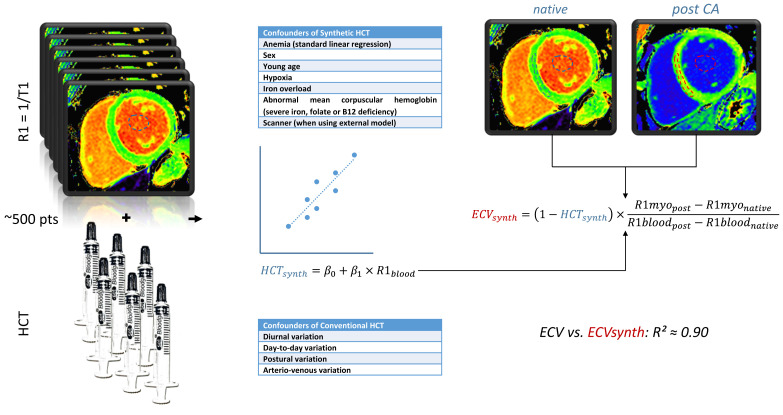
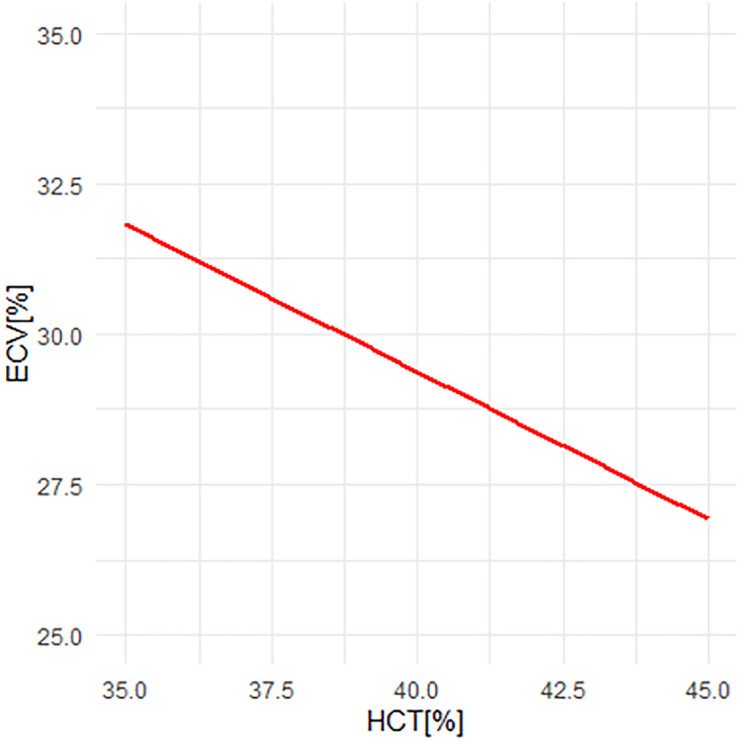
Cardiac magnetic resonance (CMR) 1 relaxation time mapping is an established technique primarily used to identify diffuse interstitial fibrosis and oedema. The myocardial extracellular volume (ECV) can be calculated from pre- and post-contrast 1 relaxation times and is a reproducible parametric index of the proportion of volume occupied by non-cardiomyocyte components in myocardial tissue. The conventional calculation of the ECV requires blood sampling to measure the haematocrit (HCT). Given the high variability of the HCT, the blood collection is recommended within 24 h of the CMR scan, limiting its applicability and posing a barrier to the clinical routine use of ECV measurements. In recent years, several research groups have proposed a method to determine the ECV by CMR without blood sampling. This is based on the inverse relationship between the 1 relaxation rate (1) of blood and the HCT. Consequently, a 'synthetic' HCT could be estimated from the native blood 1, avoiding blood sampling.
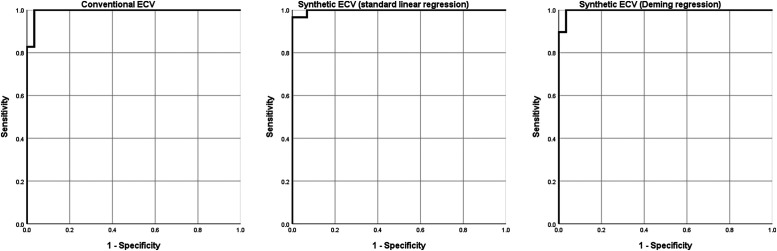
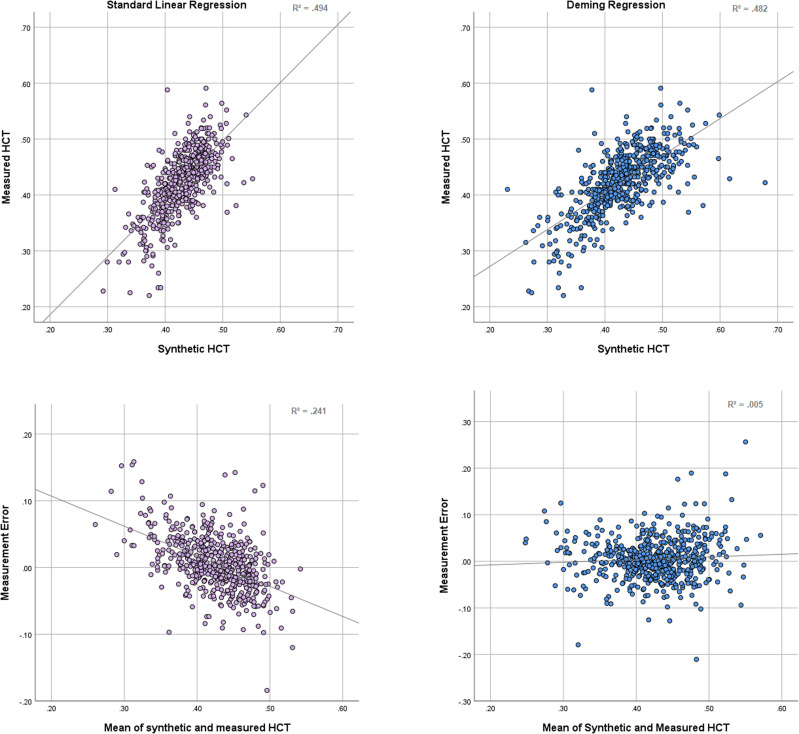
We performed a review and meta-analysis of published studies on synthetic ECV, as well as a secondary analysis of previously published data to examine the effect of the chosen regression modell on bias. While, overall, a good correlation and little bias between synthetic and conventional ECV were found in these studies, questions regarding its accuracy remain.
Synthetic HCT and ECV can provide a 'non-invasive' quantitative measurement of the myocardium's extracellular space when timely HCT measurements are not available and large alterations in ECV are expected, such as in cardiac amyloidosis. Due to the dependency of 1 relaxation times on the local setup, calculation of local formulas using linear regression is recommended, which can be easily performed using available data.
心脏磁共振(CMR)T1弛豫时间映射是一种成熟的技术,主要用于识别弥漫性间质纤维化和水肿。心肌细胞外容积(ECV)可根据对比剂注射前后的T1弛豫时间计算得出,是心肌组织中非心肌细胞成分所占容积比例的一个可重复的参数指标。传统的ECV计算需要采集血样来测量血细胞比容(HCT)。鉴于HCT的高度变异性,建议在CMR扫描后24小时内采集血样,这限制了其适用性,并对ECV测量在临床常规应用中构成了障碍。近年来,几个研究小组提出了一种无需采集血样即可通过CMR测定ECV的方法。这是基于血液的T1弛豫率(R1)与HCT之间的反比关系。因此,可以根据天然血液的R1估算出“合成”HCT,从而避免采集血样。
我们对已发表的关于合成ECV的研究进行了综述和荟萃分析,并对先前发表的数据进行了二次分析,以检验所选回归模型对偏差的影响。虽然总体而言,这些研究发现合成ECV与传统ECV之间具有良好的相关性且偏差较小,但其准确性仍存在问题。
当无法及时测量HCT且预计ECV会有较大变化时,如在心脏淀粉样变性中,合成HCT和ECV可以提供心肌细胞外间隙的“非侵入性”定量测量。由于T1弛豫时间依赖于局部设置,建议使用线性回归计算局部公式,这可以使用现有数据轻松完成。