Wiendl Heinz, Foley John, Defer Gilles, Zhovtis Ryerson Lana, Cohen Jeffrey A, Arnold Douglas L, Butzkueven Helmut, Cutter Gary R, Giovannoni Gavin, Killestein Joep, Domingo-Horne Rose, Toukam Marie, Nunn Aimie, Maghzi Amir-Hadi, Kuhelj Robert, Lasky Tyler
Department of Neurology with Institute of Translational Neurology, University of Münster, Albert-Schweitzer-Campus 1, Building A1, 48149, Münster, Germany.
Rocky Mountain MS Clinic, Salt Lake City, UT, USA.
Neurol Ther. 2024 Oct;13(5):1385-1401. doi: 10.1007/s40120-024-00647-0. Epub 2024 Jul 24.
Following NOVA (part 1) and the approval of the subcutaneous (SC) route of administration of natalizumab by the European Medicines Agency, an extension phase of the NOVA phase IIIb study (part 2) was initiated to collect patient preference data for SC versus intravenous (IV) dosing in patients receiving every-6-week (Q6W) dosing of natalizumab. This study was performed to evaluate patient preference for SC versus IV natalizumab administration and explore the efficacy, safety, and pharmacology characteristics of both routes of administration.
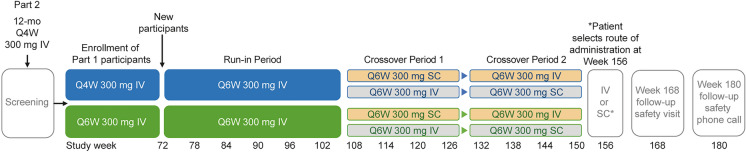
In part 2, participants received natalizumab (Tysabri) 300 mg via IV infusion Q6W for 36 weeks and then were randomized to 48 weeks of crossover treatment (24 weeks SC Q6W and 24 weeks IV Q6W, or vice versa). The primary endpoint was the proportion of participants who indicated a preference for natalizumab SC administration on the Patient Preference Questionnaire.
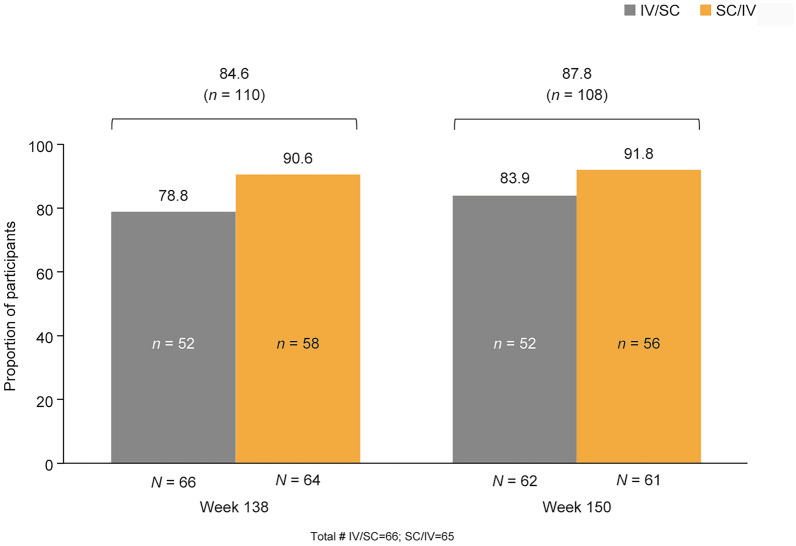
A total of 153 participants were randomized in NOVA part 2. Of 123 with patient preference data, 108 (87.8%) preferred the SC route of administration for natalizumab over the IV route; 102 (82.9%) specified "requires less time in the clinic" as the reason for the SC preference.
In NOVA (part 2), most participants on Q6W dosing of natalizumab preferred SC administration versus IV administration.
GOV: NCT03689972. INFOGRAPHIC.
继NOVA(第1部分)以及欧洲药品管理局批准那他珠单抗的皮下(SC)给药途径之后,启动了NOVA IIIb期研究的扩展阶段(第2部分),以收集接受每6周(Q6W)给药那他珠单抗的患者对SC与静脉内(IV)给药的偏好数据。进行这项研究是为了评估患者对那他珠单抗SC给药与IV给药的偏好,并探索两种给药途径的疗效、安全性和药理学特征。
在第2部分中,参与者每6周通过IV输注接受300mg那他珠单抗(泰萨比),持续36周,然后随机接受48周的交叉治疗(24周SC Q6W和24周IV Q6W,或反之)。主要终点是在患者偏好问卷上表明偏好那他珠单抗SC给药的参与者比例。
共有153名参与者在NOVA第2部分中被随机分组。在123名有患者偏好数据的参与者中,108名(87.8%)更喜欢那他珠单抗的SC给药途径而非IV给药途径;102名(82.9%)指定“在诊所花费时间更少”作为偏好SC给药的原因。
在NOVA(第2部分)中,大多数接受Q6W给药那他珠单抗的参与者更喜欢SC给药而非IV给药。
GOV:NCT03689972。信息图。