Department of Lymphoma/Myeloma, University of Texas MD Anderson Cancer Center, Houston, TX, USA.
UTHealth Houston McGovern Medical School, Houston, TX, USA.
JNCI Cancer Spectr. 2024 Jul 1;8(4). doi: 10.1093/jncics/pkae062.
Neighborhood socioeconomic deprivation has been linked to adverse health outcomes, yet it is unclear whether neighborhood-level social determinants of health (SDOH) measures affect overall survival in adolescent and young adult patients with cancer.
This study used a diverse cohort of adolescent and young adult patients with cancer (N = 10 261) seen at MD Anderson Cancer Center. Zip codes were linked to Area Deprivation Index (ADI) values, a validated neighborhood-level SDOH measure, with higher ADI values representing worse SDOH.
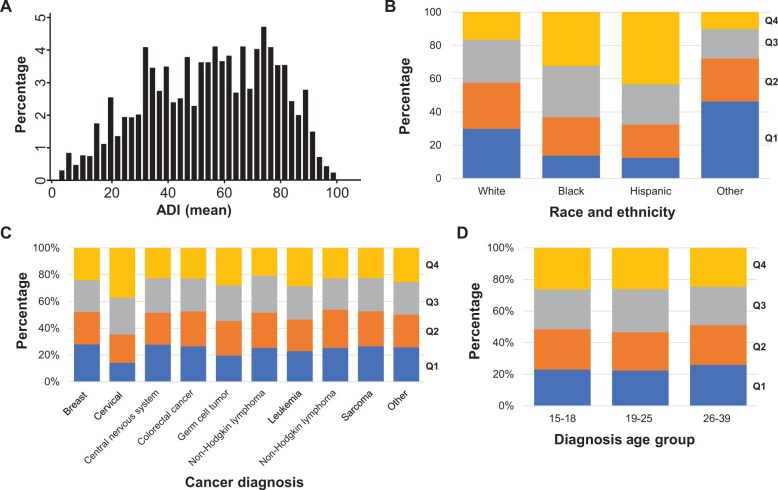
ADI was statistically significantly worse (P < .050) for Black (61.7) and Hispanic (65.3) patients than for White patients (51.2). Analysis of ADI by cancer type showed statistically significant differences, mainly driven by worse ADI in patients with cervical cancer (62.3) than with other cancers. In multivariable models including sex, age at diagnosis, cancer diagnosis, and race and ethnicity, risk of shorter survival for people residing in neighborhoods with the least favorable ADI quartile was greater than for individuals in the most favorable ADI quartile (hazard ratio = 1.09, 95% confidence interval = 1.00 to 1.19, P = .043).
Adolescent and young adult patients with cancer and the worst ADI values experienced a nearly 10% increase in risk of dying than patients with more favorable ADI values. This effect was strongest among White adolescent and young adult survivors. Although the magnitude of the effect of ADI on survival was moderate, the presence of a relationship between neighborhood-level SDOH and survival among patients who received care at a tertiary cancer center suggests that ADI is a meaningful predictor of survival. These findings provide intriguing evidence for potential interventions aimed at supporting adolescent and young adult patients with cancer from disadvantaged neighborhoods.
社区社会经济剥夺与不良健康结果相关,但尚不清楚社区层面的健康社会决定因素(SDOH)指标是否会影响青少年和年轻成年癌症患者的总体生存。
本研究使用了 MD 安德森癌症中心收治的不同种族青少年和年轻成年癌症患者的多样化队列(N=10261)。邮政编码与区域剥夺指数(ADI)值相关联,ADI 是一种经过验证的社区层面 SDOH 指标,ADI 值越高表示 SDOH 越差。
与白人患者(51.2)相比,黑人(61.7)和西班牙裔(65.3)患者的 ADI 明显更差(P<.050)。按癌症类型分析 ADI 时,发现存在统计学显著差异,主要是由于宫颈癌患者(62.3)的 ADI 更差。在包括性别、诊断时年龄、癌症诊断以及种族和民族的多变量模型中,居住在 ADI 最不利四分位数的街区的人群比居住在 ADI 最有利四分位数的人群的生存风险更高(风险比=1.09,95%置信区间=1.00 至 1.19,P=.043)。
患有癌症且 ADI 值最差的青少年和年轻成年患者的死亡风险比 ADI 值更有利的患者增加近 10%。这种影响在白人青少年和年轻成年幸存者中最强。尽管 ADI 对生存的影响幅度适中,但在接受三级癌症中心治疗的患者中,社区层面的 SDOH 与生存之间存在关系,这表明 ADI 是生存的一个有意义的预测指标。这些发现为针对来自贫困社区的青少年和年轻成年癌症患者的潜在干预措施提供了有趣的证据。