Guo Weiming, Liu Yuan, Han Yu, Tang Huan, Fan Xinyuan, Wang Chu, Chen Peng R
Synthetic and Functional Biomolecules Center, Beijing National Laboratory for Molecular Sciences, Key Laboratory of Bioorganic Chemistry and Molecular Engineering of Ministry of Education, College of Chemistry and Molecular Engineering, Peking University, Beijing 100871, China.
Peking-Tsinghua Center for Life Sciences, Academy for Advanced Interdisciplinary Studies, Peking University, Beijing 100871, China.
Natl Sci Rev. 2024 May 28;11(7):nwae183. doi: 10.1093/nsr/nwae183. eCollection 2024 Jul.
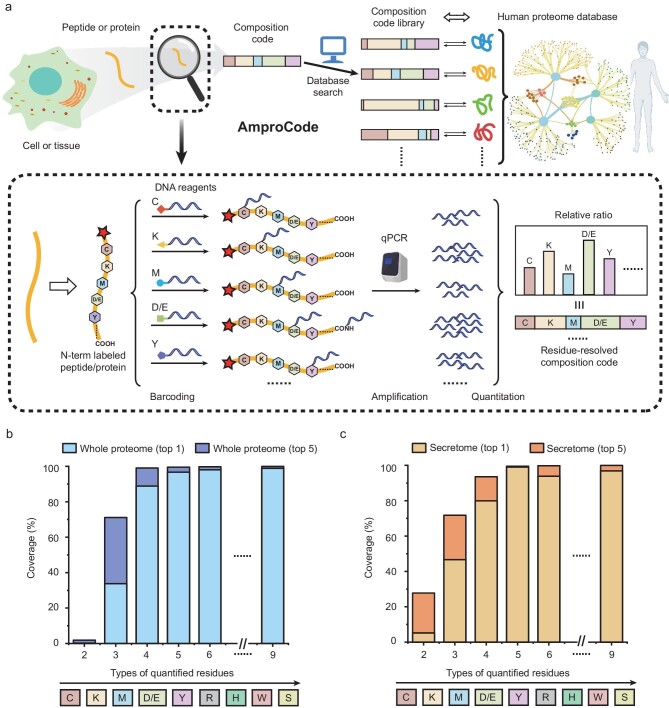
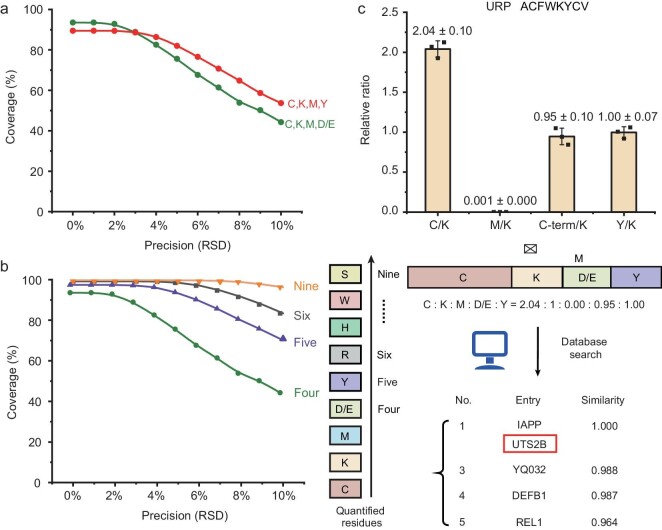
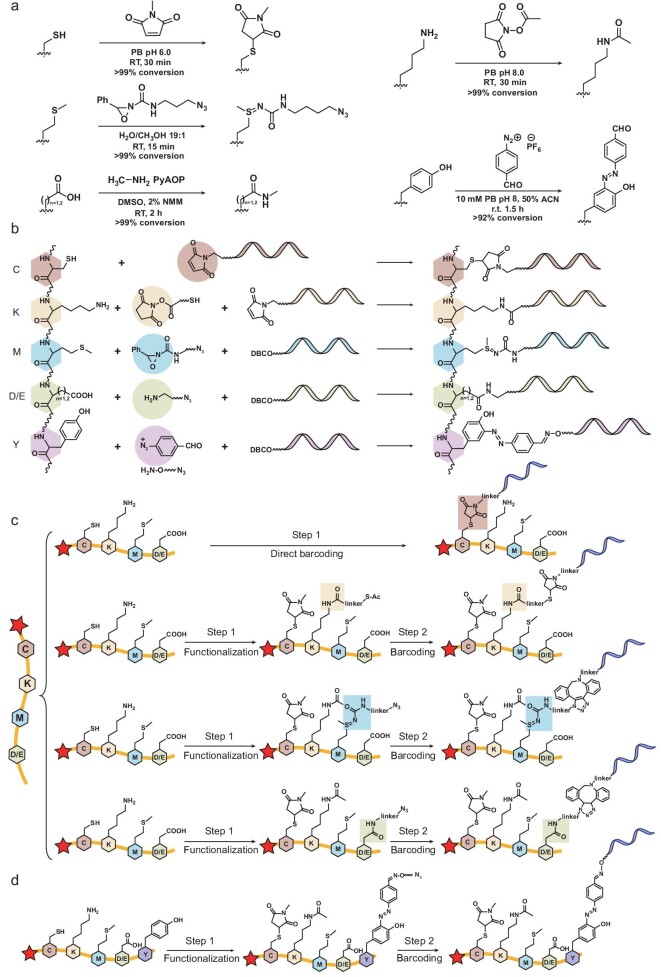
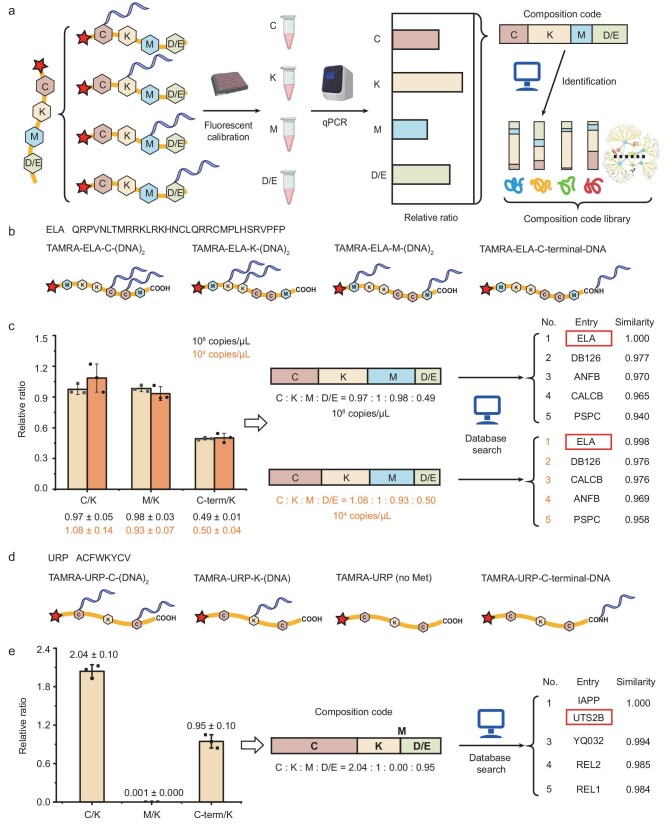
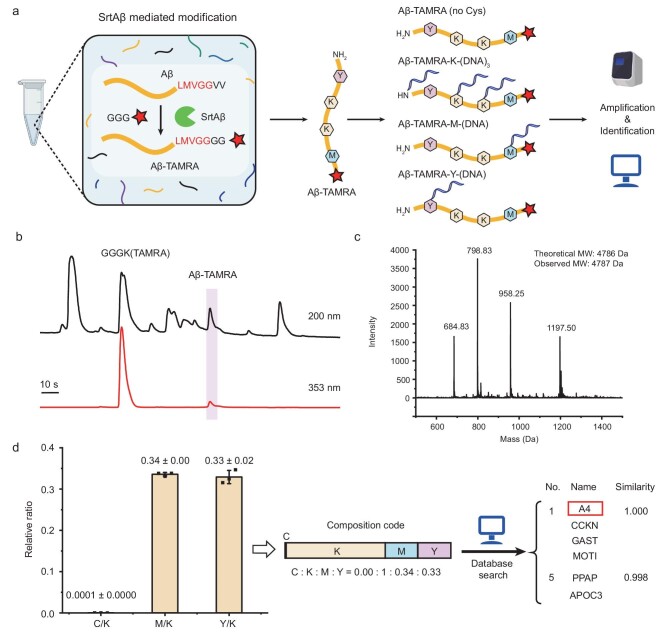
Ultrasensitive protein identification is of paramount importance in basic research and clinical diagnostics but remains extremely challenging. A key bottleneck in preventing single-molecule protein sequencing is that, unlike the revolutionary nucleic acid sequencing methods that rely on the polymerase chain reaction (PCR) to amplify DNA and RNA molecules, protein molecules cannot be directly amplified. Decoding the proteins via amplification of certain fingerprints rather than the intact protein sequence thus represents an appealing alternative choice to address this formidable challenge. Herein, we report a proof-of-concept method that relies on residue-resolved DNA barcoding and composition code counting for amplifiable protein fingerprinting (AmproCode). In AmproCode, selective types of residues on peptides or proteins are chemically labeled with a DNA barcode, which can be amplified and quantified via quantitative PCR. The operation generates a relative ratio as the residue-resolved 'composition code' for each target protein that can be utilized as the fingerprint to determine its identity from the proteome database. We developed a database searching algorithm and applied it to assess the coverage of the whole proteome and secretome via computational simulations, proving the theoretical feasibility of AmproCode. We then designed the residue-specific DNA barcoding and amplification workflow, and identified different synthetic model peptides found in the secretome at as low as the fmol/L level for demonstration. These results build the foundation for an unprecedented amplifiable protein fingerprinting method. We believe that, in the future, AmproCode could ultimately realize single-molecule amplifiable identification of trace complex samples without further purification, and it may open a new avenue in the development of next-generation protein sequencing techniques.
超灵敏蛋白质鉴定在基础研究和临床诊断中至关重要,但仍然极具挑战性。阻碍单分子蛋白质测序的一个关键瓶颈在于,与依靠聚合酶链反应(PCR)来扩增DNA和RNA分子的革命性核酸测序方法不同,蛋白质分子无法直接扩增。因此,通过扩增某些指纹而非完整的蛋白质序列来解码蛋白质,代表了应对这一艰巨挑战的一个有吸引力的替代选择。在此,我们报告一种概念验证方法,该方法依赖于基于残基解析的DNA条形码和用于可扩增蛋白质指纹识别(AmproCode)的组成代码计数。在AmproCode中,肽或蛋白质上特定类型的残基用DNA条形码进行化学标记,可通过定量PCR对其进行扩增和定量。该操作生成每个目标蛋白质的相对比率作为基于残基解析的“组成代码”,可用作指纹以从蛋白质组数据库中确定其身份。我们开发了一种数据库搜索算法,并通过计算模拟将其应用于评估整个蛋白质组和分泌蛋白质组的覆盖范围,证明了AmproCode的理论可行性。然后,我们设计了残基特异性DNA条形码和扩增工作流程,并在低至飞摩尔/升水平鉴定了分泌蛋白质组中发现的不同合成模型肽以进行演示。这些结果为一种前所未有的可扩增蛋白质指纹识别方法奠定了基础。我们相信,在未来,AmproCode最终可能无需进一步纯化就能实现对痕量复杂样品的单分子可扩增鉴定,并且可能为下一代蛋白质测序技术的发展开辟一条新途径。