Department of Endocrinology and Metabolism, Affiliated Hospital of Southwest Medical University, Luzhou, China.
Metabolic Vascular Disease Key Laboratory of Sichuan Province, Luzhou, China.
Front Cell Infect Microbiol. 2024 Jul 11;14:1421128. doi: 10.3389/fcimb.2024.1421128. eCollection 2024.
Some observational studies and clinical experiments suggest a close association between gut microbiota and metabolic diseases. However, the causal effects of gut microbiota on adrenal diseases, including Adrenocortical insufficiency, Cushing syndrome, and Hyperaldosteronism, remain unclear.
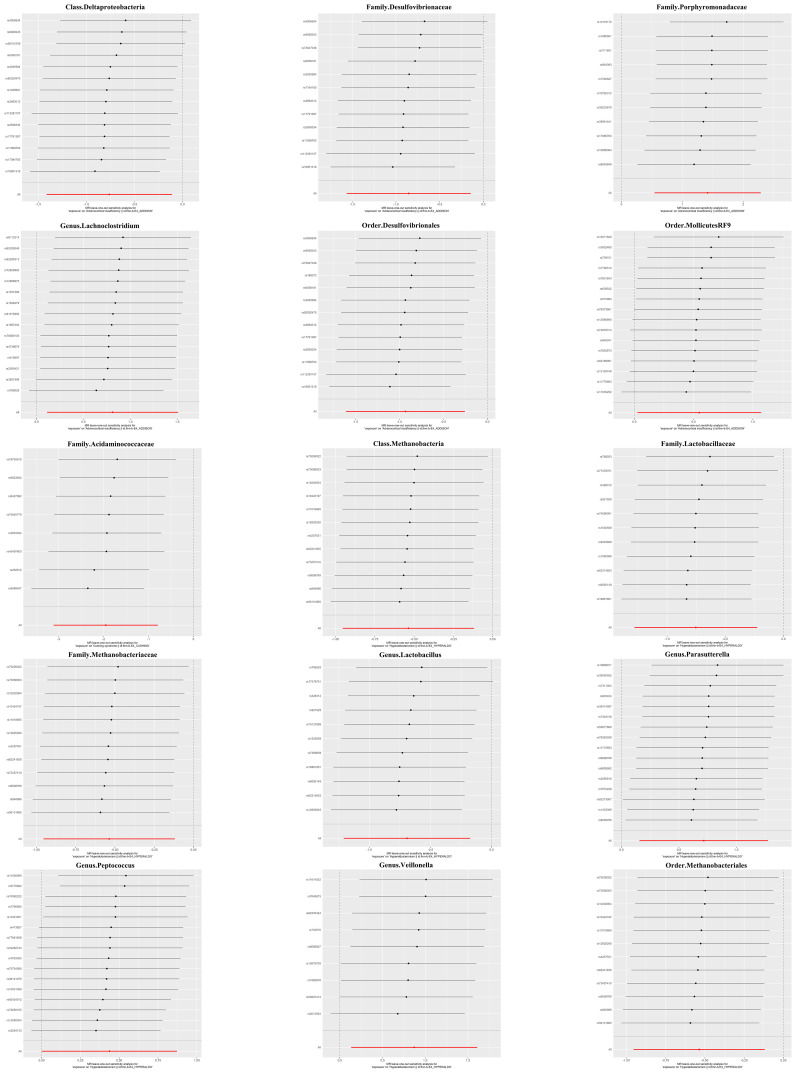
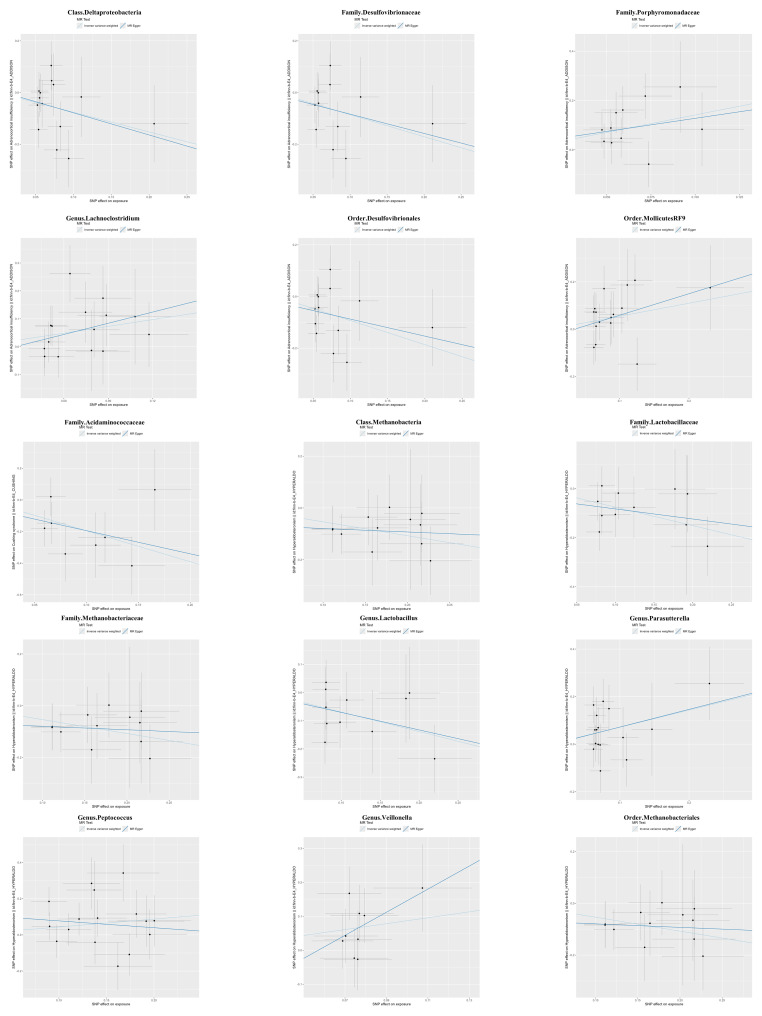
This study conducted a two-sample Mendelian randomization analysis using summary statistics data of gut microbiota from a large-scale genome-wide association study conducted by the MiBioGen Consortium. Summary statistics data for the three adrenal diseases were obtained from the FinnGen study. The study employed Inverse variance weighting, MR-Egger, and MR-PRESSO methods to assess the causal relationship between gut microbiota and these three adrenal diseases. Additionally, a reverse Mendelian randomization analysis was performed for bacteria found to have a causal relationship with these three adrenal diseases in the forward Mendelian randomization analysis. Cochran's Q statistic was used to test for heterogeneity of instrumental variables.
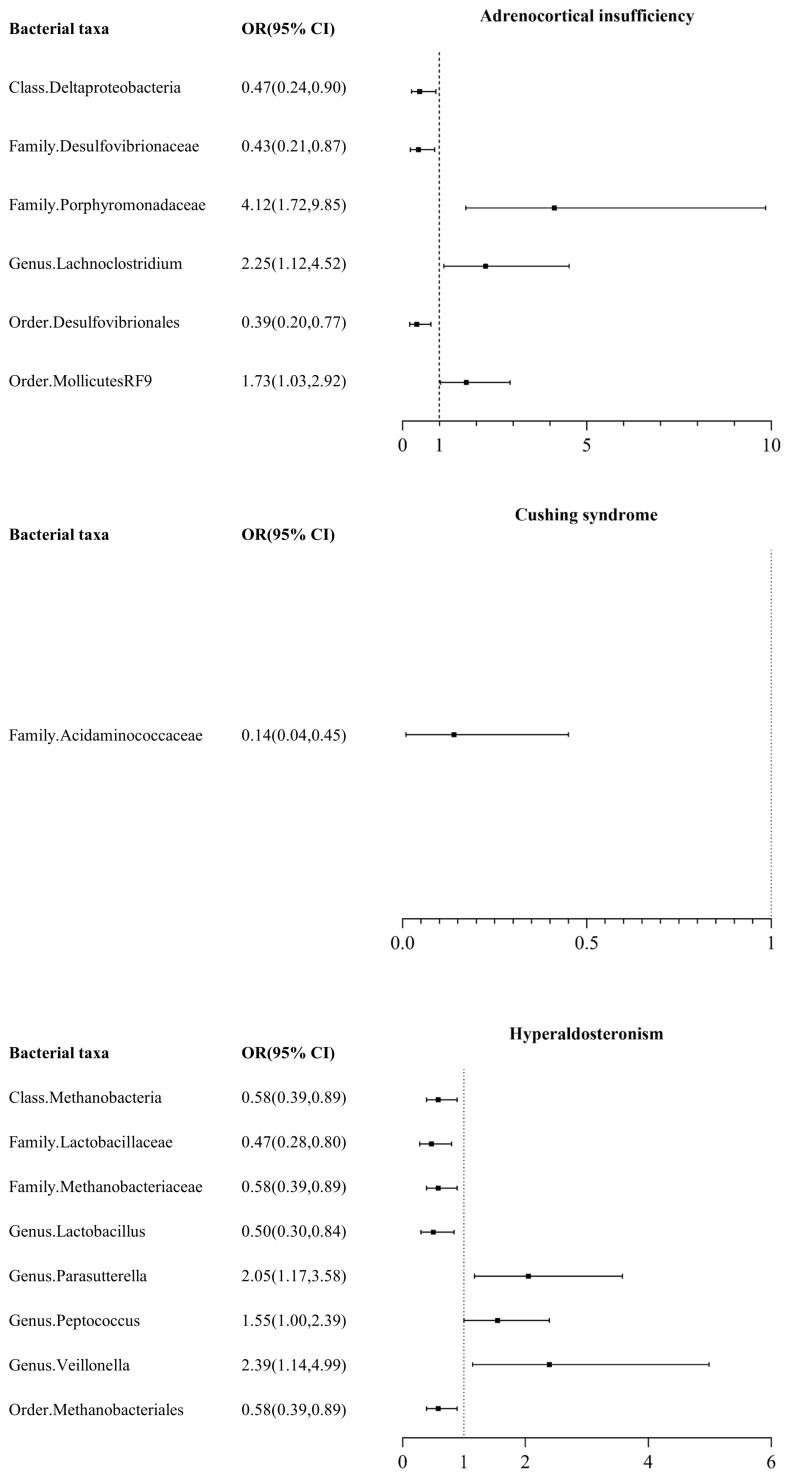
The IVW test results demonstrate that class Deltaproteobacteria, Family Desulfovibrionaceae, and Order Desulfovibrionales exhibit protective effects against adrenocortical insufficiency. Conversely, Family Porphyromonadaceae, Genus Lachnoclostridium, and Order MollicutesRF9 are associated with an increased risk of adrenocortical insufficiency. Additionally, Family Acidaminococcaceae confers a certain level of protection against Cushing syndrome. In contrast, Class Methanobacteria, Family Lactobacillaceae, Family Methanobacteriaceae, Genus. Lactobacillus and Order Methanobacteriales are protective against Hyperaldosteronism. Conversely, Genus Parasutterella, Genus Peptococcus, and Genus Veillonella are identified as risk factors for Hyperaldosteronism.
This two-sample Mendelian randomization analysis revealed a causal relationship between microbial taxa such as Deltaproteobacteria and Desulfovibrionaceae and Adrenocortical insufficiency, Cushing syndrome, and Hyperaldosteronism. These findings offer new avenues for comprehending the development of adrenal diseases mediated by gut microbiota.
一些观察性研究和临床实验表明,肠道微生物群与代谢性疾病密切相关。然而,肠道微生物群对包括肾上腺皮质功能不全、库欣综合征和醛固酮增多症在内的肾上腺疾病的因果影响尚不清楚。
本研究使用 MiBioGen 联盟进行的大规模全基因组关联研究中的肠道微生物组汇总统计数据进行了两样本孟德尔随机化分析。三种肾上腺疾病的汇总统计数据来自 FinnGen 研究。该研究采用逆方差加权、MR-Egger 和 MR-PRESSO 方法来评估肠道微生物群与这三种肾上腺疾病之间的因果关系。此外,对于在前向孟德尔随机化分析中与这三种肾上腺疾病具有因果关系的细菌,进行了反向孟德尔随机化分析。Cochran's Q 统计量用于检验工具变量的异质性。
IVW 检验结果表明,Class Deltaproteobacteria、Family Desulfovibrionaceae 和 Order Desulfovibrionales 对肾上腺皮质功能不全具有保护作用。相反,Family Porphyromonadaceae、Genus Lachnoclostridium 和 Order MollicutesRF9 与肾上腺皮质功能不全的风险增加相关。此外,Family Acidaminococcaceae 对库欣综合征具有一定的保护作用。相反,Class Methanobacteria、Family Lactobacillaceae、Family Methanobacteriaceae、Genus. Lactobacillus 和 Order Methanobacteriales 对醛固酮增多症具有保护作用。相反,Genus Parasutterella、Genus Peptococcus 和 Genus Veillonella 被确定为醛固酮增多症的危险因素。
这项两样本孟德尔随机化分析揭示了微生物类群(如 Deltaproteobacteria 和 Desulfovibrionaceae)与肾上腺皮质功能不全、库欣综合征和醛固酮增多症之间的因果关系。这些发现为理解肠道微生物群介导的肾上腺疾病的发展提供了新的途径。