The Border Biomedical Research Center, The University of Texas El Paso, El Paso, TX 79968, USA.
Department of Biological Sciences, The University of Texas El Paso, El Paso, TX 79968, USA.
Cells. 2024 Jul 20;13(14):1225. doi: 10.3390/cells13141225.
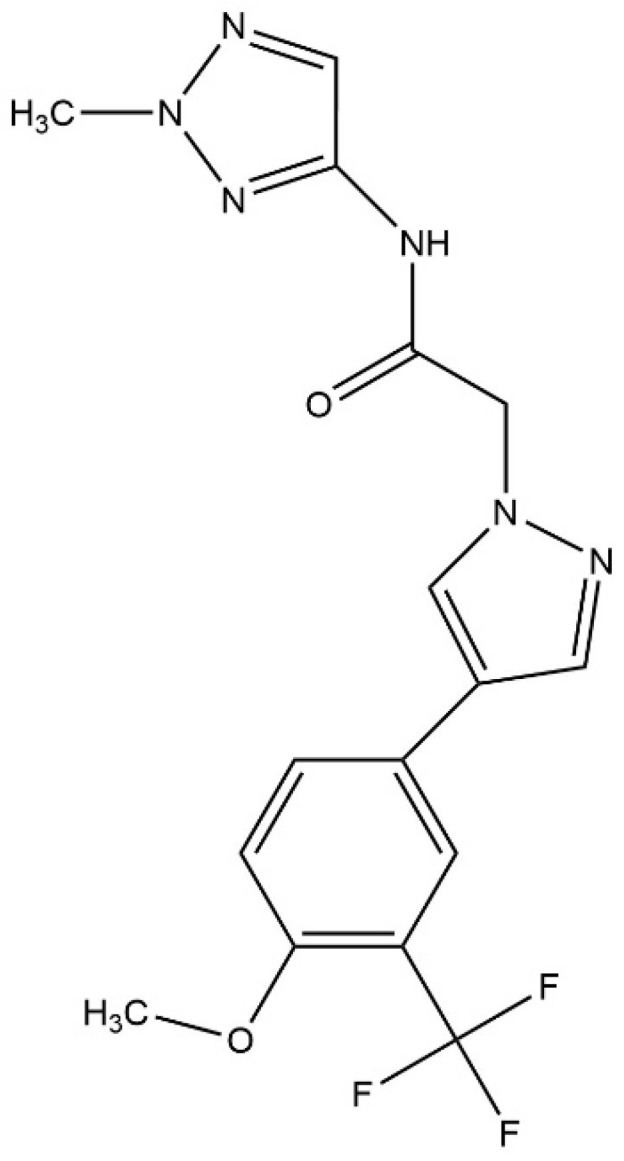
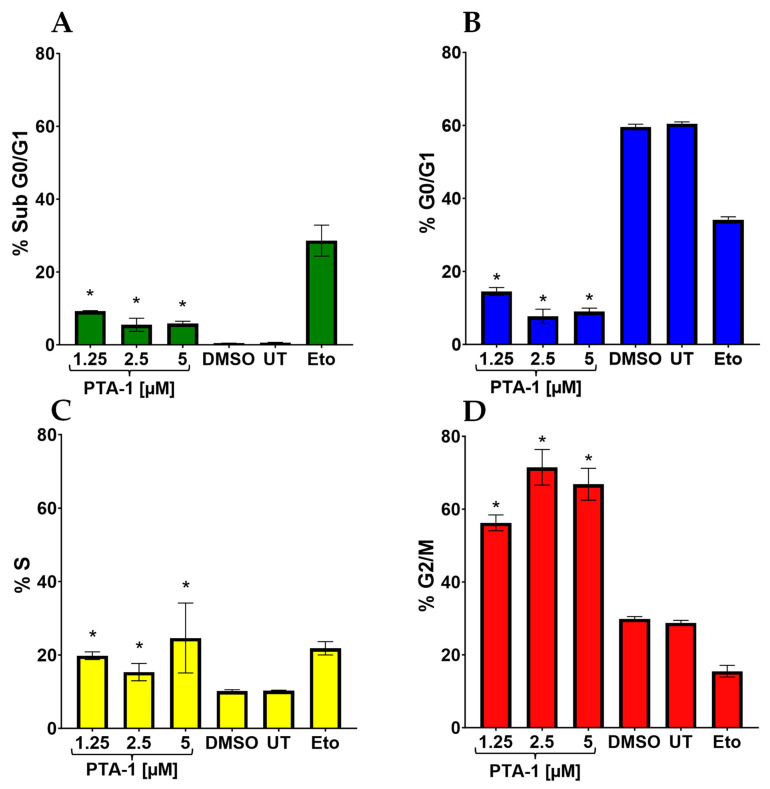
In this study, we screened a chemical library to find potent anticancer compounds that are less cytotoxic to non-cancerous cells. This study revealed that pyrazole PTA-1 is a potent anticancer compound. Additionally, we sought to elucidate its mechanism of action (MOA) in triple-negative breast cancer cells. Cytotoxicity was analyzed with the differential nuclear staining assay (DNS). Additional secondary assays were performed to determine the MOA of the compound. The potential MOA of PTA-1 was assessed using whole RNA sequencing, Connectivity Map (CMap) analysis, in silico docking, confocal microscopy, and biochemical assays. PTA-1 is cytotoxic at a low micromolar range in 17 human cancer cell lines, demonstrating less cytotoxicity to non-cancerous human cells, indicating a favorable selective cytotoxicity index (SCI) for the killing of cancer cells. PTA-1 induced phosphatidylserine externalization, caspase-3/7 activation, and DNA fragmentation in triple-negative breast MDA-MB-231 cells, indicating that it induces apoptosis. Additionally, PTA-1 arrests cells in the S and G2/M phases. Furthermore, gene expression analysis revealed that PTA-1 altered the expression of 730 genes at 24 h (198 upregulated and 532 downregulated). A comparison of these gene signatures with those within CMap indicated a profile similar to that of tubulin inhibitors. Subsequent studies revealed that PTA-1 disrupts microtubule organization and inhibits tubulin polymerization. Our results suggest that PTA-1 is a potent drug with cytotoxicity to various cancer cells, induces apoptosis and cell cycle arrest, and inhibits tubulin polymerization, indicating that PTA-1 is an attractive drug for future clinical cancer treatment.
在这项研究中,我们筛选了一个化学文库,以寻找对非癌细胞毒性较小的有效抗癌化合物。本研究发现吡唑 PTA-1 是一种有效的抗癌化合物。此外,我们试图阐明其在三阴性乳腺癌细胞中的作用机制 (MOA)。采用差核染色法 (DNS) 分析细胞毒性。进行了额外的二次测定,以确定化合物的作用机制。使用全 RNA 测序、连接图 (CMap) 分析、计算机对接、共聚焦显微镜和生化测定来评估 PTA-1 的潜在作用机制。PTA-1 在 17 个人类癌细胞系中以低微摩尔范围表现出细胞毒性,对非癌细胞的毒性较小,表明对癌细胞的杀伤具有有利的选择性细胞毒性指数 (SCI)。PTA-1 在三阴性乳腺癌 MDA-MB-231 细胞中诱导磷脂酰丝氨酸外排、caspase-3/7 激活和 DNA 片段化,表明其诱导细胞凋亡。此外,PTA-1 将细胞阻滞在 S 和 G2/M 期。此外,基因表达分析显示,PTA-1 在 24 小时内改变了 730 个基因的表达(198 个上调和 532 个下调)。将这些基因特征与 CMap 中的基因特征进行比较表明,其特征与微管蛋白抑制剂相似。随后的研究表明,PTA-1 破坏微管组织并抑制微管蛋白聚合。我们的研究结果表明,PTA-1 是一种有效的药物,对各种癌细胞具有细胞毒性,诱导细胞凋亡和细胞周期停滞,并抑制微管蛋白聚合,表明 PTA-1 是一种有吸引力的未来癌症治疗药物。