Wang Hua-Ling, Chen Zhen-Zhu, Koski Tuuli-Marjaana, Zhang Bin, Wang Xue-Fei, Zhang Rui-Bo, Li Ruo-Qi, Wang Shi-Xian, Zeng Jian-Yong, Li Hui-Ping
College of Forestry, Hebei Agricultural University, Baoding 071001, China.
Hebei Urban Forest Health Technology Innovation Center, Hebei Agricultural University, Baoding 071001, China.
Insects. 2024 Jul 14;15(7):534. doi: 10.3390/insects15070534.
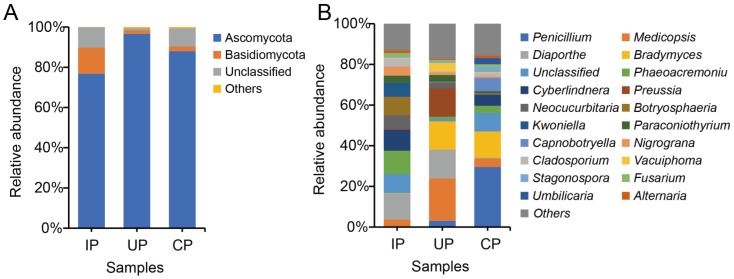
Endophytes, prevalent in plants, mediate plant-insect interactions. Nevertheless, our understanding of the key members of endophyte communities involved in inhibiting or assisting EAB infestation remains limited. Employing ITS and 16S rRNA high-throughput sequencing, along with network analysis techniques, we conducted a comprehensive investigation into the reaction of endophytic fungi and bacteria within phloem by comparing EAB-infested and uninfected samples. Our findings reveal that EAB infestation significantly impacts the endophytic communities, altering both their diversity and overall structure. Interestingly, both endophytic fungi and bacteria exhibited distinct patterns in response to the infestation. For instance, in the EAB-infested phloem, the fungi abundance remained unchanged, but diversity decreased significantly. Conversely, bacterial abundance increased, without significant diversity changes. The fungi community structure altered significantly, which was not observed in bacteria. The bacterial composition in the infested phloem underwent significant changes, characterized by a substantial decrease in beneficial species abundance, whereas the fungal composition remained largely unaffected. In network analysis, the endophytes in infested phloem exhibited a modular topology, demonstrating greater complexity due to an augmented number of network nodes, elevated negative correlations, and a core genera shift compared to those observed in healthy phloem. Our findings increase understanding of plant-insect-microorganism relationships, crucial for pest control, considering endophytic roles in plant defense.
内生菌普遍存在于植物中,介导植物与昆虫的相互作用。然而,我们对参与抑制或促进光肩星天牛侵害的内生菌群落关键成员的了解仍然有限。利用ITS和16S rRNA高通量测序以及网络分析技术,我们通过比较受光肩星天牛侵害和未受感染的样本,对韧皮部内的内生真菌和细菌的反应进行了全面调查。我们的研究结果表明,光肩星天牛侵害显著影响内生菌群落,改变其多样性和整体结构。有趣的是,内生真菌和细菌对侵害均表现出不同的模式。例如,在受光肩星天牛侵害的韧皮部中,真菌丰度保持不变,但多样性显著下降。相反,细菌丰度增加,多样性无显著变化。真菌群落结构发生显著改变,而细菌未出现这种情况。受侵害韧皮部中的细菌组成发生显著变化,其特征是有益物种丰度大幅下降,而真菌组成基本未受影响。在网络分析中,受侵害韧皮部中的内生菌呈现模块化拓扑结构,与健康韧皮部相比,由于网络节点数量增加、负相关性增强和核心属转移,显示出更高的复杂性。考虑到内生菌在植物防御中的作用,我们的研究结果增进了对植物-昆虫-微生物关系的理解,这对害虫防治至关重要。