Cresswell Kathrin, Hinder Susan, Sheikh Aziz, Watson Neil, Price David, Heed Andrew, Pontefract Sarah Katie, Coleman Jamie, Beggs Jillian, Chuter Antony, Slee Ann, Williams Robin
Usher Institute, University of Edinburgh, Edinburgh, United Kingdom.
Newcastle upon Tyne Hospitals National Health Service Foundation Trust, Newcastle, United Kingdom.
JMIR Form Res. 2024 Jul 26;8:e54458. doi: 10.2196/54458.
Antimicrobial resistance (AMR) represents a growing concern for public health.
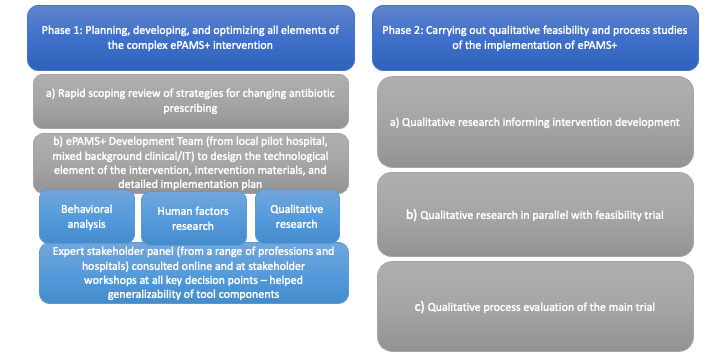
We sought to explore the challenges associated with development and implementation of a complex intervention designed to improve AMS in hospitals.
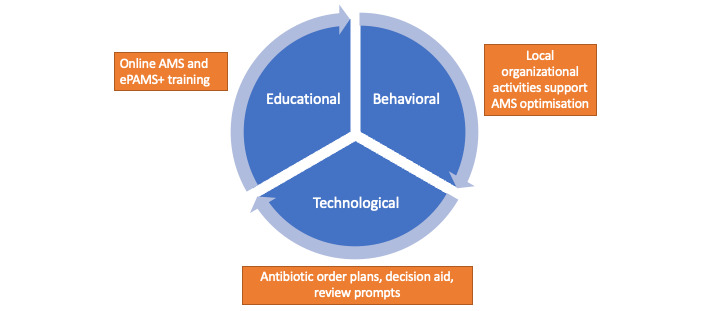
We conducted a qualitative evaluation of a complex AMS intervention with educational, behavioral, and technological components in 5 wards of an English hospital. At 2 weeks and 7 weeks after initiating the intervention, we interviewed 25 users of the intervention, including senior and junior prescribers, a senior nurse, a pharmacist, and a microbiologist. Topics discussed included perceived impacts of different elements of the intervention and facilitators and barriers to effective use. Interviews were supplemented by 2 observations of ward rounds to gain insights into AMS practices. Data were audio-recorded, transcribed, and inductively and deductively analyzed thematically using NVivo12.
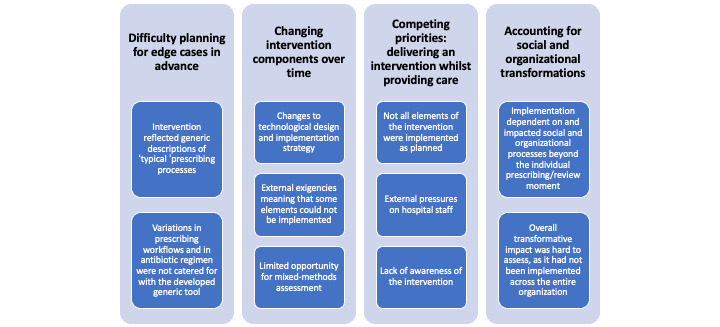
Tracing the adoption and impact of the various components of the intervention was difficult, as it had been introduced into a setting with competing pressures. These particularly affected behavioral and educational components (eg, training, awareness-building activities), which were often delivered ad hoc. We found that the participatory intervention design had addressed typical use cases but had not catered for edge cases that only became visible when the intervention was delivered in real-world settings (eg, variations in prescribing workflows across different specialties and conditions).
Effective user-focused design of complex interventions to promote AMS can support acceptance and use. However, not all requirements and potential barriers to use can be fully anticipated or tested in advance of full implementation in real-world settings.
抗菌药物耐药性(AMR)日益引起公众健康关注。
我们试图探讨与开发和实施旨在改善医院抗菌药物管理(AMS)的复杂干预措施相关的挑战。
我们对一家英国医院5个病房中一项包含教育、行为和技术成分的复杂AMS干预措施进行了定性评估。在干预开始后的第2周和第7周,我们采访了25名干预措施使用者,包括高级和初级开方者、一名高级护士、一名药剂师和一名微生物学家。讨论的主题包括干预措施不同要素的感知影响以及有效使用的促进因素和障碍。通过对查房进行2次观察来补充访谈,以深入了解AMS实践。数据进行了录音、转录,并使用NVivo12进行了主题的归纳和演绎分析。
追踪干预措施各组成部分的采用情况和影响很困难,因为它被引入到了一个存在竞争压力的环境中。这些压力尤其影响行为和教育成分(如培训、提高认识活动),这些成分往往是临时提供的。我们发现参与式干预设计解决了典型用例,但没有考虑到边缘情况,这些情况只有在干预措施在实际环境中实施时才会显现出来(例如,不同专科和病情的开方工作流程存在差异)。
以用户为中心的有效设计复杂干预措施以促进AMS可以支持其接受和使用。然而,并非所有使用要求和潜在障碍都能在实际环境中全面实施之前得到充分预见或测试。