Hochmair Maximilian, Terbuch Angelika, Lang David, Trockenbacher Christian, Augustin Florian, Ghanim Bahil, Maurer Dominik, Taghizadeh Hossein, Kamhuber Christoph, Wurm Robert, Lindenmann Jörg, Braz Petra, Bundalo Tatjana, Begic Merjem, Bauer Johanna, Reimann Patrick, Müser Nino, Huemer Florian, Schlintl Verena, Bianconi Daniela, Baumgartner Bernhard, Schenk Peter, Rauter Markus, Hötzenecker Konrad
Department of Respiratory and Critical Care Medicine, Karl Landsteiner Institute of Lung Research and Pulmonary Oncology, Klinik Floridsdorf, 1210 Vienna, Austria.
Division of Oncology, Department of Internal Medicine, Medical University of Graz, 8036 Graz, Austria.
Cancers (Basel). 2024 Jul 19;16(14):2586. doi: 10.3390/cancers16142586.
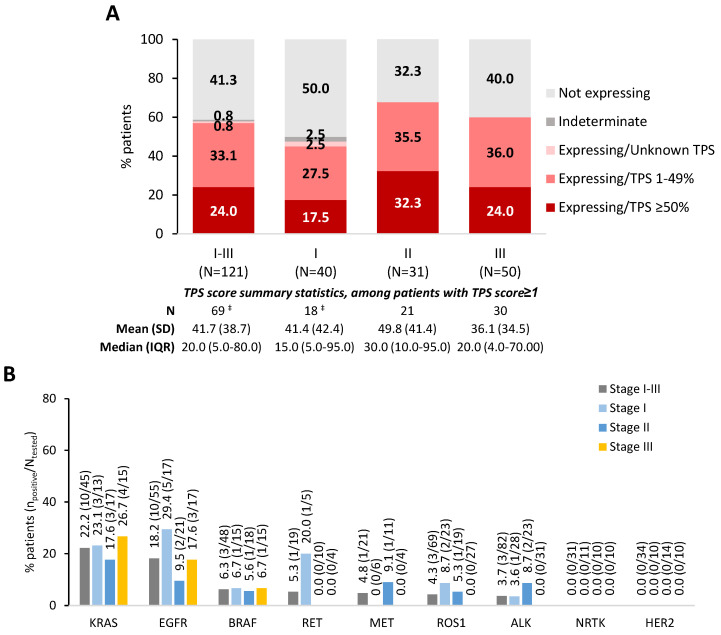
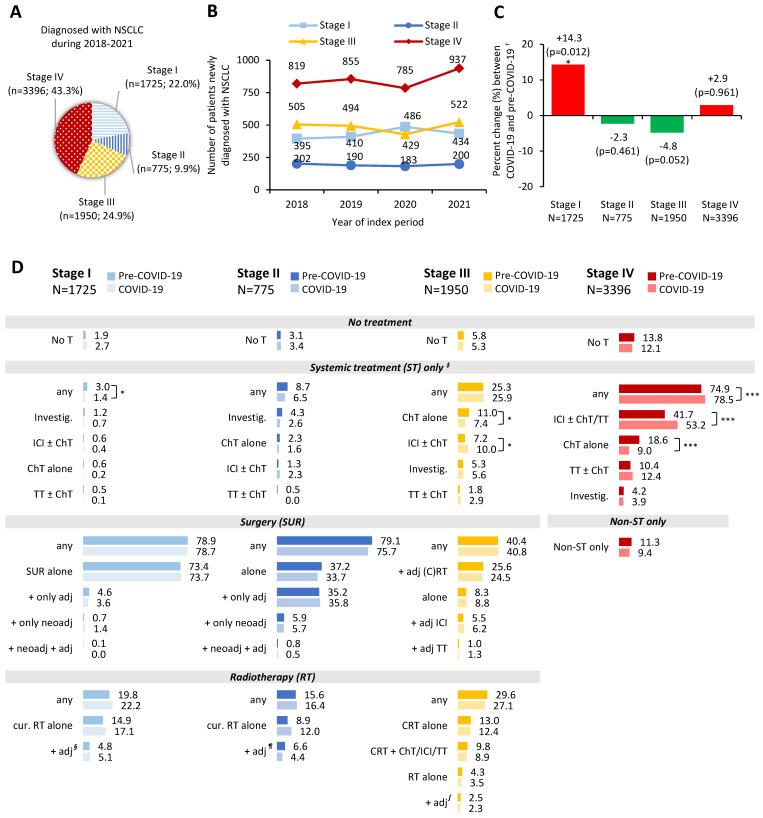
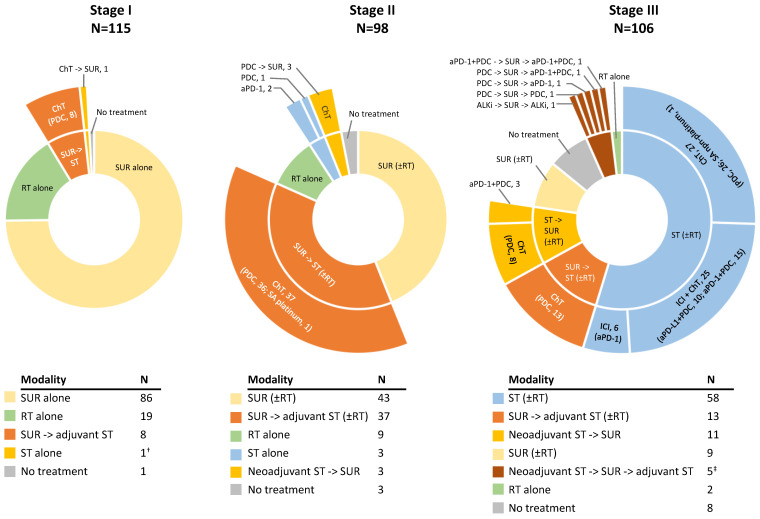
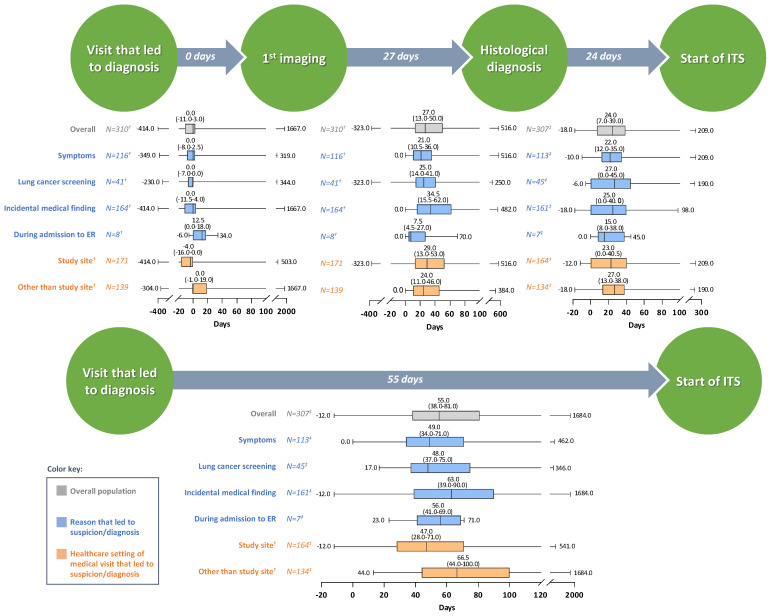
This was a retrospective study of the profile and initial treatments of adults diagnosed with early-stage (ES) non-small cell lung cancer (NSCLC) during January 2018-December 2021 at 16 leading hospital institutions in Austria, excluding patients enrolled in clinical trials. In total, 319 patients were enrolled at a planned ~1:1:1 ratio across StI:II:III. Most tested biomarkers were programmed death ligand 1 (PD-L1; 58% expressing), Kirsten rat sarcoma virus (KRAS; 22% positive), and epidermal growth factor receptor (EGFR; 18% positive). Of 115/98/106 StI/II/III patients, 82%/85%/36% underwent surgery, followed by systemic therapy in 9%/45%/47% of those [mostly chemotherapy (ChT)]. Unresected treated StIII patients received ChT + radiotherapy [43%; followed by immune checkpoint inhibitors (ICIs) in 39% of those], ICI ± ChT (35%), and ChT-alone/radiotherapy-alone (22%). Treatment was initiated a median (interquartile range) of 24 (7-39) days after histological confirmation, and 55 (38-81) days after first medical visit. Based on exploratory analyses of all patients newly diagnosed with any stage NSCLC during 2018-2021 at 14 of the sites (N = 7846), 22%/10%/25%/43% had StI/II/III/IV. The total number was not significantly different between pre-COVID-19 (2018-2019) and study-specific COVID-19 (2020-2021) periods, while StI proportion increased (21% vs. 23%; = 0.012). Small differences were noted in treatments. In conclusion, treatments were aligned with guideline recommendations at a time which preceded the era of ICIs and targeted therapies in the (neo)adjuvant setting.
这是一项回顾性研究,研究对象为2018年1月至2021年12月期间在奥地利16家主要医院机构被诊断为早期(ES)非小细胞肺癌(NSCLC)的成年人,不包括参加临床试验的患者。总共319例患者按计划以约1:1:1的比例纳入I期:II期:III期。检测的大多数生物标志物为程序性死亡配体1(PD-L1;58%表达)、 Kirsten大鼠肉瘤病毒(KRAS;22%阳性)和表皮生长因子受体(EGFR;18%阳性)。在115/98/106例I期/II期/III期患者中,82%/85%/36%接受了手术,其中9%/45%/47%随后接受了全身治疗[主要是化疗(ChT)]。未接受手术治疗的III期患者接受了ChT + 放疗[43%;其中39%随后接受了免疫检查点抑制剂(ICI)]、ICI ± ChT(35%)以及单纯ChT/单纯放疗(22%)。治疗在组织学确诊后中位(四分位间距)24(7 - 39)天开始,在首次就诊后55(38 - 81)天开始。基于对2018 - 2021年期间在14个研究地点新诊断为任何期NSCLC的所有患者(N = 7846)的探索性分析,22%/10%/25%/43%为I期/II期/III期/IV期。在COVID - 19之前(2018 - 2019年)和特定研究的COVID - 19期间(2020 - 2021年)总数无显著差异,而I期比例有所增加(21%对23%;P = 0.012)。治疗方面存在细微差异。总之,在ICI和(新)辅助治疗时代之前,治疗符合指南推荐。