Trilla Solà Cristina, Parra Roca Juan, Llurba Olivé Elisa
Department of Obstetrics and Gynecology, Institut d'Investigació Biomèdica Sant Pau-IIB Sant Pau, Hospital de la Santa Creu i Sant Pau, 08025 Barcelona, Spain.
Faculty of Medicine, Universitat Autònoma de Barcelona, 08025 Barcelona, Spain.
Diagnostics (Basel). 2024 Jul 18;14(14):1556. doi: 10.3390/diagnostics14141556.
The purpose of this study was to provide gestational age (GA) specific reference ranges for 2-dimensional (2D) placental biometry and 3-dimensional (3D) placental volume between 11 and 14 weeks of gestation.
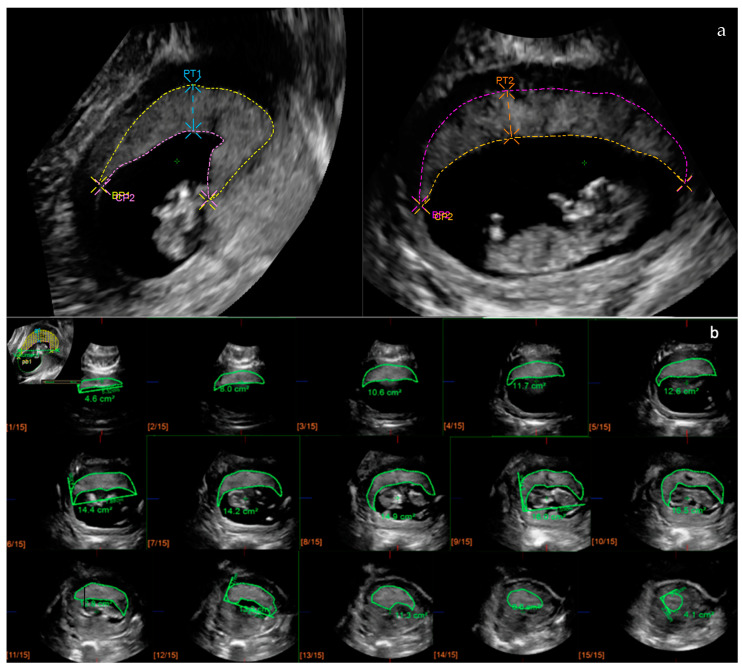
Placental biometry including 2D and 3D variables was calculated in 1142 first-trimester singleton pregnancies with non-complicated outcome between September 2016 and February 2020. Ultrasound datasets were obtained at the time of the first-trimester ultrasound, and 2D basal plate (BP), chorionic plate (CP), placental thickness (PT), and 3D placental volume (PV) were measured following a standardized methodology. Reference ranges for each variable were calculated according to GA and crown-rump-length (CRL).
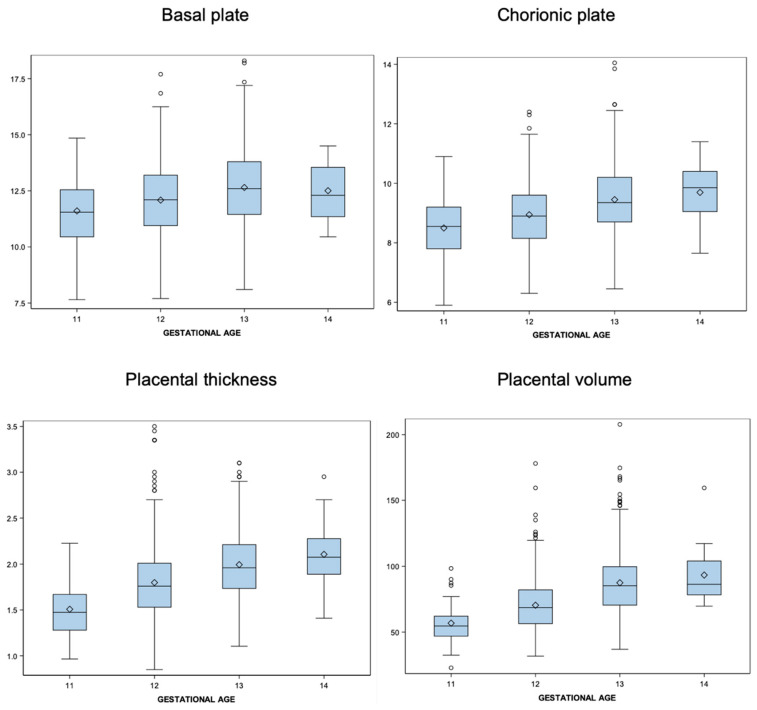
A total of 1142 uncomplicated pregnancies were considered for analysis. All placental measurements increased significantly between 11 and 14 weeks, especially for PT (39.64%) and PV (64.4%). Reference ranges were constructed for each 2D and 3D first-trimester placental variable using the best-fit regression model for the predicted mean and SD as a function of GA and CRL.
Reference ranges of 2D placental biometry and 3D placental volume between 11 and 14 weeks of gestation were constructed, generating reference values. Placental biometry showed a progressive increase during the first trimester. This highlights the importance of using reference range charts according to GA.
本研究旨在提供妊娠11至14周二维(2D)胎盘生物测量和三维(3D)胎盘体积的特定孕周(GA)参考范围。
对2016年9月至2020年2月期间1142例孕早期单胎妊娠且结局无并发症的孕妇进行胎盘生物测量,包括2D和3D变量。在孕早期超声检查时获取超声数据集,并按照标准化方法测量2D基底板(BP)、绒毛板(CP)、胎盘厚度(PT)和3D胎盘体积(PV)。根据孕周和头臀长(CRL)计算每个变量的参考范围。
共1142例无并发症妊娠纳入分析。所有胎盘测量值在11至14周之间均显著增加,尤其是PT(39.64%)和PV(64.4%)。使用最佳拟合回归模型,以孕周和CRL的函数形式预测均值和标准差,为孕早期每个2D和3D胎盘变量构建参考范围。
构建了妊娠11至14周2D胎盘生物测量和3D胎盘体积的参考范围,得出了参考值。胎盘生物测量在孕早期呈逐渐增加趋势。这突出了根据孕周使用参考范围图表的重要性。