Bartek Virág, Szabó István, Harmath Ágnes, Rudas Gábor, Steiner Tidhar, Fintha Attila, Ács Nándor, Beke Artúr
Department of Obstetrics and Gynecology, Semmelweis University, 1085 Budapest, Hungary.
Heim Pál National Pediatric Institute, 1089 Budapest, Hungary.
Children (Basel). 2024 Jun 28;11(7):797. doi: 10.3390/children11070797.
The corpus callosum is one of the five main cerebral commissures. It is key to combining sensory and motor functions. Its structure can be pathological (dysgenesis) or completely absent (agenesis). The corpus callosum dys- or agenesis is a rare disease (1:4000 live births), but it can have serious mental effects.
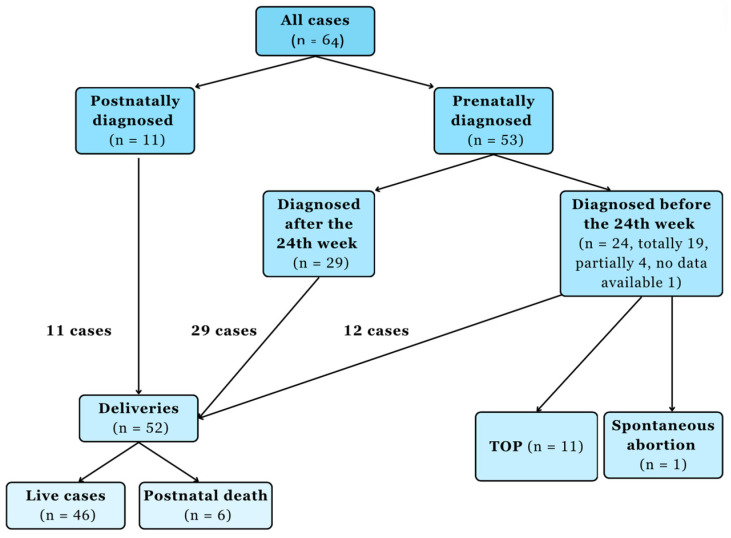
In our study, we processed the data of 64 pregnant women. They attended a prenatal diagnostic center and genetic counseling from 2005 to 2019 at the Department of Obstetrics and Gynecology at Semmelweis University.
The pregnancies had the following outcomes: 52 ended in delivery, 1 in spontaneous abortion, and 11 in termination of pregnancy (TOP) cases (n = 64). The average time of detection with imaging tests was 25.24 gestational weeks. In 16 cases, prenatal magnetic resonance imaging (MRI) was performed. If the abnormality was detected before the 20th week, a genetic test was performed on an amniotic fluid sample obtained from a genetic amniocentesis. Karyotyping and cytogenetic tests were performed in 15 of the investigated cases. Karyotyping gave normal results in three cases (46,XX or XY). In one of these cases, postnatally chromosomal microarray (CMA) was later performed, which confirmed Aicardi syndrome (3q21.3-21.1 microdeletion). In one case, postnatally, the test found Wiedemann-Rautenstrauch syndrome. In other cases, it found X ring, Di George syndrome, 46,XY,del(13q)(q13q22) and 46,XX,del(5p)(p13) (Cri-du-chat syndrome). Edwards syndrome was diagnosed in six cases, and Patau syndrome in one case.
We found that corpus callosum abnormalities are often linked to chromosomal problems. We recommend that a cytogenetic test be performed in all cases to rule out inherited diseases. Also, the long-term outcome does not just depend on the disease's severity and the associated other conditions, and hence proper follow-up and early development are also key. For this reason, close teamwork between neonatology, developmental neurology, and pediatric surgery is vital.
胼胝体是大脑五个主要连合之一。它是整合感觉和运动功能的关键。其结构可能出现病理状态(发育不全)或完全缺失(发育不全)。胼胝体发育不全或发育不全是一种罕见疾病(活产儿中为1:4000),但可能产生严重的精神影响。
在我们的研究中,我们处理了64名孕妇的数据。她们于2005年至2019年在塞梅尔维斯大学妇产科的产前诊断中心和遗传咨询处就诊。
这些妊娠有以下结局:52例以分娩结束,1例自然流产,11例终止妊娠(TOP)病例(n = 64)。影像学检查的平均检测时间为妊娠25.24周。16例进行了产前磁共振成像(MRI)检查。如果在第20周前检测到异常,则对从遗传羊膜穿刺术获得的羊水样本进行基因检测。在15例受调查病例中进行了核型分析和细胞遗传学检测。核型分析在3例中给出了正常结果(46,XX或XY)。其中1例在出生后进行了染色体微阵列(CMA)检测,证实为艾卡迪综合征(3q21.3 - 21.1微缺失)。1例在出生后检测发现维德曼 - 劳滕施拉赫综合征。在其他病例中,发现了X环、迪乔治综合征、46,XY,del(13q)(q13q22)和46,XX,del(5p)(p13)(猫叫综合征)。6例诊断为爱德华兹综合征,1例诊断为帕陶综合征。
我们发现胼胝体异常通常与染色体问题有关。我们建议对所有病例进行细胞遗传学检测以排除遗传性疾病。此外,长期结局不仅取决于疾病的严重程度和相关的其他情况,因此适当的随访和早期发育也是关键。因此,新生儿科、发育神经科和小儿外科之间密切的团队合作至关重要。