Laboratory of Translational Oncology and Experimental Cancer Therapeutics, Warren Alpert Medical School, Brown University, Providence, RI 02912, USA.
Department of Pathology and Laboratory Medicine, Warren Alpert Medical School, Brown University, Providence, RI 02912, USA.
Int J Mol Sci. 2024 Jul 21;25(14):7974. doi: 10.3390/ijms25147974.
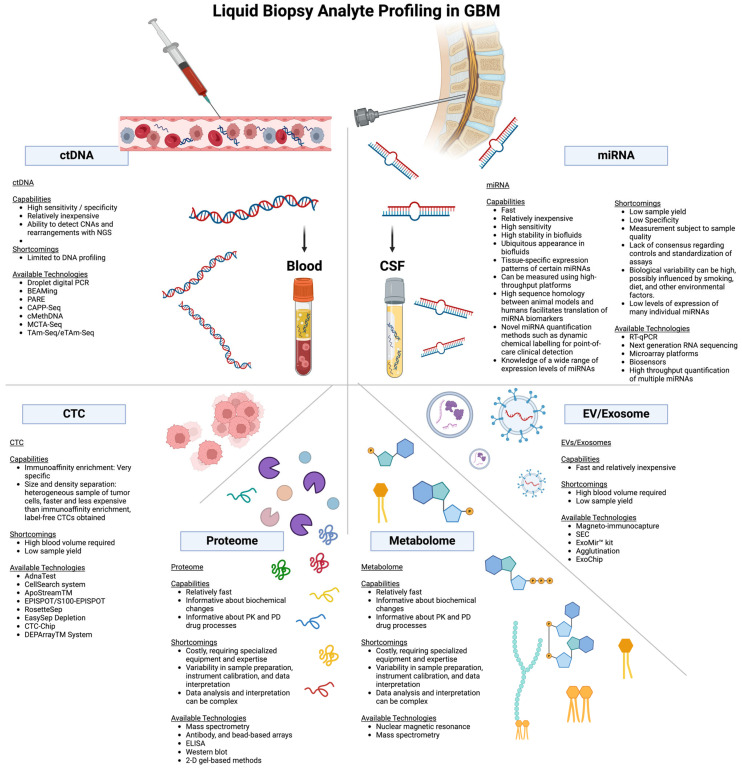
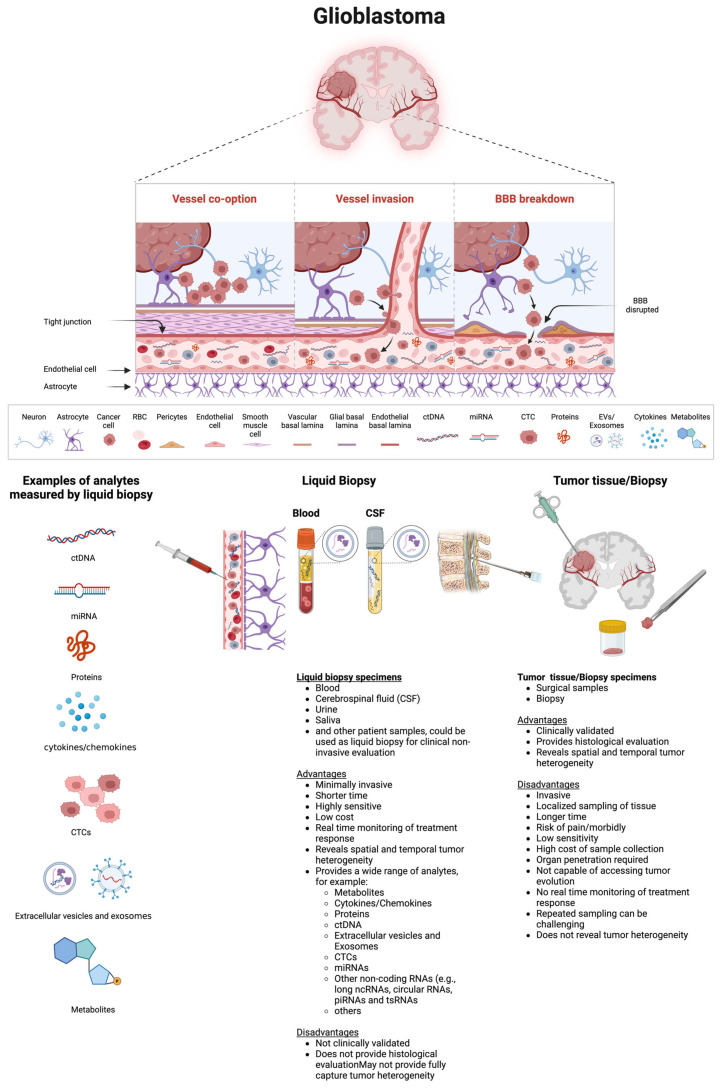
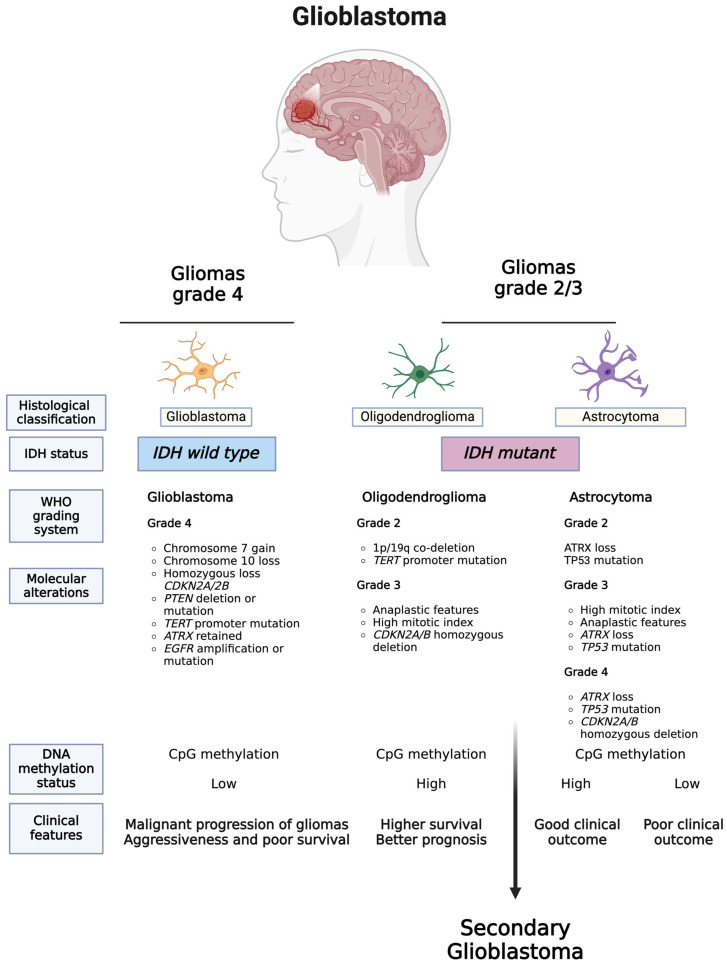
Gliomas, particularly glioblastoma (GBM), represent the most prevalent and aggressive tumors of the central nervous system (CNS). Despite recent treatment advancements, patient survival rates remain low. The diagnosis of GBM traditionally relies on neuroimaging methods such as magnetic resonance imaging (MRI) or computed tomography (CT) scans and postoperative confirmation via histopathological and molecular analysis. Imaging techniques struggle to differentiate between tumor progression and treatment-related changes, leading to potential misinterpretation and treatment delays. Similarly, tissue biopsies, while informative, are invasive and not suitable for monitoring ongoing treatments. These challenges have led to the emergence of liquid biopsy, particularly through blood samples, as a promising alternative for GBM diagnosis and monitoring. Presently, blood and cerebrospinal fluid (CSF) sampling offers a minimally invasive means of obtaining tumor-related information to guide therapy. The idea that blood or any biofluid tests can be used to screen many cancer types has huge potential. Tumors release various components into the bloodstream or other biofluids, including cell-free nucleic acids such as microRNAs (miRNAs), circulating tumor DNA (ctDNA), circulating tumor cells (CTCs), proteins, extracellular vesicles (EVs) or exosomes, metabolites, and other factors. These factors have been shown to cross the blood-brain barrier (BBB), presenting an opportunity for the minimally invasive monitoring of GBM as well as for the real-time assessment of distinct genetic, epigenetic, transcriptomic, proteomic, and metabolomic changes associated with brain tumors. Despite their potential, the clinical utility of liquid biopsy-based circulating biomarkers is somewhat constrained by limitations such as the absence of standardized methodologies for blood or CSF collection, analyte extraction, analysis methods, and small cohort sizes. Additionally, tissue biopsies offer more precise insights into tumor morphology and the microenvironment. Therefore, the objective of a liquid biopsy should be to complement and enhance the diagnostic accuracy and monitoring of GBM patients by providing additional information alongside traditional tissue biopsies. Moreover, utilizing a combination of diverse biomarker types may enhance clinical effectiveness compared to solely relying on one biomarker category, potentially improving diagnostic sensitivity and specificity and addressing some of the existing limitations associated with liquid biomarkers for GBM. This review presents an overview of the latest research on circulating biomarkers found in GBM blood or CSF samples, discusses their potential as diagnostic, predictive, and prognostic indicators, and discusses associated challenges and future perspectives.
神经胶质瘤,尤其是胶质母细胞瘤(GBM),是中枢神经系统(CNS)最常见且侵袭性最强的肿瘤。尽管最近的治疗取得了进展,但患者的生存率仍然很低。GBM 的传统诊断依赖于神经影像学方法,如磁共振成像(MRI)或计算机断层扫描(CT)扫描,以及术后通过组织病理学和分子分析进行确认。影像学技术难以区分肿瘤进展和治疗相关的变化,导致潜在的误诊和治疗延误。同样,组织活检虽然提供了信息,但具有侵入性,不适合监测正在进行的治疗。这些挑战导致了液体活检的出现,特别是通过血液样本,作为 GBM 诊断和监测的有前途的替代方法。目前,血液和脑脊液(CSF)采样提供了一种微创的方法来获取与肿瘤相关的信息,以指导治疗。血液或任何生物液体检测可用于筛查多种癌症类型的想法具有巨大的潜力。肿瘤会将各种成分释放到血液或其他生物流体中,包括细胞游离核酸,如 microRNAs(miRNAs)、循环肿瘤 DNA(ctDNA)、循环肿瘤细胞(CTC)、蛋白质、细胞外囊泡(EVs)或外泌体、代谢物和其他因素。这些因素已经被证明可以穿过血脑屏障(BBB),为 GBM 的微创监测以及实时评估与脑肿瘤相关的不同遗传、表观遗传、转录组、蛋白质组和代谢组变化提供了机会。尽管它们具有潜力,但液体活检基于循环生物标志物的临床实用性受到一些限制,例如缺乏血液或 CSF 采集、分析物提取、分析方法和小样本量的标准化方法。此外,组织活检可以更精确地了解肿瘤形态和微环境。因此,液体活检的目的应该是通过提供传统组织活检之外的额外信息来补充和增强 GBM 患者的诊断准确性和监测。此外,与仅依赖一种生物标志物类别相比,利用多种生物标志物类型的组合可能会提高临床效果,从而提高诊断的敏感性和特异性,并解决与 GBM 液体生物标志物相关的一些现有局限性。本综述介绍了 GBM 血液或 CSF 样本中循环生物标志物的最新研究概述,讨论了它们作为诊断、预测和预后指标的潜力,并讨论了相关的挑战和未来展望。