Moraes Francisco Cezar Aquino de, Kelly Francinny Alves, Leite Marianna Gerardo Hidalgo Santos Jorge, Dal Moro Lucca, Morbach Victória, Burbano Rommel Mario Rodríguez
Department of Medicine, Federal University of Pará, Belém 66073-005, PA, Brazil.
Dante Pazzanese Institute of Cardiology, São Paulo 04012-909, SP, Brazil.
J Pers Med. 2024 Jul 4;14(7):724. doi: 10.3390/jpm14070724.
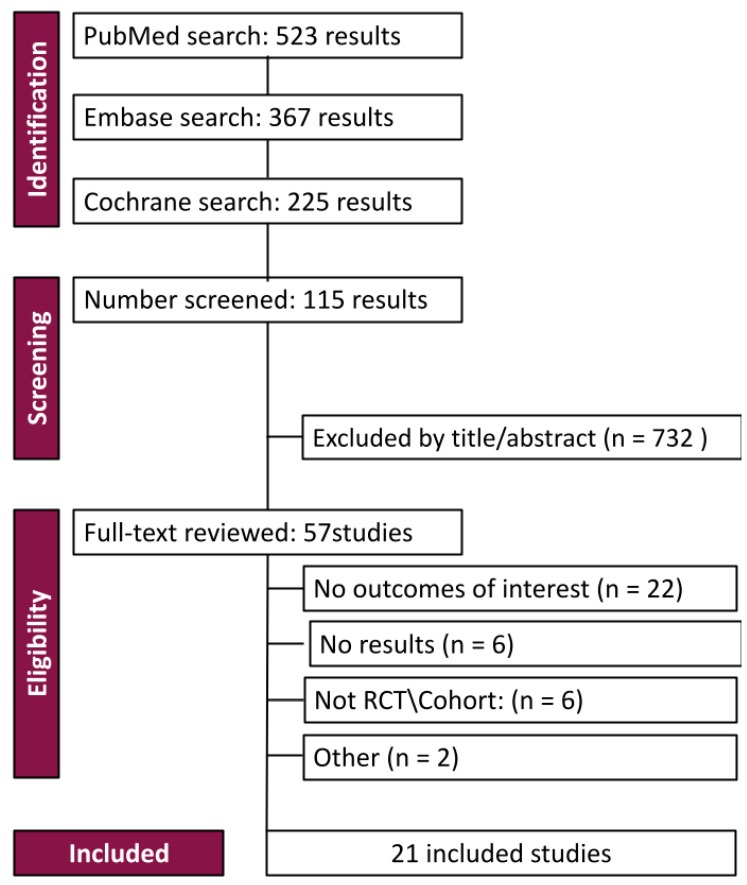
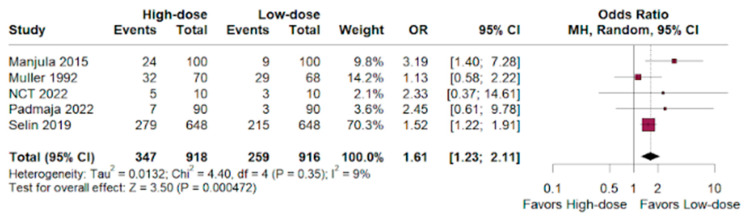
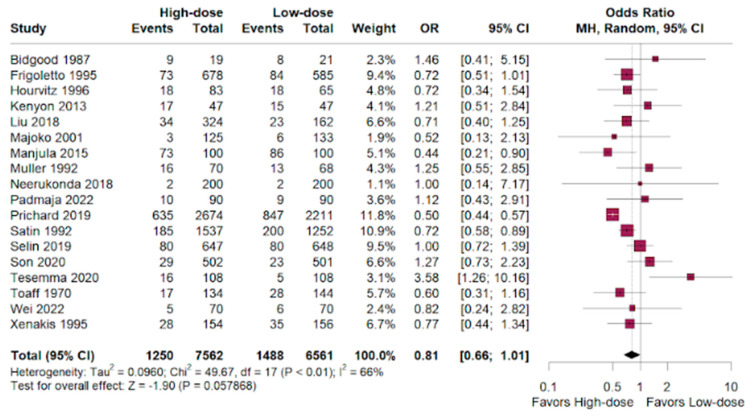
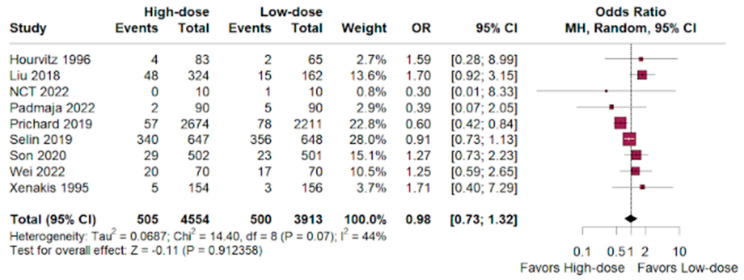
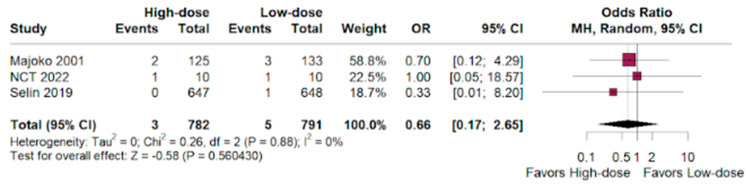
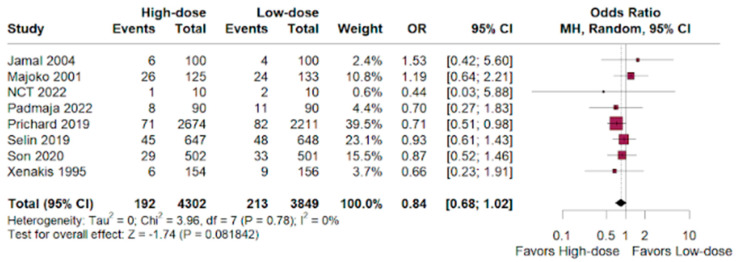
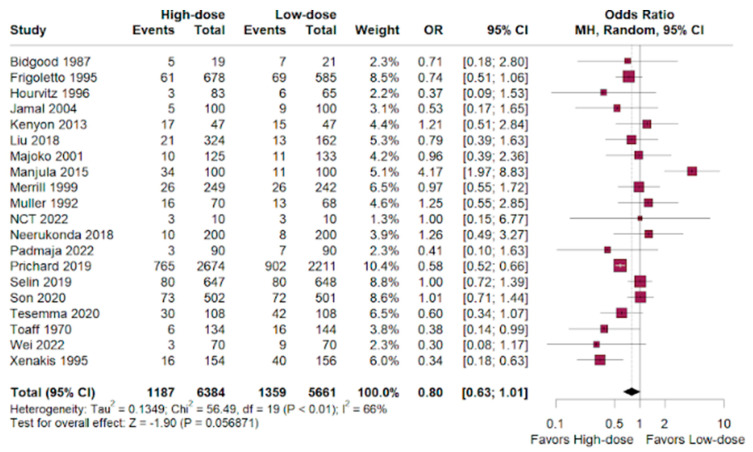
Although oxytocin administration is recommended for delayed labor progress, there is no consensus over the preferred optimal dose of oxytocin. We aimed to perform a meta-analysis of pregnancy outcomes comparing high-dose versus low-dose oxytocin regimens for augmentation of delayed labor. PubMed, Embase, and Cochrane databases were systematically searched for studies comparing high-dose with low-dose oxytocin for labor augmentation from inception up to May 2023. The outcomes assessed were cesarean rate, instrumental delivery rate, postpartum hemorrhage, neonatal death, and uterine tachysystole. Subgroup analysis was performed with randomized controlled trials (RCTs) and propensity-matched studies. Statistical analysis was performed using Rstudio. Heterogeneity was assessed with I statistics, and a random-risk effect was used if I > 50%. Twenty-one studies met inclusion criteria, and eighteen were RCTs. A total of 14.834 patients were included, of whom 7.921 (53.3%) received high-dose and 6.913 (46.6%) received low-dose oxytocin during labor augmentation. No statistical differences were found in cesarean delivery, neonatal mortality, postpartum hemorrhage and vaginal instrumentation rate. However, uterine tachysystole incidence was significantly higher with high-dose oxytocin (95% Cl, 1.30-1.94, = 0.3; 0.6; I = 9%). Labor augmentation with a low-dose oxytocin regimen is effective as with a high-dose regimen, but with significantly less uterine tachysystole events, which can lead to intrauterine and neonatal complications. Our findings suggest that a low-dose regimen may be safe and effective for labor augmentation in medical practice.
尽管推荐使用缩宫素治疗产程进展缓慢,但对于缩宫素的最佳剂量尚无共识。我们旨在进行一项荟萃分析,比较高剂量与低剂量缩宫素方案用于加强产程进展缓慢时的妊娠结局。系统检索了PubMed、Embase和Cochrane数据库,以查找从开始到2023年5月比较高剂量与低剂量缩宫素用于加强产程的研究。评估的结局包括剖宫产率、器械助产率、产后出血、新生儿死亡和子宫收缩过速。对随机对照试验(RCT)和倾向匹配研究进行了亚组分析。使用Rstudio进行统计分析。用I统计量评估异质性,如果I>50%,则采用随机风险效应。21项研究符合纳入标准,其中18项为RCT。总共纳入了14834例患者,其中7921例(53.3%)在加强产程时接受了高剂量缩宫素,6913例(46.6%)接受了低剂量缩宫素。剖宫产、新生儿死亡率、产后出血和阴道助产率方面未发现统计学差异。然而,高剂量缩宫素的子宫收缩过速发生率显著更高(95%CI,1.30-1.94,P = 0.3;0.6;I = 9%)。低剂量缩宫素方案加强产程与高剂量方案同样有效,但子宫收缩过速事件明显更少,而这可能导致宫内和新生儿并发症。我们的研究结果表明,低剂量方案在医学实践中用于加强产程可能是安全有效的。