Department of Urology, University Hospital, Goethe University Frankfurt, 60590 Frankfurt am Main, Germany.
Cancer Prognostics and Health Outcomes Unit, Division of Urology, University of Montréal Health Center, Montréal, QC H2X 3E4, Canada.
Medicina (Kaunas). 2024 Jul 11;60(7):1119. doi: 10.3390/medicina60071119.
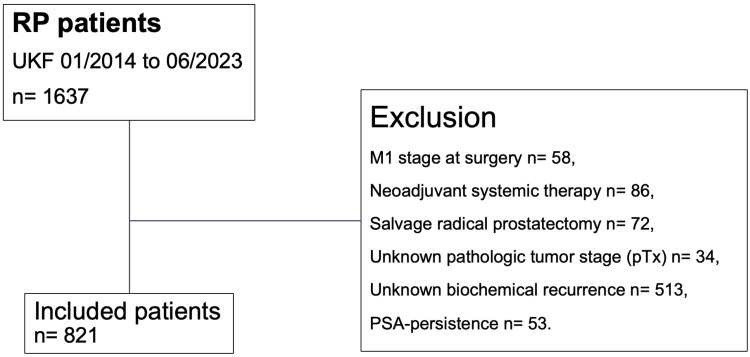
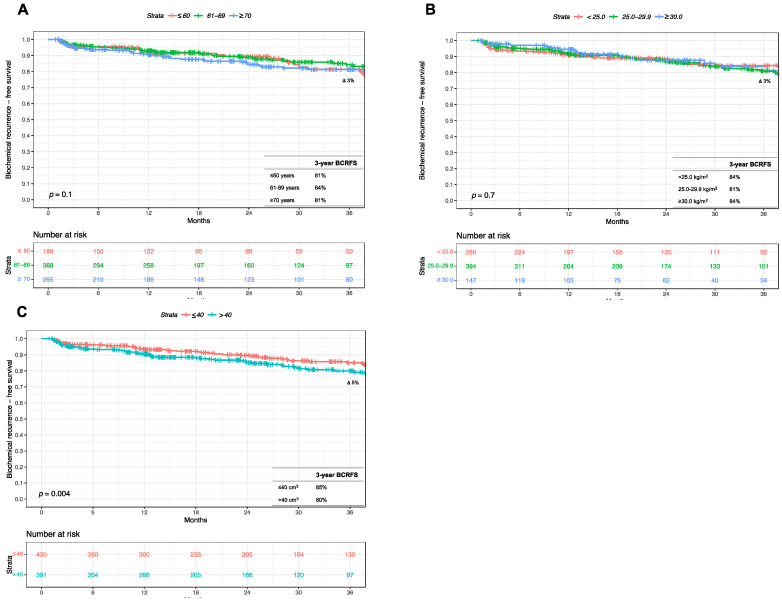
: Biochemical recurrence (BCR) represents the rise of prostate-specific antigen (PSA) levels after treatment with curative radical prostatectomy (RP) or radiation for prostate cancer. The objective of the current study was to test for the association between patient characteristics, namely age, body mass index (BMI), as well as prostate volume at surgery, and BCR after RP. : Within a tertiary care database, patients with prostate cancer treated with RP between January 2014 and June 2023 were included. Kaplan-Meier survival analyses and Cox regression models addressed BCR after RP according to patient characteristics. : Of 821 patients, the median age was 66 years (interquartile range [IQR] 61-71 years), BMI was 26.2 kg/m (IQR 24.3-28.8 kg/m), and prostate volume was 40 cm (IQR 30-55 cm). Median follow-up was 20 months. In survival analyses, the three-year BCR-free survival rates were 81 vs. 84 vs. 81% in patients aged ≤60 vs. 61-69 vs. 70 years ( = 0.1). In patients with BMI < 25.0 vs. 25.0-29.9 vs. ≥30.0 kg/m, the three-year BCR-free survival rates were 84 vs. 81 vs. 84% ( = 0.7). In patients with prostate volume ≤40 vs. >40 cm, the three-year BCR-free survival rates were 85 vs. 80% ( = 0.004). In multivariable Cox regression models accounting for patient and pathologic tumor characteristics and adjuvant radiation therapy, a higher prostate volume independently predicted BCR as continuous (hazard ratio 1.012, 95% confidence interval 1.005-1.019; < 0.001), as well as categorized the variable based on the median (hazard ratio 1.66, 95% confidence interval 1.17-2.36; = 0.005). Conversely, neither age nor BMI were significantly associated with BCR after RP. : The higher prostate volume independently predicted BCR after RP, but not age or BMI at surgery. Consequently, patients with an elevated prostate volume should be considered for closer postoperative follow-up.
生化复发(BCR)表示在根治性前列腺切除术(RP)或前列腺癌放射治疗后,前列腺特异性抗原(PSA)水平的升高。本研究的目的是检测患者特征(即年龄、体重指数(BMI)和手术时前列腺体积)与 RP 后 BCR 之间的关联。
在一个三级护理数据库中,纳入了 2014 年 1 月至 2023 年 6 月期间接受 RP 治疗的前列腺癌患者。Kaplan-Meier 生存分析和 Cox 回归模型根据患者特征分析 RP 后的 BCR。
在 821 名患者中,中位年龄为 66 岁(四分位距[IQR] 61-71 岁),BMI 为 26.2kg/m(IQR 24.3-28.8kg/m),前列腺体积为 40cm(IQR 30-55cm)。中位随访时间为 20 个月。在生存分析中,≤60 岁、61-69 岁和 70 岁的患者的三年 BCR 无复发生存率分别为 81%、84%和 81%(=0.1)。BMI<25.0、25.0-29.9 和≥30.0kg/m 的患者的三年 BCR 无复发生存率分别为 84%、81%和 84%(=0.7)。前列腺体积≤40cm 和>40cm 的患者的三年 BCR 无复发生存率分别为 85%和 80%(=0.004)。在考虑患者和病理肿瘤特征以及辅助放疗的多变量 Cox 回归模型中,较高的前列腺体积独立预测 BCR 为连续变量(风险比 1.012,95%置信区间 1.005-1.019;<0.001),以及基于中位数的分类变量(风险比 1.66,95%置信区间 1.17-2.36;=0.005)。相反,年龄和 BMI 与 RP 后 BCR 均无显著相关性。
较高的前列腺体积独立预测 RP 后的 BCR,但与手术时的年龄或 BMI 无关。因此,前列腺体积升高的患者应考虑进行更密切的术后随访。