Castilhos Jussimar Scheffer, Gasparello Gil Guilherme, Mota-Júnior Sergio Luiz, Hartmann Giovani Ceron, Miyagusuku Luiz Fernando Iyda, Pithon Matheus Melo, Tanaka Orlando Motohiro
Department of Orthodontics, Medicine and Life Sciences School, Pontifícia Universidade Católica do Paraná, Curitiba, Brazil.
Orthodontist, Private Practice, Juiz de Fora Federal University, Juiz de Fora, Minas Gerais, Brazil.
J Dent Res Dent Clin Dent Prospects. 2024 Spring;18(2):102-109. doi: 10.34172/joddd.40793. Epub 2024 Jun 24.
This study explored the layperson's perception of comfort, satisfaction, and willingness to use various accessories in clear aligner therapy.
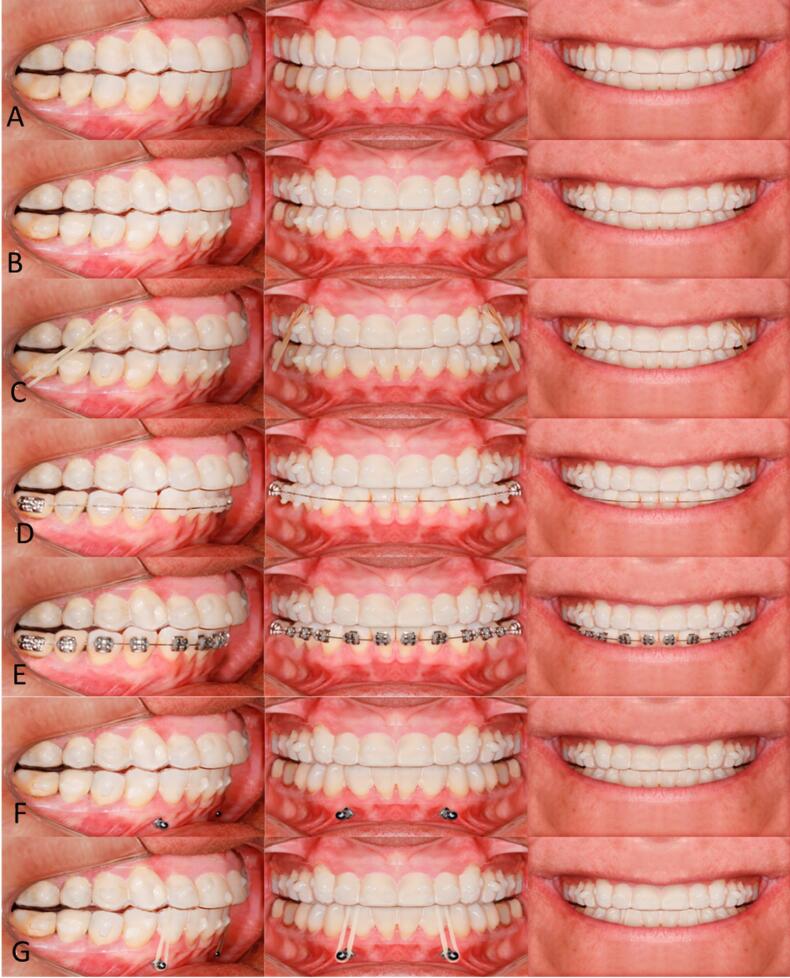
A total of 267 people analyzed standardized intraoral photographs of a female model in orthodontic treatment using: 1) only clear aligner (CA), the control group; 2) clear aligner+attachments (AT); 3) clear aligners+Cl II elastics (EL); 4) clear aligner+hybrid treatment with esthetic braces (HEB); 5) Clear aligner+hybrid treatment with metallic braces (HMB); 6) clear aligner+mini-implants (MI); 7) clear aligner+mini-implants and elastics for intrusion (MIE). In addition, a social media questionnaire was distributed to assess the willingness to undergo orthodontic treatment with various accessories.
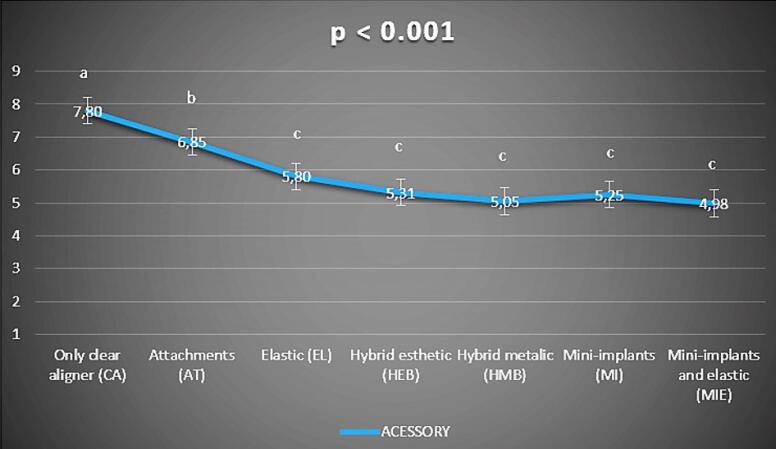
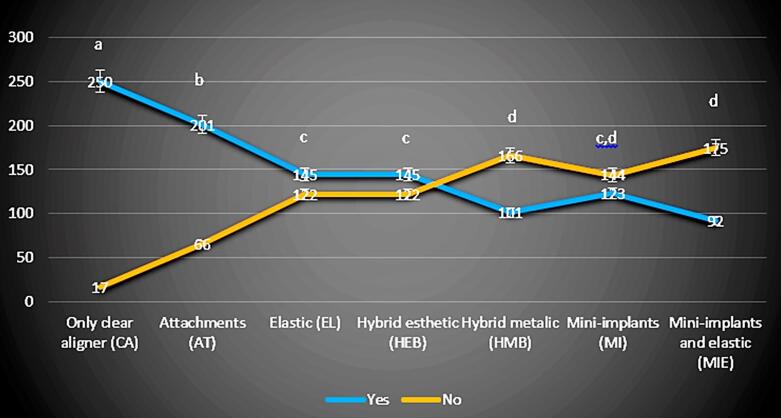
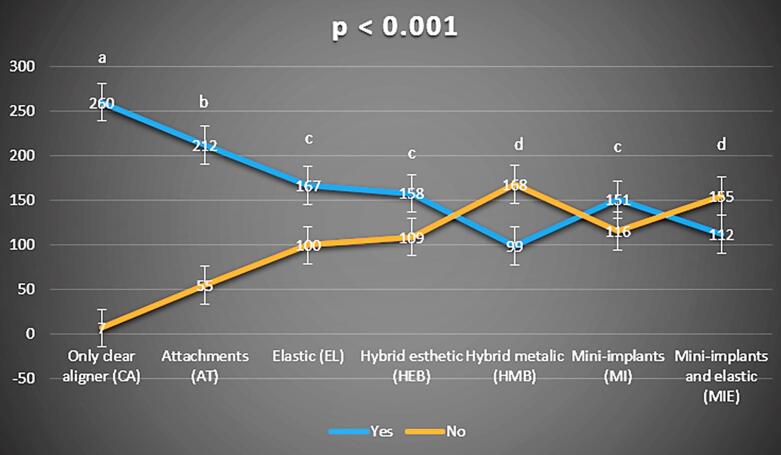
There was a significant difference between CA and all the other groups (<0.001), with CA being considered more comfortable and providing greater satisfaction compared to other accessories. Moreover, AT showed a significant difference in reducing treatment time compared to other groups.
The CA was the most comfortable, exhibiting a higher satisfaction rate and a greater willingness to use it. The AT therapy was perceived as more comfortable and was associated with higher satisfaction and a greater likelihood of use, especially if it resulted in reduced treatment time. On the other hand, the participants reported that the HMB, MI, and MIE accessories were less comfortable.
本研究探讨了外行人士对隐形矫治器治疗中舒适感、满意度以及使用各种附件意愿的认知。
共有267人分析了一名正在接受正畸治疗的女性模型的标准化口腔内照片,使用的情况包括:1)仅使用隐形矫治器(CA),为对照组;2)隐形矫治器+附件(AT);3)隐形矫治器+Ⅱ类弹性牵引(EL);4)隐形矫治器+与美观牙套联合治疗(HEB);5)隐形矫治器+与金属牙套联合治疗(HMB);6)隐形矫治器+微型种植体(MI);7)隐形矫治器+用于压低的微型种植体和弹性牵引(MIE)。此外,还发放了一份社交媒体调查问卷,以评估使用各种附件进行正畸治疗的意愿。
CA组与所有其他组之间存在显著差异(<0.001),与其他附件相比,CA组被认为更舒适且满意度更高。此外,与其他组相比,AT组在缩短治疗时间方面存在显著差异。
CA是最舒适的,具有更高的满意率和更大的使用意愿。AT治疗被认为更舒适,且与更高的满意度和更大的使用可能性相关,尤其是在能缩短治疗时间的情况下。另一方面,参与者报告称HMB、MI和MIE附件不太舒适。