Gandit Bérénice, Posani Lorenzo, Zhang Chun-Lei, Saha Soham, Ortiz Cantin, Allegra Manuela, Schmidt-Hieber Christoph
Institut Pasteur, Université Paris Cité, Neural Circuits for Spatial Navigation and Memory, Department of Neuroscience, F-75015 Paris, France.
Sorbonne Université, Collège Doctoral, F-75005 Paris, France.
iScience. 2024 Jun 24;27(7):110361. doi: 10.1016/j.isci.2024.110361. eCollection 2024 Jul 19.
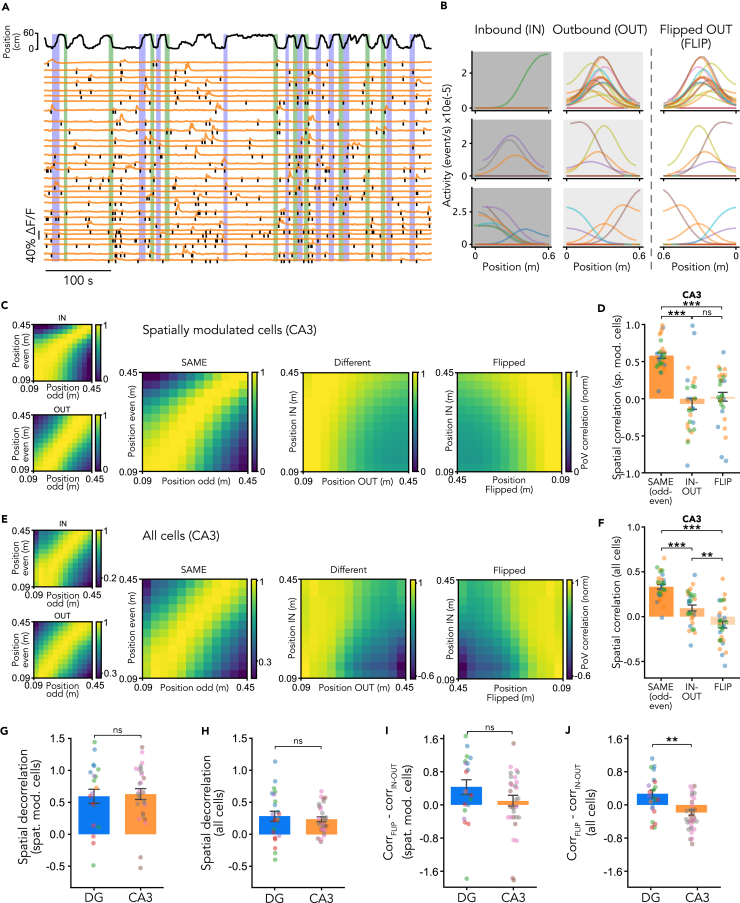
The hippocampus is thought to provide the brain with a cognitive map of the external world by processing various types of spatial information. To understand how essential spatial variables such as direction, position, and distance are transformed along its circuits to construct this global map, we perform single-photon widefield microendoscope calcium imaging in the dentate gyrus and CA3 of mice freely navigating along a narrow corridor. We find that spatial activity maps in the dentate gyrus, but not in CA3, are correlated after aligning them to the running directions, suggesting that they represent the distance traveled along the track in egocentric coordinates. Together with population activity decoding, our data suggest that while spatial representations in the dentate gyrus and CA3 are anchored in both egocentric and allocentric coordinates, egocentric distance coding is more prevalent in the dentate gyrus than in CA3, providing insights into the assembly of the cognitive map.
海马体被认为通过处理各种类型的空间信息为大脑提供外部世界的认知地图。为了理解诸如方向、位置和距离等基本空间变量是如何沿着其神经回路进行转换以构建这个全局地图的,我们在小鼠沿着狭窄走廊自由导航时,对其齿状回和CA3区域进行单光子宽场显微内窥镜钙成像。我们发现,将齿状回而非CA3区域的空间活动图与奔跑方向对齐后,它们是相关的,这表明它们以自我中心坐标表示沿着轨迹行进的距离。结合群体活动解码,我们的数据表明,虽然齿状回和CA3区域的空间表征都以自我中心和非自我中心坐标为锚定,但自我中心距离编码在齿状回中比在CA3区域更普遍,这为认知地图的组装提供了见解。