Jiangsu Center for Pharmacodynamics Research and Evaluation, State Key Laboratory of Natural Medicines, New Drug Screening Center, China Pharmaceutical University, Nanjing, 210009, China.
Center for Drug Research and Development, Guangdong Pharmaceutical University, Guangzhou, 510006, China.
Cell Biol Toxicol. 2024 Jul 29;40(1):60. doi: 10.1007/s10565-024-09903-3.
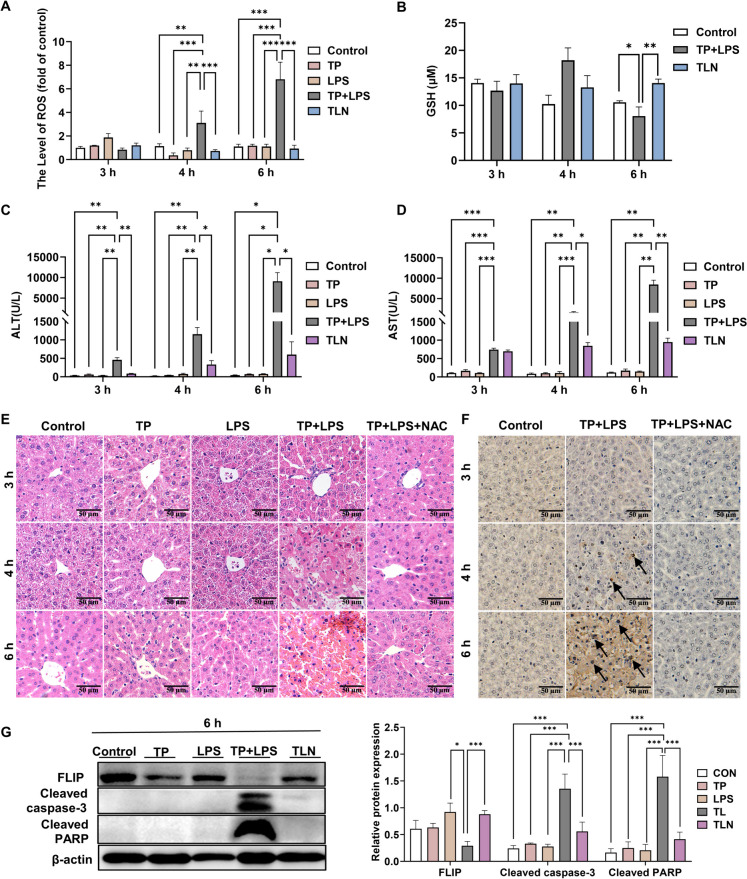
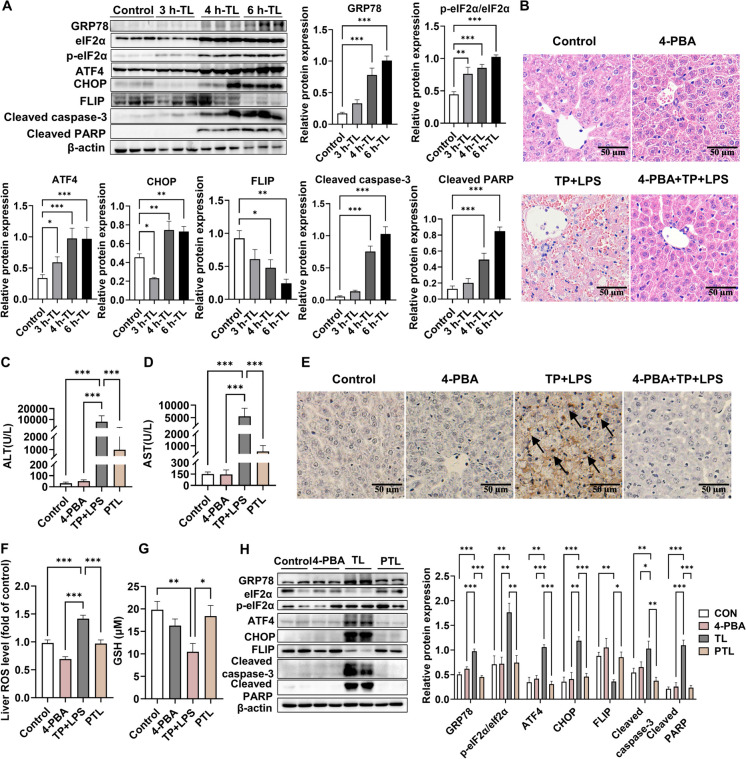
Triptolide (TP) is a major active and toxic composition of the Chinese medicine Tripterygium wilfordii Hook. F. (TWHF), exhibiting various therapeutic bioactivities. Among the toxic effects, the hepatotoxicity of TP deserves serious attention. Previously, our research group proposed a new view of TP-related hepatotoxicity: hepatic hypersensitivity under lipopolysaccharide (LPS) stimulation. However, the mechanism of TP/LPS-induced hepatic hypersensitivity remains unclear. In this study, we investigated the mechanism underlying TP/LPS-induced hypersensitivity from the perspective of the inhibition of proteasome activity, activated endoplasmic reticulum stress (ERS)-related apoptosis, and the accumulation of reactive oxygen species (ROS). Our results showed that N-acetylcysteine (NAC), a common ROS inhibitor, decreased the expression of cleaved caspase-3 and cleaved PARP, which are associated with FLIP enhancement. Moreover, 4-phenylbutyric acid (4-PBA), an ERS inhibitor, was able to alleviate TP/LPS-induced hepatotoxicity by reducing ERS-related apoptosis protein expression (GRP78, p-eIF2α/eIF2α, ATF4, CHOP, cleaved caspase-3 and cleaved PARP) and ROS levels, with ATF4 being an indispensable mediator. In addition, the proteasome activity inhibitor MG-132 further aggravated ERS-related apoptosis, which indicated that the inhibition of proteasome activity also plays an important role in TP/LPS-related liver injuries. In summary, we propose that TP/LPS may upregulate the activation of ERS-associated apoptosis by inhibiting proteasome activity and enhancing ROS production through ATF4.
雷公藤红素(TP)是中药雷公藤(TWHF)的主要活性和毒性成分,具有多种治疗生物活性。在其毒性作用中,雷公藤红素的肝毒性值得高度关注。此前,我们的研究小组提出了一种新的雷公藤红素相关肝毒性观点:脂多糖(LPS)刺激下的肝过度敏感。然而,TP/LPS 诱导的肝过度敏感的机制尚不清楚。在这项研究中,我们从抑制蛋白酶体活性、激活内质网应激(ERS)相关凋亡以及活性氧(ROS)积累的角度研究了 TP/LPS 诱导的过度敏感的机制。结果表明,常见的 ROS 抑制剂 N-乙酰半胱氨酸(NAC)降低了与 FLIP 增强相关的裂解半胱天冬酶-3 和裂解多聚(ADP-核糖)聚合酶的表达。此外,ERS 抑制剂 4-苯丁酸(4-PBA)通过降低 ERS 相关凋亡蛋白表达(GRP78、p-eIF2α/eIF2α、ATF4、CHOP、裂解半胱天冬酶-3 和裂解多聚(ADP-核糖)聚合酶)和 ROS 水平,能够减轻 TP/LPS 诱导的肝毒性,ATF4 是必不可少的介质。此外,蛋白酶体活性抑制剂 MG-132 进一步加重了 ERS 相关凋亡,这表明蛋白酶体活性的抑制也在 TP/LPS 相关肝损伤中发挥重要作用。综上所述,我们提出 TP/LPS 可能通过抑制蛋白酶体活性和通过 ATF4 增强 ROS 产生来上调 ERS 相关凋亡的激活。