Ryu Seok Jin, Lee Ji Ho, Lee Dong Hun, Lee Byung Kook, Bae Sung Jin, Choi Yun Hyung, Jeong Won Gi
Department of Emergency Medicine, Chonnam National University Hospital, 61469 Gwangju, Republic of Korea.
Department of Emergency Medicine, Chonnam National University Medical School, 61469 Gwangju, Republic of Korea.
Rev Cardiovasc Med. 2024 May 8;25(5):157. doi: 10.31083/j.rcm2505157. eCollection 2024 May.
Progressive ischemic brain injury after cardiac arrest can cause damage to the hypothalamic-pituitary axis, particularly the pituitary gland. This may impact serum osmolality (SOsm) and urine osmolality (UOsm) in patients who have experienced out-of-hospital cardiac arrest (OHCA). We assumed that a low ratio of UOsm to SOsm (USR) is related to poor outcomes among OHCA patients. Therefore, the present study was designed to evaluate the association between the USR within 72 h after the restoration of spontaneous circulation (ROSC) and 6-month neurological outcomes in OHCA patients.
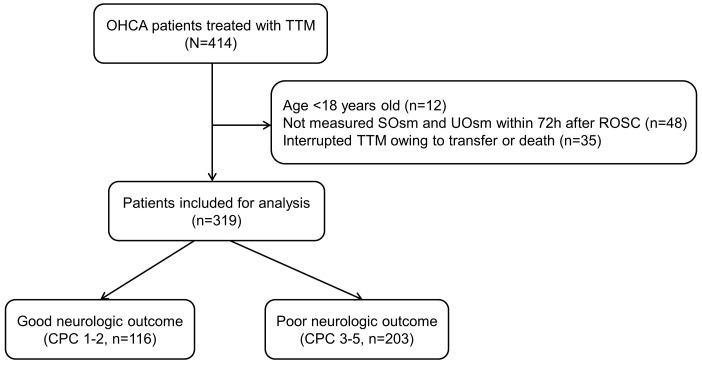
This prospective, observational study included OHCA patients with targeted temperature management at Chonnam National University Hospital in Gwangju, Korea, between January 2016 and December 2022. We collected SOsm and UOsm data at admission (T0) and 24 (T1), 48 (T2), and 72 h (T3) after ROSC. The primary outcome was a poor neurological outcome at 6 months defined by cerebral performance categories 3, 4, or 5.
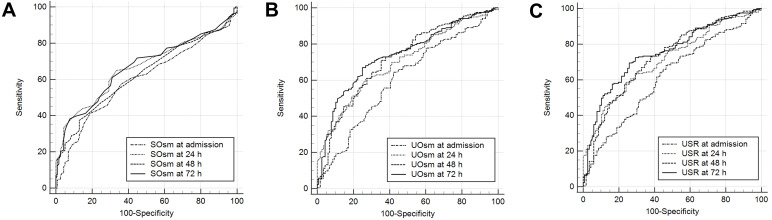
This study included 319 patients. The mean UOsm and USRs at T0, T1, T2, and T3 of patients with poor outcomes were lower than those of patients with good outcomes. Multivariable analysis indicated that the USRs at T1 (odds ratio [OR], 0.363; 95% confidence interval [CI], 0.221-0.594), T2 (OR, 0.451; 95% CI, 0.268-0.761), and T3 (OR, 0.559; 95% CI, 0.357-0.875) were associated with a poor outcome. The areas under the receiver operating characteristic curves of USRs at T0, T1, T2, and T3 for predicting poor outcomes were 0.615 (95% CI, 0.559-0.669), 0.711 (95% CI, 0.658-0.760), 0.724 (95% CI, 0.671-0.772), and 0.751 (95% CI, 0.699-0.797), respectively.
The USRs within 72 h of ROSC were associated with poor neurological outcomes at 6 months in OHCA patients.
心脏骤停后进行性缺血性脑损伤可导致下丘脑 - 垂体轴受损,尤其是垂体。这可能会影响院外心脏骤停(OHCA)患者的血清渗透压(SOsm)和尿渗透压(UOsm)。我们假设尿渗透压与血清渗透压比值(USR)低与OHCA患者的不良预后相关。因此,本研究旨在评估自主循环恢复(ROSC)后72小时内的USR与OHCA患者6个月神经功能结局之间的关联。
这项前瞻性观察性研究纳入了2016年1月至2022年12月在韩国光州全南国立大学医院接受目标温度管理的OHCA患者。我们在入院时(T0)以及ROSC后24小时(T1)、48小时(T2)和72小时(T3)收集SOsm和UOsm数据。主要结局是6个月时由脑功能分类3、4或5定义的不良神经功能结局。
本研究纳入了319例患者。预后不良患者在T0、T1、T2和T3时的平均UOsm和USR低于预后良好的患者。多变量分析表明,T1时的USR(比值比[OR],0.363;95%置信区间[CI],0.221 - 0.594)、T2时的USR(OR,0.451;95%CI,0.268 - 0.761)和T3时的USR(OR,0.559;95%CI,0.357 - 0.875)与不良结局相关。T0、T1、T2和T3时USR预测不良结局的受试者工作特征曲线下面积分别为0.615(95%CI,0.559 - 0.669)、0.711(95%CI,0.658 - 0.760)、0.724(95%CI,0.671 - 0.772)和0.751(95%CI,0.699 - 0.797)。
ROSC后72小时内的USR与OHCA患者6个月时的不良神经功能结局相关。