Song Jian, Gao Shiqi, Xie Enzehua, Wang Wei, Dai Lu, Zhao Rui, Zhou Chenyu, Qiu Juntao, Yu Cuntao
Department of Vascular Surgery, Fuwai Hospital, National Center for Cardiovascular Diseases, Chinese Academy of Medical Sciences and Peking Union Medical College, 100037 Beijing, China.
Department of Cardiac Surgery, Fuwai Hospital, National Center for Cardiovascular Diseases, Chinese Academy of Medical Sciences and Peking Union Medical College, 100037 Beijing, China.
Rev Cardiovasc Med. 2023 Dec 19;24(12):355. doi: 10.31083/j.rcm2412355. eCollection 2023 Dec.
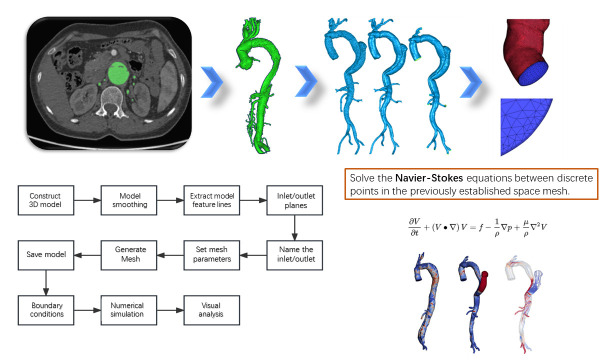
Computational fluid dynamics (CFD) is a new medical method combining medicine and science. The aim of this study is to summarize and analyze the application of CFD in adult aortic diseases.
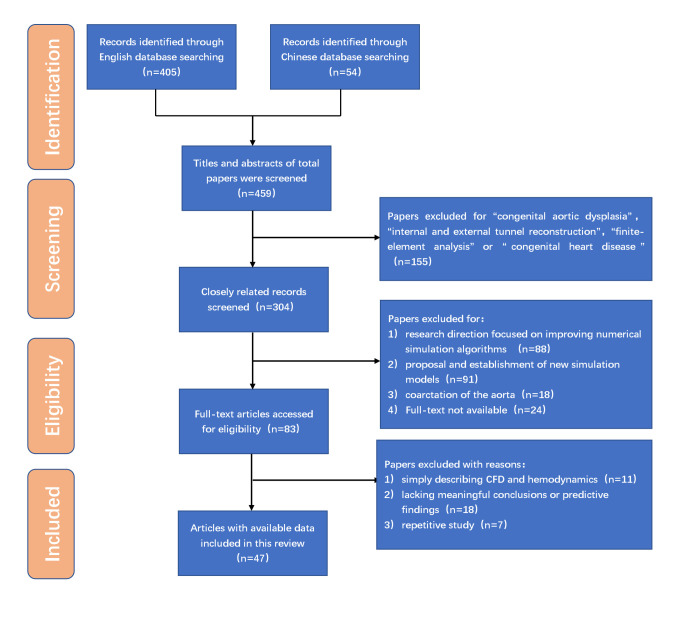
This systematic review followed the Preferred Reporting Items for Systematic Reviews and Meta-Analyses (PRISMA) guidelines. A search in the PubMed, Cochrane Library and Chinese databases identified 47 highly relevant articles. Studies were included if they assessed biomechanical markers and their potential association with progression or rupture of aortic aneurysms or dissections.
There are no randomized controlled trials to examine the direct relationship between all biomechanical parameters and aortic disease progression or rupture. Wall stress and peak wall rupture risk can predict the risk of aortic aneurysm rupture using biomechanics, which is more accurate than the prediction based on "diameter" alone. Areas with lower time averaged wall shear stress (TAWSS) and higher oscillatory shear index (OSI) are at risk for further aortic expansion or dissection. Higher relative residence time (RRT) area can predict platelet activation and thrombosis. In addition, pressure, flow field and other indicators can also roughly predict the risk of aortic disease progression.
Contemporary evidence suggests that CFD can provide additional hemodynamic parameters, which have the potential to predict the progression of aortic lesions, the effect of surgical intervention, and prognosis.
计算流体动力学(CFD)是一种将医学与科学相结合的新型医学方法。本研究的目的是总结和分析CFD在成人主动脉疾病中的应用。
本系统评价遵循系统评价和Meta分析的首选报告项目(PRISMA)指南。在PubMed、Cochrane图书馆和中文数据库中进行检索,共识别出47篇高度相关的文章。纳入的研究需评估生物力学标志物及其与主动脉瘤或夹层进展或破裂的潜在关联。
尚无随机对照试验来检验所有生物力学参数与主动脉疾病进展或破裂之间的直接关系。壁应力和壁破裂峰值风险可利用生物力学预测主动脉瘤破裂风险,这比仅基于“直径”的预测更为准确。时间平均壁面切应力(TAWSS)较低且振荡剪切指数(OSI)较高的区域有主动脉进一步扩张或夹层形成的风险。相对停留时间(RRT)较高的区域可预测血小板活化和血栓形成。此外,压力、流场等指标也可大致预测主动脉疾病进展风险。
当代证据表明,CFD能够提供额外的血流动力学参数,这些参数有可能预测主动脉病变的进展、手术干预效果及预后。