Li Ming, Peng Xi, Zheng Naixin, Ai Hu, Zhao Ying, Li Hui, Yang Guojian, Tang Guodong, Sun Fucheng, Zhang Huiping
Department of Cardiology, Beijing Hospital, National Center of Gerontology, Institute of Geriatric Medicine, Chinese Academy of Medical Sciences & Peking Union Medical College, 100730 Beijing, China.
Rev Cardiovasc Med. 2024 Feb 20;25(2):69. doi: 10.31083/j.rcm2502069. eCollection 2024 Feb.
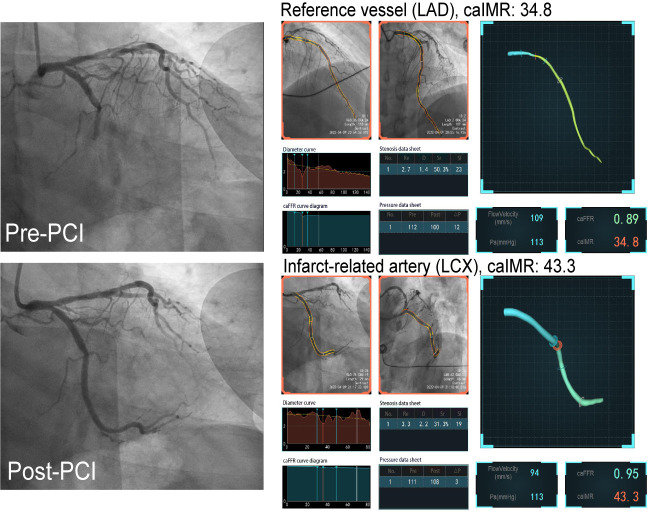
Studies reporting the status of coronary microvascular function in the infarct-related artery (IRA) after primary percutaneous coronary intervention (PCI) remain limited. This study utilized the coronary angiography-derived index of microcirculatory resistance (caIMR) to assess coronary microvascular function in patients with ST-segment elevation myocardial infarction (STEMI) undergoing primary PCI.
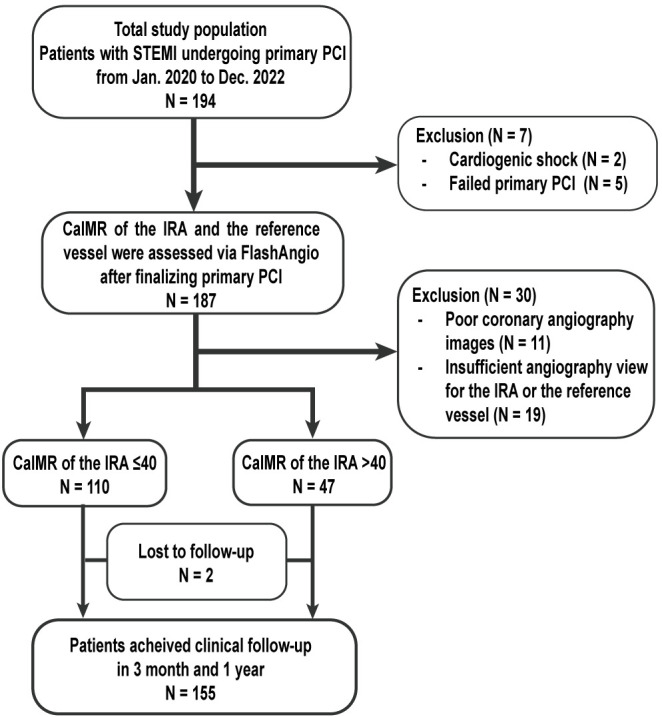
We used the FlashAngio system to measure the caIMR after primary PCI in 157 patients with STEMI. The primary endpoint was the occurrence of a major adverse cardiovascular event (MACE), defined as a composite endpoint encompassing cardiac mortality, target vessel revascularization, and rehospitalization due to congestive heart failure (CHF), myocardial infarction (MI), or angina.
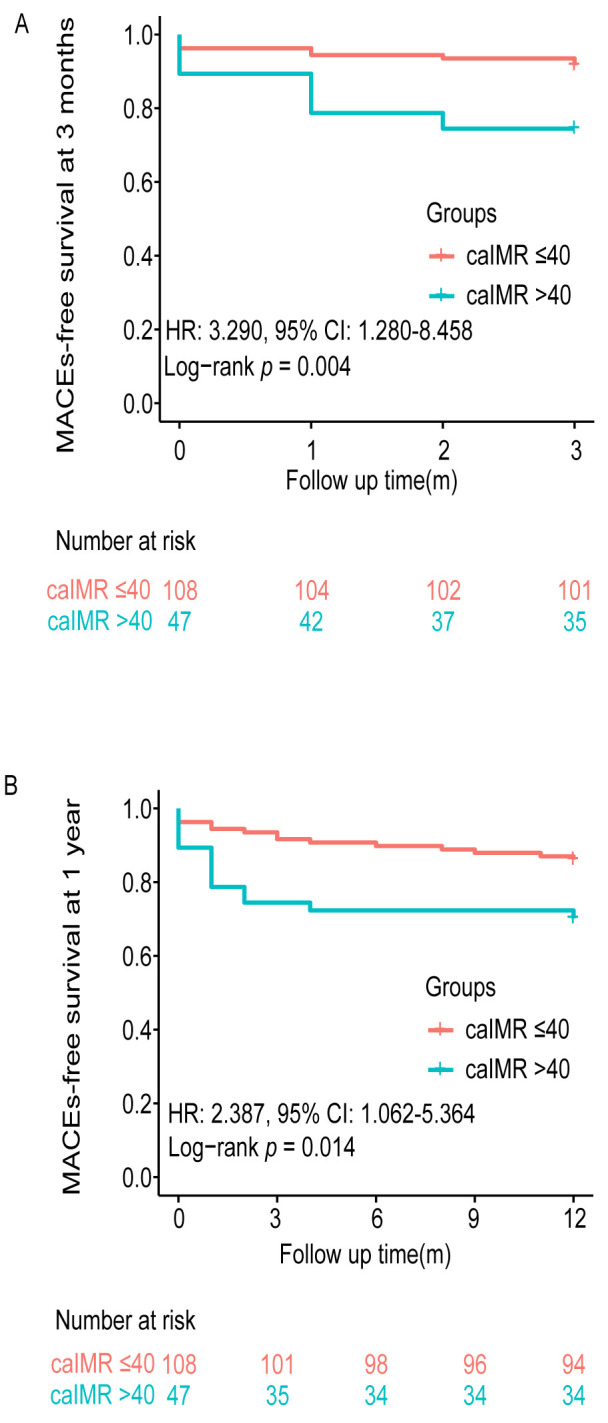
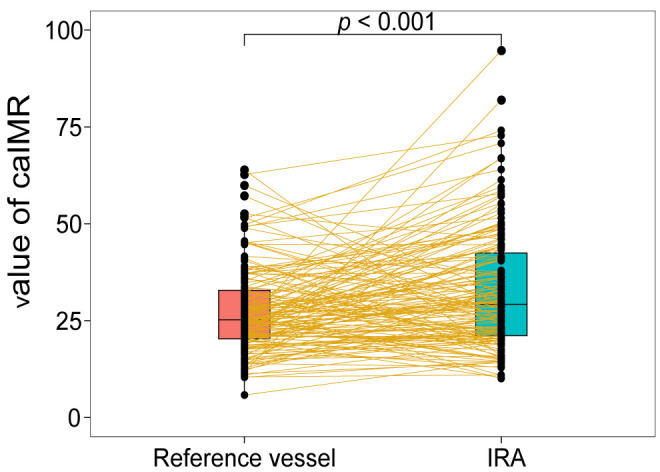
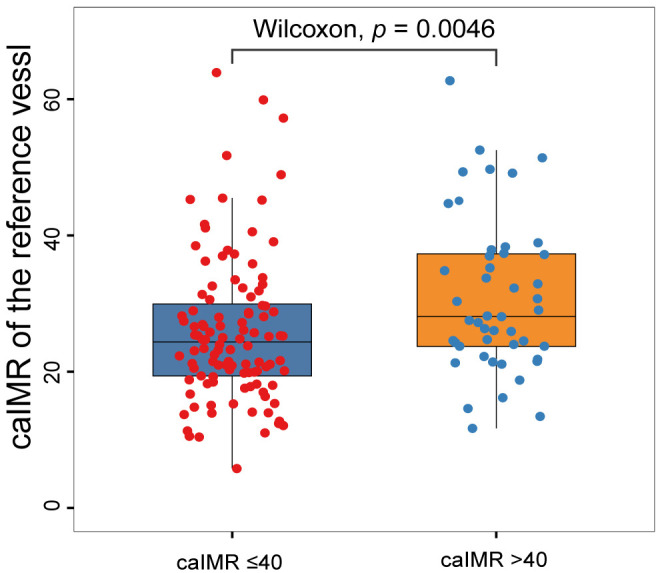
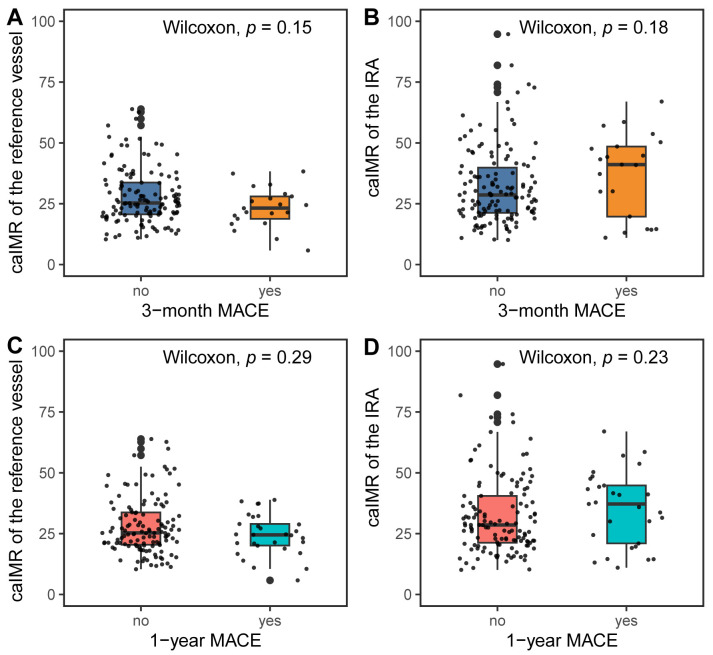
Approximately 30% of patients diagnosed with STEMI and who experienced successful primary PCI during the study period had a caIMR in the IRA of 40. The caIMR in the IRA was significantly higher than in the reference vessel (32.9 15.8 vs. 27.4 11.1, 0.001). The caIMR in the reference vessel of the caIMR 40 group was greater than in the caIMR 40 group (30.9 11.3 vs. 25.9 10.7, = 0.009). Moreover, the caIMR 40 group had higher incidence rates of MACEs at 3 months (25.5% vs. 8.3%, = 0.009) and 1 year (29.8% vs. 13.9%, = 0.04), than in the caIMR 40 group, which were mainly driven by a higher rate of rehospitalization due to CHF, MI, or angina. A caIMR in the IRA of 40 was an independent predictor of a MACE at 3 months (hazard ratio (HR): 3.459, 95% confidence interval (CI): 1.363-8.779, = 0.009) and 1 year (HR: 2.384, 95% CI: 1.100-5.166, = 0.03) in patients with STEMI after primary PCI.
Patients with STEMI after primary PCI often have coronary microvascular dysfunction, which is indicated by an increased caIMR in the IRA. An elevated caIMR of 40 in the IRA was associated with an increased risk of adverse outcomes in STEMI patients undergoing primary PCI.
关于初次经皮冠状动脉介入治疗(PCI)后梗死相关动脉(IRA)中冠状动脉微血管功能状态的研究仍然有限。本研究利用冠状动脉造影衍生的微血管阻力指数(caIMR)来评估接受初次PCI的ST段抬高型心肌梗死(STEMI)患者的冠状动脉微血管功能。
我们使用FlashAngio系统测量了157例STEMI患者初次PCI后的caIMR。主要终点是主要不良心血管事件(MACE)的发生,MACE被定义为一个综合终点,包括心源性死亡、靶血管血运重建以及因充血性心力衰竭(CHF)、心肌梗死(MI)或心绞痛再次住院。
在研究期间被诊断为STEMI且初次PCI成功的患者中,约30%的IRA中caIMR≥40。IRA中的caIMR显著高于参照血管(32.9±15.8 vs. 27.4±11.1,P<0.001)。caIMR≥40组的参照血管中的caIMR大于caIMR<40组(30.9±11.3 vs. 25.9±10.7,P = 0.009)。此外,caIMR≥40组在3个月时(25.5% vs. 8.3%,P = 0.009)和1年时(29.8% vs. 13.9%,P = 0.04)的MACE发生率高于caIMR<40组,这主要是由因CHF、MI或心绞痛再次住院的较高发生率所致。IRA中caIMR≥40是初次PCI后STEMI患者3个月时(风险比(HR):3.459,95%置信区间(CI):1.363 - 8.779,P = 0.009)和1年时(HR:2.384,95%CI:1.100 - 5.166,P = 0.03)发生MACE的独立预测因素。
初次PCI后的STEMI患者常存在冠状动脉微血管功能障碍,这表现为IRA中caIMR升高。IRA中caIMR≥40与接受初次PCI的STEMI患者不良结局风险增加相关。