Stankeviciute Laura, Chhatwal Jasmeer P, Levin Raina, Pinilla Valentina, Schultz Aaron P, Redline Susan, Johnson Keith A, Sperling Reisa A, Kozhemiako Nataliia, Purcell Shaun, Djonlagic Ina
Department of Neurology Brigham and Women's Hospital Boston Massachusetts USA.
Barcelonaβeta Brain Research Center (BBRC) Pasqual Maragall Foundation Barcelona Spain.
Alzheimers Dement (Amst). 2024 Jul 29;16(3):e12616. doi: 10.1002/dad2.12616. eCollection 2024 Jul-Sep.
Sleep is crucial for memory consolidation and the clearance of toxic proteins associated with Alzheimer's disease (AD). We examined the association between sleep characteristics and imaging biomarkers of early amyloid beta (Aβ) and tau pathology as well as neurodegeneration in brain regions known to be affected in the incipient stages of AD.
Thirty-nine cognitively unimpaired (CU) participants of the Harvard Aging Brain Study underwent at-home polysomnography as well as tau positron emission tomography (flortaucipir-PET), amyloid PET (Pittsburgh compound B [PiB]-PET), and magnetic resonance imaging-derived assessment of cortical thickness (CT).
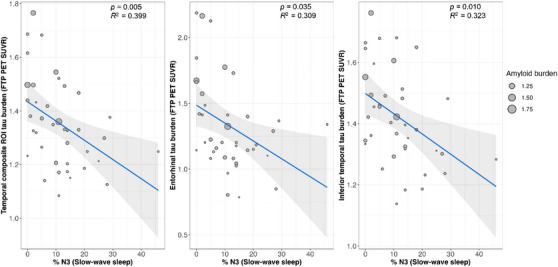
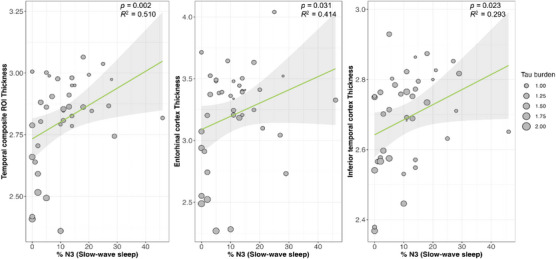
Increased N1 sleep was associated with a higher tau PET signal (β = 0.009, = 0.001) and lower CT in the temporal composite region of interest (β = -0.017, = 0.007). Decreased slow-wave sleep (SWS) was associated with higher tau burden in the temporal composite (β = -0.008, = 0.005) and lower CT (β = 0.008, = 0.002), even after controlling for global PiB-PET.
In CU older adults, lower SWS and higher N1 sleep were associated with higher tau burden and lower CT in brain regions associated with early tau deposition and vulnerable to AD-related neurodegeneration through mechanisms dissociable from amyloid deposition.
We report the results of an observational study, which leveraged -a well-characterized cohort of healthy aging (Harvard Aging Brain Study) by adding in-home full polysomnograms.By adding at-home polysomnograms to this unique and deeply phenotyped cohort, we examined variations in sleep architecture that are associated with Alzheimer's disease (AD) pathologic changes.Our results confirmed the association of sleep changes with early tau and cortical neurodegenerative changes that were independent of amyloid.The results will be of importance in monitoring sleep-related variations in relation to the natural history of AD pathology and in designing sleep-focused clinical trials.
睡眠对于记忆巩固以及与阿尔茨海默病(AD)相关的毒性蛋白清除至关重要。我们研究了睡眠特征与早期淀粉样β蛋白(Aβ)和tau病理成像生物标志物以及已知在AD早期阶段受影响的脑区神经退行性变之间的关联。
哈佛衰老大脑研究中的39名认知未受损(CU)参与者接受了在家多导睡眠监测以及tau正电子发射断层扫描(氟代脱氧葡萄糖-PET)、淀粉样蛋白PET(匹兹堡化合物B [PiB]-PET)和磁共振成像衍生的皮质厚度(CT)评估。
N1睡眠增加与更高的tau PET信号(β = 0.009,P = 0.001)以及颞叶复合感兴趣区域更低的CT相关(β = -0.017,P = 0.007)。慢波睡眠(SWS)减少与颞叶复合区域更高的tau负担(β = -0.008,P = 0.005)和更低的CT相关(β = 0.008,P = 0.002),即使在控制了整体PiB-PET之后。
在CU老年人中,较低的SWS和较高的N1睡眠与tau负担增加以及与早期tau沉积相关且易受AD相关神经退行性变影响的脑区中更低的CT相关,其机制与淀粉样蛋白沉积无关。
我们报告了一项观察性研究的结果,该研究通过增加在家的全多导睡眠图,利用了一个特征明确的健康衰老队列(哈佛衰老大脑研究)。通过将在家多导睡眠图添加到这个独特且深度表型化的队列中,我们研究了与阿尔茨海默病(AD)病理变化相关的睡眠结构变化。我们的结果证实了睡眠变化与早期tau和皮质神经退行性变化之间的关联,这些变化与淀粉样蛋白无关。这些结果对于监测与AD病理自然史相关的睡眠相关变化以及设计以睡眠为重点的临床试验具有重要意义。