Department of Internal Medicine II, Hematology, Oncology, Clinical Immunology, and Rheumatology, University Hospital Tübingen, Otfried-Mueller-Strasse 10, 72076, Tübingen, Germany.
Mol Diagn Ther. 2024 Sep;28(5):593-600. doi: 10.1007/s40291-024-00730-0. Epub 2024 Jul 30.
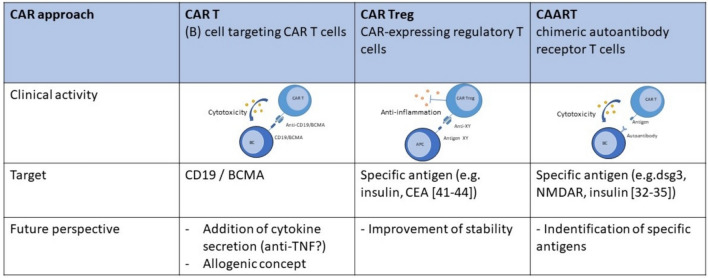
The concept of chimeric antigen receptor (CAR) T cell therapy emerged from cancer immunotherapy and has been rapidly adapted and developed for the treatment of autoimmune, especially B-cell-driven, diseases since the first publication of an article featuring a patient with systemic lupus erythematosus in 2021. Phase II studies are about to start, but up to now, only case reports and small series have been published. In contrast to hemato-oncological diseases, where an aggressive response to malignant cells and long-lasting persistence of CAR T cells has been aimed at and observed in many patients, this is not the case with autoimmune diseases but might not be necessary to control disease. Future studies will focus on the optimal target but also on the optimal level of immunogenicity. The latter can be influenced by numerous modulations that affect not only cytokine release but also regulation. In addition, there are potential applications in regulatory cells such as CAR regulatory T cells (Treg). The question of toxicity reduction must also be addressed, as long-term complications such as the potential development of malignant diseases, infections, or cytopenia must be considered even more critically in the area of autoimmune diseases than is the case for patients with oncologic diseases. Alternative antibody-based therapies using the same target (e.g., CD3/CD19 bispecific targeting antibodies) have not been used in these patients and might also be considered in the future. In conclusion, CAR T cell therapy represents a promising therapeutic approach for autoimmune diseases, offering a targeted strategy to modulate immune responses and restore immune tolerance.
嵌合抗原受体 (CAR) T 细胞疗法的概念源于癌症免疫疗法,自 2021 年第一篇报道系统性红斑狼疮患者的文章发表以来,该疗法已迅速被应用和开发用于治疗自身免疫性疾病,尤其是 B 细胞驱动的疾病。二期研究即将开始,但迄今为止,仅发表了病例报告和小系列研究。与血液肿瘤学疾病不同,在血液肿瘤学疾病中,针对恶性细胞的激进反应和 CAR T 细胞的长期持续存在已被针对并在许多患者中观察到,在自身免疫性疾病中并非如此,但可能没有必要控制疾病。未来的研究将集中在最佳靶点上,但也将集中在最佳免疫原性水平上。后者可以通过影响细胞因子释放和调节的众多调节来影响。此外,在调节性细胞(如 CAR 调节性 T 细胞 (Treg))中也有潜在的应用。还必须解决减少毒性的问题,因为与肿瘤疾病患者相比,在自身免疫性疾病领域,必须更加仔细地考虑长期并发症,如恶性疾病、感染或细胞减少症的潜在发展。在这些患者中尚未使用针对同一靶点的替代抗体疗法(例如,CD3/CD19 双特异性靶向抗体),将来也可能会考虑使用。总之,CAR T 细胞疗法为自身免疫性疾病提供了一种有前途的治疗方法,提供了一种靶向策略来调节免疫反应并恢复免疫耐受。