Barnouin Olivier, Ballouz Ronald-Louis, Marchi Simone, Vincent Jean-Baptiste, Agrusa Harrison, Zhang Yun, Ernst Carolyn M, Pajola Maurizio, Tusberti Filippo, Lucchetti Alice, Daly R Terik, Palmer Eric, Walsh Kevin J, Michel Patrick, Sunshine Jessica M, Rizos Juan L, Farnham Tony L, Richardson Derek C, Parro Laura M, Murdoch Naomi, Robin Colas Q, Hirabayashi Masatoshi, Kahout Tomas, Asphaug Erik, Raducan Sabina D, Jutzi Martin, Ferrari Fabio, Hasselmann Pedro Henrique Aragao, CampoBagatin Adriano, Chabot Nancy L, Li Jian-Yang, Cheng Andrew F, Nolan Michael C, Stickle Angela M, Karatekin Ozgur, Dotto Elisabetta, Della Corte Vincenzo, Mazzotta Epifani Elena, Rossi Alessandro, Gai Igor, Deshapriya Jasinghege Don Prasanna, Bertini Ivano, Zinzi Angelo, Trigo-Rodriguez Josep M, Beccarelli Joel, Ivanovski Stavro Lambrov, Brucato John Robert, Poggiali Giovanni, Zanotti Giovanni, Amoroso Marilena, Capannolo Andrea, Cremonese Gabriele, Dall'Ora Massimo, Ieva Simone, Impresario Gabriele, Lavagn Michèle, Modenini Dario, Palumbo Pasquale, Perna Davide, Pirrotta Simone, Tortora Paolo, Zannoni Marco, Rivkin Andrew S
Johns Hopkins University Applied Physics Laboratory, Laurel, MD, USA.
Southwest Research Institute, Boulder, CO, USA.
Nat Commun. 2024 Jul 30;15(1):6202. doi: 10.1038/s41467-024-50146-x.
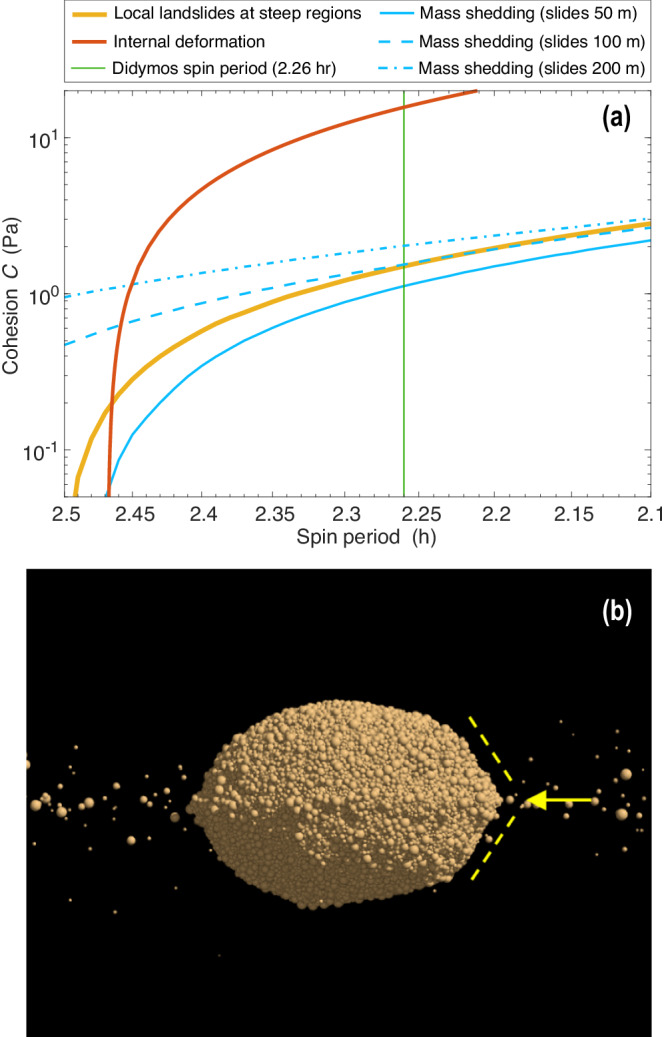
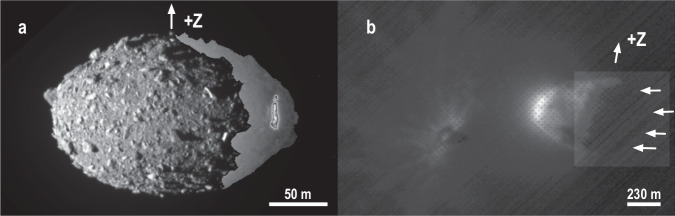
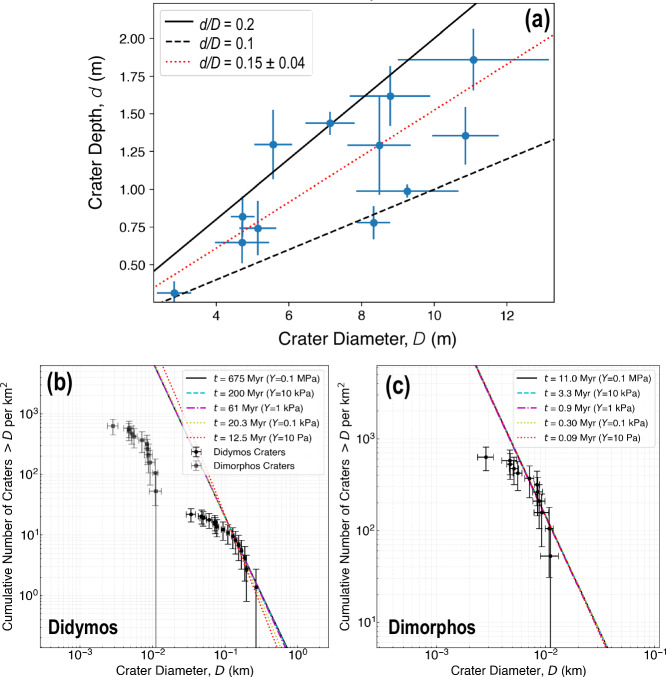
Images collected during NASA's Double Asteroid Redirection Test (DART) mission provide the first resolved views of the Didymos binary asteroid system. These images reveal that the primary asteroid, Didymos, is flattened and has plausible undulations along its equatorial perimeter. At high elevations, its surface is rough and contains large boulders and craters; at low elevations its surface is smooth and possesses fewer large boulders and craters. Didymos' moon, Dimorphos, possesses an intimate mixture of boulders, several asteroid-wide lineaments, and a handful of craters. The surfaces of both asteroids include boulders that are large relative to their host body, suggesting that both asteroids are rubble piles. Based on these observations, our models indicate that Didymos has a surface cohesion ≤ 1 Pa and an interior cohesion of ∼10 Pa, while Dimorphos has a surface cohesion of <0.9 Pa. Crater size-frequency analyzes indicate the surface age of Didymos is 40-130 times older than Dimorphos, with likely absolute ages of 12.5 Myr and <0.3 Myr, respectively. Solar radiation could have increased Didymos' spin rate leading to internal deformation and surface mass shedding, which likely created Dimorphos.
美国国家航空航天局(NASA)的双小行星重定向测试(DART)任务期间收集的图像首次提供了双小行星迪迪莫斯系统的清晰视图。这些图像显示,主小行星迪迪莫斯呈扁平状,其赤道周长有明显的起伏。在高海拔地区,其表面粗糙,有大石块和陨石坑;在低海拔地区,其表面光滑,大石块和陨石坑较少。迪迪莫斯的卫星迪莫弗斯有巨石、几条贯穿小行星的纹理和少量陨石坑的紧密混合。两颗小行星的表面都有相对于其主体较大的巨石,这表明两颗小行星都是碎石堆。基于这些观测,我们的模型表明,迪迪莫斯的表面凝聚力≤1帕,内部凝聚力约为10帕,而迪莫弗斯的表面凝聚力<0.9帕。陨石坑大小频率分析表明,迪迪莫斯的表面年龄比迪莫弗斯大40 - 130倍,绝对年龄可能分别为1250万年和<30万年。太阳辐射可能增加了迪迪莫斯的自转速度,导致内部变形和表面质量脱落,这可能造就了迪莫弗斯。