Hudac Caitlin M, Dommer Kelsey, Mahony Monique, DesChamps Trent D, Cairney Brianna, Earl Rachel, Kurtz-Nelson Evangeline C, Bradshaw Jessica, Bernier Raphael A, Eichler Evan E, Neuhaus Emily, Webb Sara Jane, Shic Frederick
Department of Psychology, University of South Carolina, Columbia, South Carolina, USA.
Center for Autism and Neurodevelopment (CAN) Research Center, University of South Carolina, Columbia, South Carolina, USA.
Autism Res. 2024 Jul 30. doi: 10.1002/aur.3202.
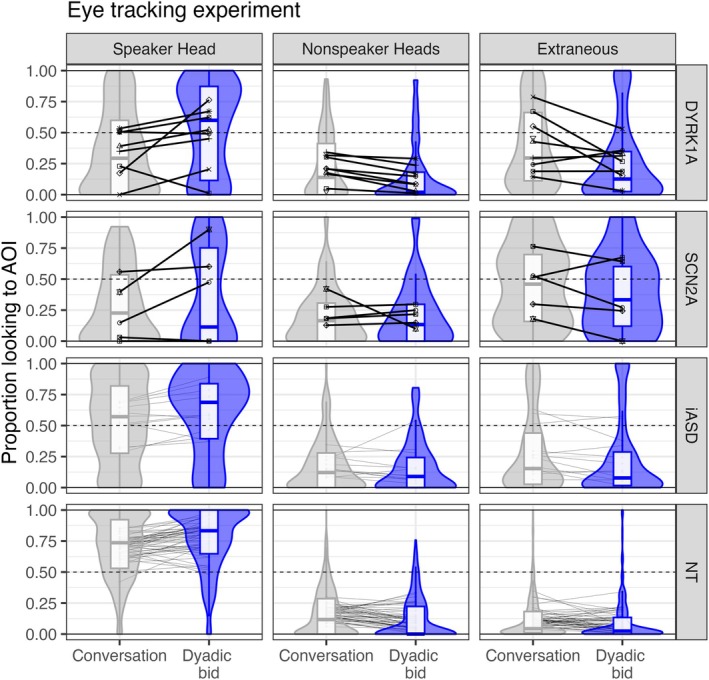
This preliminary study sought to assess biomarkers of attention using electroencephalography (EEG) and eye tracking in two ultra-rare monogenic populations associated with autism spectrum disorder (ASD). Relative to idiopathic ASD (n = 12) and neurotypical comparison (n = 49) groups, divergent attention profiles were observed for the monogenic groups, such that individuals with DYRK1A (n = 9) exhibited diminished auditory attention condition differences during an oddball EEG paradigm whereas individuals with SCN2A (n = 5) exhibited diminished visual attention condition differences noted by eye gaze tracking when viewing social interactions. Findings provide initial support for alignment of auditory and visual attention markers in idiopathic ASD and neurotypical development but not monogenic groups. These results support ongoing efforts to develop translational ASD biomarkers within the attention domain.
这项初步研究旨在通过脑电图(EEG)和眼动追踪技术,评估与自闭症谱系障碍(ASD)相关的两个超罕见单基因群体的注意力生物标志物。相对于特发性ASD组(n = 12)和神经典型对照组(n = 49),单基因组观察到了不同的注意力特征,即携带DYRK1A基因的个体(n = 9)在oddball脑电图范式中听觉注意力条件差异减小,而携带SCN2A基因的个体(n = 5)在观看社交互动时通过眼动追踪观察到视觉注意力条件差异减小。研究结果为特发性ASD和神经典型发育中听觉和视觉注意力标志物的一致性提供了初步支持,但单基因组除外。这些结果支持了在注意力领域开发转化性ASD生物标志物的持续努力。