Tang Nan, Pei Mengyue, Liu Huihui, Chen Jingru, Wang Youting, Xie Lei, Hu Junping, Wang Jing, Gao Yuan
Department of Nursing, 1st Medical Centre of PLA General Hospital, Beijing, People's Republic of China.
School of Medicine, Henan Kaifeng College of Science Technology and Communication, Kaifei, Henan Province, People's Republic of China.
Int J Womens Health. 2024 Jul 26;16:1265-1276. doi: 10.2147/IJWH.S469513. eCollection 2024.
The purpose of this study was to explore the relationship between infertility-related stress and dyadic coping with quality of life (QoL) in couples with infertility issues, and verify gender differences and dyadic interactions in the associations between them.
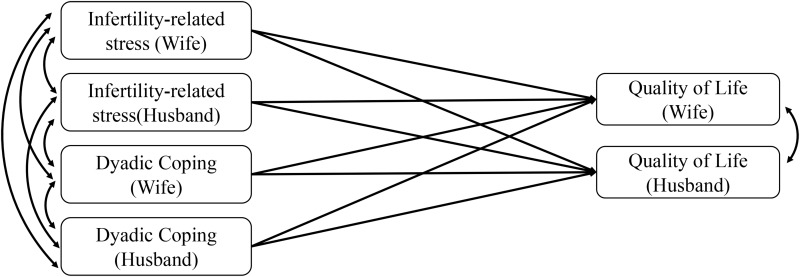
This cross-sectional study included 340 couples who were recruited from the First Affiliated Hospital of Lanzhou University between March 2022 and November 2022. The Fertility Problem Inventory, Dyadic Coping Inventory and FertiQoL were used to measure infertility-related stress, dyadic coping and QoL. The Actor-Partner Interdependence Model was used to analyze the effects of infertility-related stress and dyadic coping on the couple's own QoL (actor effect) as well as on their partner's QoL (partner effect).
Female patients perceived significantly lower levels of QoL and dyadic coping than those of husbands. There was no statistically significant difference in the infertility-related stress between wives and husbands. Husbands' infertility-related stress had actor and partner effects on their own and their wives' QoL, while wives' infertility-related stress only had an actor effect on their own QoL. Husbands' dyadic coping had both actor effect and partner effects on their own and their wives' QoL, meanwhile wives' dyadic coping had both actor effect and partner effects on their own and their husbands' QoL.
Husbands' QoL was impacted by their own infertility-related stress, dyadic coping and their wives' dyadic coping. Whereas wives' QoL was influenced by infertility-related stress and dyadic coping from both their own and their spouses. Therefore, elevating the level of dyadic coping may contribute to improving QoL for both husbands and wives. Moreover, enhancing the ability to cope with infertility-related stress might be useful for husbands and indirectly contribute to wives' QoL.
本研究旨在探讨不孕相关压力与不孕夫妇二元应对方式对生活质量(QoL)的关系,并验证它们之间关联的性别差异和二元互动。
这项横断面研究纳入了2022年3月至2022年11月期间从兰州大学第一附属医院招募的340对夫妇。使用生育问题量表、二元应对量表和生育生活质量量表来测量不孕相关压力、二元应对方式和生活质量。采用行为者-伴侣相互依赖模型分析不孕相关压力和二元应对方式对夫妇自身生活质量(行为者效应)以及对其伴侣生活质量(伴侣效应)的影响。
女性患者的生活质量和二元应对水平显著低于丈夫。妻子和丈夫在不孕相关压力方面无统计学显著差异。丈夫的不孕相关压力对其自身和妻子的生活质量有行为者效应和伴侣效应,而妻子的不孕相关压力仅对其自身生活质量有行为者效应。丈夫的二元应对方式对其自身和妻子的生活质量既有行为者效应又有伴侣效应,同时妻子的二元应对方式对其自身和丈夫的生活质量既有行为者效应又有伴侣效应。
丈夫的生活质量受到自身不孕相关压力、二元应对方式以及妻子二元应对方式的影响。而妻子的生活质量受到自身和配偶不孕相关压力及二元应对方式的影响。因此,提高二元应对水平可能有助于改善夫妻双方的生活质量。此外,增强应对不孕相关压力的能力对丈夫可能有用,并间接有助于提高妻子的生活质量。